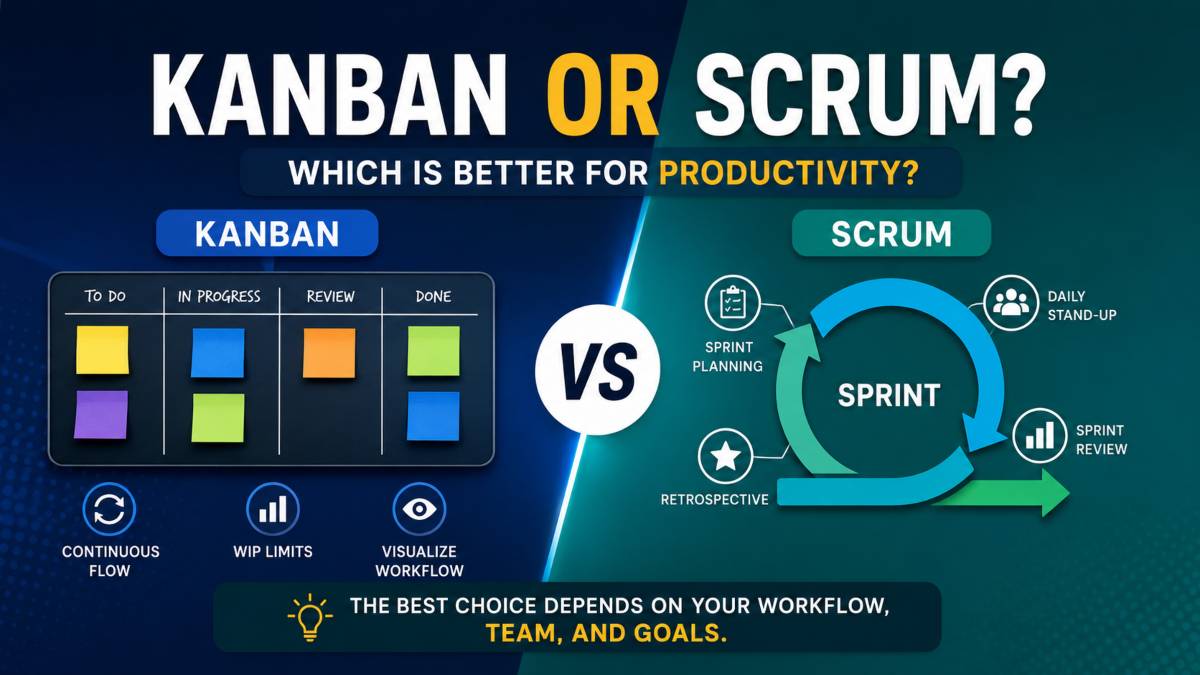
When deadlines start slipping and workloads pile up, teams usually end up asking the same question: which is better for productivity, Kanban or Scrum? It sounds simple on the surface, but the answer depends on how a team works, how projects move, and what productivity actually means inside a business.
Some teams need structure, fixed timelines, and clear planning cycles. Others need speed, flexibility, and the freedom to react to shifting priorities without waiting for the next sprint to begin. That is where the Kanban versus Scrum debate becomes interesting. Both frameworks are built to improve workflow efficiency, but they approach productivity from completely different angles.
Scrum creates momentum through short development cycles, regular reviews, and defined responsibilities. Kanban focuses on continuous task flow, visual organization, and limiting work overload so teams can stay focused. Neither framework guarantees success on its own. The real difference comes from how well the system matches the team using it.
A product development team preparing scheduled releases may perform better with Scrum. A support or operations team handling nonstop incoming requests may get stronger results from Kanban. Productivity is rarely about choosing the trendier framework. It is about choosing the one that fits the rhythm of the work.
What Are Kanban and Scrum?
Before comparing productivity results, it helps to understand how these two Agile systems actually work. Kanban and Scrum both fall under the umbrella of agile project management, but they organize work in very different ways. One focuses on continuous flow and flexibility. The other relies on structured planning and time based execution.
Teams often confuse the two because both use visual workflows and collaboration practices. Still, the way tasks move, priorities shift, and progress gets measured can feel completely different once the work begins.
What Is Kanban?
Kanban is a workflow management system built around continuous delivery and visual organization. The idea is simple: tasks move through clearly defined stages so teams can see what is being worked on, what is blocked, and what is ready for completion.
Most teams use a kanban board with columns such as To Do, In Progress, and Done. Each task appears as a card that moves across the board as work advances. This visual setup makes bottlenecks easier to spot before they slow everything down.
One of the biggest features inside the Kanban framework is WIP limits, short for work in progress limits. These limits control how many tasks can sit in active stages at the same time. By reducing multitasking, teams stay focused and complete work faster without constantly switching priorities.
Kanban works especially well for teams dealing with ongoing requests, support tickets, maintenance tasks, or unpredictable workloads where flexibility matters every day.
What Is Scrum?
Scrum is a structured agile project management framework that organizes work into fixed periods called sprints. A sprint usually lasts one to four weeks, with teams committing to a defined set of tasks before work begins.
The scrum methodology includes specific roles such as the Scrum Master, Product Owner, and development team. It also follows recurring ceremonies including sprint planning, daily standups, sprint reviews, and retrospectives. These meetings help teams stay aligned, review progress, and improve workflows over time.
Unlike Kanban’s continuous flow, Scrum creates a more controlled delivery process with scheduled checkpoints and measurable sprint goals. This structure often helps product teams stay organized while delivering updates on a predictable timeline.
Kanban vs Scrum: Core Differences
The debate around scrum vs kanban usually comes down to one thing: how teams prefer to manage work. Both frameworks support agile workflow management, but they handle planning, delivery, and team coordination in completely different ways.
Kanban focuses on flexibility and continuous movement. Scrum relies on structure and fixed delivery cycles. Neither system is automatically better. The strongest choice depends on how predictable the workload is and how teams prefer to organize progress.
| Feature | Kanban | Scrum |
|---|---|---|
| Workflow Style | Continuous flow | Sprint based cycles |
| Flexibility | High flexibility | Structured planning |
| Task Prioritization | Changes anytime | Locked during sprint |
| Team Roles | Minimal required roles | Defined Scrum roles |
| Productivity Metrics | Cycle time and throughput | Sprint velocity |
| Best For | Support and operations teams | Product development teams |
Workflow Structure
One of the biggest differences in kanban vs scrum is how work moves through the system.
Kanban uses a continuous workflow model where tasks move individually as soon as capacity becomes available. There are no fixed timelines or mandatory release windows. Teams can pull new tasks immediately after finishing current work, which creates a smoother flow and faster response to urgent requests.
Scrum works in sprint cycles. Teams commit to a set amount of work during a sprint, usually lasting one to four weeks. Once the sprint starts, priorities generally stay fixed until the next cycle begins. This structure improves focus and creates predictable delivery patterns, especially for product teams working toward scheduled releases.
Planning and Delivery
Scrum places heavy emphasis on planning before execution begins. Sprint planning meetings define goals, assign work, and estimate delivery expectations for the upcoming sprint. This creates stronger alignment but also adds more process management.
Kanban handles planning differently. Teams can reprioritize work whenever business needs change. New tasks enter the workflow based on urgency and available capacity instead of waiting for the next sprint cycle. That flexibility makes Kanban useful for environments where priorities shift daily.
Roles and Responsibilities
The scrum methodology includes clearly defined responsibilities. The Scrum Master manages the process, the Product Owner handles priorities, and the development team focuses on execution. These structured roles help teams maintain accountability and communication.
Kanban uses a lighter structure with fewer mandatory role requirements. Existing teams can often adopt Kanban without major organizational changes. This simpler setup makes onboarding easier for many businesses.
Productivity Metrics
Scrum and Kanban also measure productivity differently.
Scrum teams often track velocity, which measures how much work gets completed during each sprint. This helps forecast future delivery timelines and sprint capacity.
Kanban focuses more on cycle time, throughput, and lead time. These metrics measure how quickly work moves through the system from start to finish. Teams using Kanban often prioritize speed, flow efficiency, and reducing delays across the workflow.
How Scrum Improves Productivity
Scrum productivity often comes from structure, consistency, and clear team focus. Instead of handling endless incoming tasks, Scrum organizes work into manageable sprint cycles that give teams a defined target and timeline. For businesses building products with planned feature releases, this structure can create stronger momentum and fewer workflow distractions.
The framework works particularly well for teams that need alignment across developers, designers, product managers, and stakeholders. By creating predictable work patterns, Scrum helps teams stay focused on delivery instead of constantly reacting to shifting priorities.
Sprint Focus Reduces Distractions
One reason many teams prefer Scrum is the focus created during sprint planning. Before each sprint begins, the team agrees on a specific workload and set of goals to complete within the sprint window. Once the sprint starts, new tasks usually do not interrupt active work unless something urgent appears.
This fixed commitment reduces context switching and helps teams avoid the productivity drain caused by nonstop priority changes. Instead of juggling everything at once, team members can concentrate on completing the agreed objectives.
Scrum also builds accountability naturally. Everyone understands what needs to be delivered, who owns each task, and how progress connects to sprint goals. Daily standups keep communication active without creating unnecessary confusion.
Predictable Delivery Cycles
Predictability is another major strength behind Scrum productivity. Because work happens in recurring sprint cycles, teams can estimate timelines more accurately and create clearer release schedules.
This matters for companies launching software updates, product features, or customer facing improvements on a regular basis. Stakeholders gain visibility into progress while teams gain realistic planning windows.
The consistency created by sprint planning also makes resource management easier. Teams can forecast workloads, measure delivery capacity, and identify risks earlier before deadlines become difficult to manage.
Regular Retrospectives Improve Team Performance
Among the most valuable scrum ceremonies are retrospectives. After each sprint, teams review what worked, what slowed progress, and what should change moving forward.
These sessions create a cycle of continuous refinement rather than repeating the same workflow mistakes every month. Small adjustments to communication, task management, or collaboration can gradually improve team performance over time.
Scrum works especially well for feature driven product teams with scheduled releases because it combines accountability, planning discipline, and recurring feedback into one organized workflow system.
How Kanban Improves Productivity
Kanban productivity comes from one simple idea: keep work moving without overwhelming the team. Instead of organizing tasks into fixed sprint cycles, Kanban uses a continuous workflow system that allows teams to complete and release work whenever it is ready. This creates faster turnaround times and makes it easier to react to changing priorities without disrupting the entire process.
For operations focused environments, that flexibility can make a massive difference. Support teams, DevOps teams, and maintenance heavy departments often deal with unpredictable workloads that do not fit neatly into sprint schedules. Kanban gives those teams room to adapt in real time while keeping workflows visible and organized.
WIP Limits Reduce Context Switching
One of the strongest productivity advantages inside Kanban is the use of work in progress limits. These limits control how many active tasks can sit in a workflow stage at the same time.
Without limits, teams often overload themselves with too many parallel assignments. That creates constant context switching where employees jump between tasks instead of finishing work efficiently. Productivity drops fast when focus disappears.
Kanban solves this by forcing teams to complete current tasks before pulling in more work. The result is better concentration, cleaner workflows, and faster task completion. Instead of looking busy, teams actually move work across the finish line more consistently.
Continuous Flow Speeds Up Delivery
Unlike Scrum, Kanban does not rely on sprint deadlines or fixed release windows. Work moves continuously through the system as soon as capacity becomes available.
That means there are no waiting periods before new priorities can enter the workflow. If a critical issue appears today, teams can address it immediately instead of postponing it until the next sprint cycle.
This continuous workflow model helps businesses respond faster to customer requests, technical problems, and operational issues. Teams spend less time managing timelines and more time delivering actual results.
Flexible Prioritization
Kanban also performs well in fast moving environments because priorities can shift instantly without disrupting the entire workflow. Teams can reorder tasks based on urgency, business needs, or incoming requests at any moment.
This flexibility becomes valuable for organizations handling support tickets, infrastructure monitoring, bug fixes, and ongoing maintenance work where schedules change daily.
Rather than forcing teams into rigid planning structures, Kanban adapts to the rhythm of real world operations. That adaptability is a major reason many companies use Kanban to improve productivity while maintaining speed and workflow stability.
Which Framework Is Better for Different Teams?
The real answer to the Kanban versus Scrum debate depends on the type of team using it. A framework that improves productivity for a software product company may completely fail inside a support environment with nonstop incoming requests. The strongest results usually come from matching the workflow system to the nature of the work itself.
Some teams need structure and predictable planning. Others need flexibility and rapid response times. That is why choosing the right framework matters more than following trends.
Best for Software Development Teams
Scrum often performs best for software development teams building products with planned feature releases and long term roadmaps. The sprint structure helps developers focus on specific goals while keeping projects organized through regular planning and review cycles.
Because Scrum uses fixed sprint timelines, teams can estimate delivery windows more accurately and maintain stronger communication with stakeholders. Sprint reviews and retrospectives also create regular opportunities to improve workflows and product quality.
For companies building applications, platforms, or customer facing digital products, Scrum creates a rhythm that supports steady development and structured collaboration.
Best for Support and Operations Teams
Kanban usually works better for support teams, IT operations departments, DevOps environments, and maintenance focused workflows where priorities shift constantly.
These teams often deal with urgent tickets, outages, customer requests, and unexpected technical issues that cannot wait for the next sprint cycle. Kanban allows work to move continuously without rigid scheduling restrictions.
The visual workflow system also helps teams monitor bottlenecks quickly while keeping incoming requests organized in real time. That flexibility makes Kanban highly practical for environments where responsiveness matters every hour.
Best for Small Teams
Small teams often prefer Kanban because it is easier to adopt without major structural changes. There are fewer mandatory roles, fewer meetings, and less process overhead compared to Scrum.
Teams can start using a Kanban board almost immediately without redesigning the entire workflow. This lighter setup works well for startups, lean departments, and businesses that want faster implementation with minimal training.
Still, some small product teams may prefer Scrum if they need stronger planning discipline and clearer delivery schedules.
Best for Fast Changing Priorities
Kanban performs extremely well in environments where priorities shift frequently. Teams can reorder tasks instantly, add urgent work at any time, and adapt workflows without disrupting active delivery cycles.
This flexibility helps businesses stay responsive without creating major workflow interruptions.
Best for Predictable Releases
Scrum is usually the stronger option for organizations that rely on scheduled product launches, roadmap planning, and stakeholder reporting. The structured sprint system creates clearer timelines, measurable progress, and more predictable release management.
Teams that value consistency, planning accuracy, and organized delivery cycles often see stronger results with Scrum.
Can You Use Kanban and Scrum Together?
Yes, many teams combine both systems instead of choosing one exclusively. This hybrid approach is commonly called Scrumban, a workflow model that blends Scrum structure with Kanban flexibility. For teams caught between strict sprint planning and nonstop incoming work, Scrumban often creates a more balanced system.
A hybrid agile framework works well because modern teams rarely operate in perfectly controlled environments. Product roadmaps may require structured planning, while customer issues and urgent requests still appear unexpectedly. Scrumban gives teams a way to handle both without forcing the workflow into one rigid process.
What Is Scrumban?
Scrumban combines key parts of the Scrum methodology with the continuous flow principles of Kanban. Teams still use sprint planning, retrospectives, and scheduled reviews, but they also manage work visually through a Kanban board with flexible task movement and workflow visibility.
Many Scrumban teams also introduce work in progress limits inside sprint cycles to reduce overload and improve focus. This creates better workflow control while maintaining the structure that Scrum provides.
The result is a system that supports planning without slowing teams down when priorities suddenly change.
Why Teams Combine Both
Many businesses adopt Scrumban because it delivers flexibility plus structure in the same workflow. Teams gain Scrum’s planning discipline while keeping Kanban’s adaptability and faster response times.
This setup can also reduce workflow bottlenecks. Instead of waiting for entire sprint cycles to finish before adjusting priorities, teams can manage urgent work more smoothly without disrupting long term goals.
Scrumban works especially well for growing companies, product teams handling customer support, and organizations transitioning from traditional project management into Agile systems.
Common Productivity Mistakes Teams Make
Even the best Agile framework can fail when teams use the wrong habits, track weak metrics, or overload their workflow. Productivity problems rarely come from Kanban or Scrum alone. Most issues appear when teams misunderstand how to apply the system properly.
Many businesses adopt Agile practices expecting instant results, then wonder why delivery slows down, meetings multiply, and employees feel exhausted. The framework is only part of the equation. The way teams manage work every day matters far more.
Measuring the Wrong Metrics
One of the biggest mistakes teams make is obsessing over the wrong productivity metrics.
Scrum teams sometimes focus too heavily on velocity numbers instead of actual delivery quality or customer outcomes. Finishing more story points does not automatically mean the team is producing better work.
Kanban teams can make a similar mistake by tracking task volume while ignoring lead time and workflow bottlenecks. A busy board may look productive while tasks still move slowly through the system.
Strong Agile teams focus on meaningful measurements such as delivery speed, cycle time, workflow stability, and completed business value instead of chasing vanity metrics.
Too Much Work in Progress
Another common issue is multitasking overload. Teams often try to handle too many active assignments at once, which destroys focus and slows completion rates.
When employees constantly switch between projects, mistakes increase and momentum disappears. Tasks stay half finished while new work keeps piling up.
This is exactly why work in progress limits matter so much inside Agile systems. Limiting active work helps teams finish tasks faster while reducing mental fatigue and workflow chaos.
Following Agile Rituals Without Purpose
Some teams fall into the trap of running Agile ceremonies simply because the framework says they should. Meetings become routine instead of useful.
Daily standups turn repetitive. Retrospectives lose honesty. Sprint planning sessions become bloated discussions that waste time instead of creating clarity.
Agile processes should support productivity, not bury teams under unnecessary structure. The strongest teams adjust workflows based on real business needs rather than treating every ceremony like a mandatory checklist.
Final Verdict
So, which is better for productivity: Kanban or Scrum?
The honest answer is that both frameworks can produce excellent results when matched with the right type of work. Scrum works best for teams that need structure, predictable delivery cycles, and organized sprint planning. Product development teams building scheduled releases often benefit from the accountability and focus that Scrum creates.
Kanban performs better for teams handling continuous incoming work, changing priorities, and fast response requirements. Support departments, operations teams, and DevOps environments usually gain more flexibility and faster workflow movement through Kanban’s continuous system.
The biggest mistake companies make is choosing a framework based on popularity instead of workflow compatibility. A highly structured process can slow down reactive teams, while an overly flexible system can create chaos for teams needing roadmap discipline.
That is why many growing organizations eventually move toward hybrid approaches like Scrumban. Combining structured planning with flexible task flow often creates a more balanced system that adapts as teams evolve.
The smartest way to decide is through testing, not assumptions. Track measurable KPIs such as cycle time, delivery speed, backlog stability, and team workload over several months. The framework that improves focus, consistency, and delivery quality for your team is the right choice.