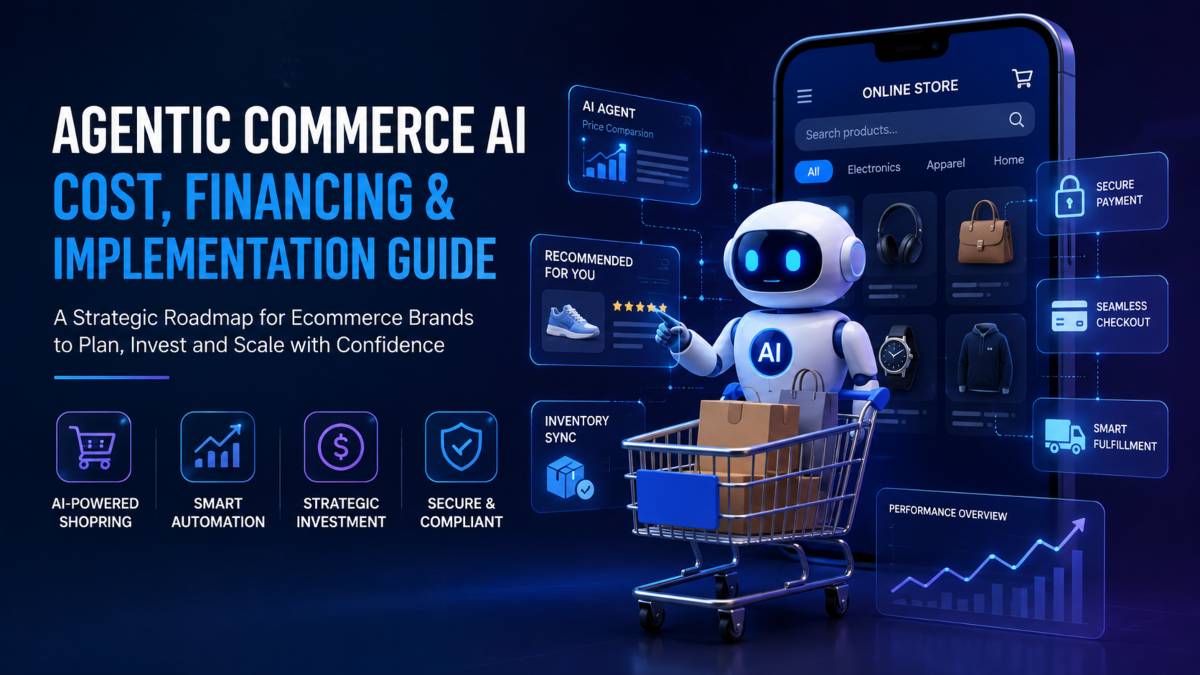
Financing the future moving your store to agentic commerce AI is quickly becoming a serious discussion for ecommerce brands preparing for the next stage of online retail. Traditional digital storefronts were built around human browsing, manual search behavior, and standard checkout flows. Agentic commerce AI changes that model completely by allowing intelligent shopping agents to discover products, compare prices, manage purchases, and complete transactions with minimal human input.
This shift marks the rise of AI driven ecommerce where autonomous systems handle much of the buying journey on behalf of consumers. Instead of customers searching through endless product pages, AI agents can analyze preferences, monitor inventory, track pricing changes, and purchase items automatically based on user intent and shopping behavior.
For retailers, the opportunity is massive, but the transition is not simple. Moving toward agentic commerce requires infrastructure upgrades, real time APIs, structured product data, payment integrations, and stronger governance systems built for AI based transactions. Those changes create new financing challenges that many ecommerce businesses are only beginning to understand.
Some companies will fund early adoption through internal budgets while others may rely on external capital, vendor partnerships, or phased pilot programs to manage costs. The brands that plan carefully and build scalable foundations early may place themselves in a stronger position as AI commerce systems continue reshaping digital retail.
What Is Agentic Commerce AI?
Agentic commerce AI refers to ecommerce systems where artificial intelligence agents actively assist or complete shopping actions on behalf of customers. Instead of relying entirely on manual browsing and decision making, these systems allow software agents to search products, compare options, monitor prices, recommend purchases, and even complete transactions automatically based on user preferences and goals.
This approach pushes ecommerce beyond simple automation. It creates a more intelligent buying environment where machines participate directly in the shopping journey. As AI shopping agents become more advanced, online retail may shift from search driven experiences toward intent driven commerce where customers describe what they need and AI systems handle much of the process behind the scenes.
How AI Shopping Agents Change Ecommerce
Traditional ecommerce depends heavily on customers browsing websites manually, filtering products, and comparing options themselves. AI shopping agents reduce much of that effort through autonomous product discovery and intelligent recommendations.
A shopper searching for running shoes, for example, may eventually rely on an AI system that already understands their preferred brands, sizing, budget, style, and delivery preferences. The agent can scan multiple stores, compare prices, evaluate reviews, and suggest the best option within seconds.
AI assisted purchasing also creates faster decision making. Instead of navigating through long checkout processes, intelligent agents may complete transactions automatically once predefined conditions are met. Personalized transactions become far more precise because the system learns continuously from shopping behavior, purchase history, and user intent.
This creates a more seamless AI powered shopping experience that feels faster and more tailored to individual customers.
Core Infrastructure Behind Agentic Commerce
Agentic commerce depends on strong technical infrastructure operating behind the scenes. Real time APIs allow AI systems to access live inventory, pricing updates, shipping availability, and transaction data instantly across ecommerce platforms.
Structured product metadata is equally important because AI agents need detailed and organized product information to interpret catalogs accurately. This includes attributes, specifications, availability, and semantic product relationships.
Payment integrations also play a major role. Autonomous commerce systems require secure payment authorization, fraud monitoring, consent management, and transaction verification before AI agents can complete purchases reliably on behalf of users.
Without these systems working together smoothly, large scale agent driven commerce becomes difficult to support.
Why Retailers Are Investing Early
Retailers see agentic commerce as more than a technology trend. Many view it as a major shift in how digital shopping may function over the next decade.
Customer convenience remains one of the biggest drivers. Faster transactions, personalized experiences, and reduced friction create a smoother buying process that many consumers may eventually expect as standard.
Early adoption also offers competitive advantage. Businesses building AI ready infrastructure now may adapt faster as intelligent shopping systems become more common across ecommerce platforms, marketplaces, and payment ecosystems.
Why Ecommerce Brands Are Moving Toward Agentic Commerce
Online retail has changed rapidly over the last few years. Customers now expect faster service, more personalized experiences, and smoother buying journeys across every device and platform. Traditional ecommerce systems still depend heavily on manual browsing and search behavior, but modern consumers increasingly expect technology to reduce effort and speed up decision making.
That shift is pushing more brands toward agentic retail commerce where intelligent systems actively assist with shopping, recommendations, transactions, and post purchase interactions. Businesses are no longer treating AI as a side feature. Many now see it as a core part of future ecommerce operations and customer experience strategy.
Rising Customer Expectations
Consumer expectations continue rising as platforms compete to deliver more convenience and personalization. Shoppers want product suggestions that match their interests instantly instead of scrolling through endless catalogs manually.
Instant personalization helps customers discover products faster based on browsing history, preferences, budgets, and previous purchases. AI systems can analyze behavior patterns in real time and recommend products with far greater precision than traditional filtering tools.
Frictionless checkout is another major factor driving ecommerce AI transformation. Customers increasingly expect purchasing experiences that feel fast, simple, and nearly invisible. AI powered systems can reduce delays by automating product comparisons, payment approvals, and repeat purchases.
Smart recommendations also increase engagement and conversion opportunities. When AI agents understand customer behavior accurately, they can suggest products that feel more relevant and timely throughout the buying journey.
The Push for AI Retail Automation
Retailers are also investing heavily in AI retail automation to improve operational efficiency behind the scenes. Many ecommerce businesses still rely on fragmented workflows that require large amounts of manual oversight across inventory management, pricing updates, customer support, and fulfillment systems.
AI automation helps reduce repetitive processes while improving speed and accuracy. Inventory synchronization becomes easier when systems update stock levels and pricing automatically across multiple sales channels in real time.
Automated customer journeys create more connected experiences as AI systems manage product recommendations, abandoned cart recovery, customer communication, and loyalty engagement without constant manual input from marketing teams.
This automation allows businesses to scale operations more efficiently while improving customer experience simultaneously.
The Competitive Pressure Facing Online Stores
Competition in ecommerce has become more intense as marketplaces and large retailers continue improving their AI capabilities. Smaller brands now face pressure to deliver buying experiences that feel just as fast, personalized, and seamless as major platforms.
Faster buying experiences are becoming a competitive necessity rather than a luxury feature. Customers who experience friction or delays can quickly move to alternative stores with smarter shopping systems.
AI driven retail trends are also reshaping customer expectations industry wide. As more platforms adopt intelligent shopping assistants and automated purchasing systems, businesses that delay modernization may struggle to keep pace with changing consumer behavior and emerging commerce standards.
The Real Costs of Moving to Agentic Commerce AI
The excitement surrounding agentic commerce AI often focuses on automation, personalization, and future growth potential. What receives less attention is the financial reality behind building the infrastructure required to support intelligent shopping systems at scale. For many retailers, the transition involves much more than installing a new software layer on top of an existing ecommerce platform.
AI commerce implementation costs can grow quickly when businesses begin restructuring product data, upgrading APIs, modernizing payment systems, and preparing teams for AI driven workflows. Brands planning this transition need a clear understanding of where investments are likely to happen before scaling too aggressively.
Product Data and Catalog Engineering Costs
Product data sits at the center of agentic commerce. AI systems cannot interpret messy or incomplete catalogs accurately, which means many retailers must first rebuild and standardize their product information.
Catalog normalization often requires cleaning inconsistent attributes, improving taxonomy structures, and organizing product metadata into formats AI systems can understand easily. Large ecommerce stores with thousands of SKUs may face significant engineering workloads during this phase.
Semantic search systems also require additional investment. Instead of relying only on exact keyword matching, AI driven search tools use contextual understanding to interpret customer intent and product relationships more intelligently.
Embeddings add another layer of complexity by converting products, categories, and customer interactions into machine readable representations that AI models can process efficiently. These systems improve personalization and recommendation quality, but they also increase infrastructure and data processing costs.
Infrastructure and API Integration Expenses
Agentic commerce depends heavily on real time connectivity between systems. Ecommerce API integration becomes essential because AI agents need instant access to inventory availability, pricing updates, shipping estimates, and transactional data.
Many retailers moving toward autonomous commerce also adopt headless commerce architectures that separate frontend experiences from backend systems. This structure provides greater flexibility for AI integrations but usually requires platform upgrades, development resources, and ongoing maintenance.
API gateways and AI communication protocols add further expenses as businesses build secure connections between commerce platforms, payment providers, fulfillment systems, and external AI agents. Subscription costs, usage fees, and engineering support often continue long after initial deployment.
Payments, Compliance, and Governance Costs
Payments introduce another major layer of complexity. Agentic commerce requires systems capable of handling AI assisted purchases securely while maintaining customer consent and transaction verification standards.
Agent permissions and authorization controls become critical because businesses must define what actions AI systems can perform on behalf of customers. Fraud monitoring tools also require upgrades to detect suspicious automated behavior and prevent abuse.
AI commerce governance includes audit logging, policy enforcement, regulatory compliance, and transaction monitoring. Legal reviews, security assessments, and compliance frameworks all increase implementation costs but remain necessary for protecting both customers and retailers.
Payment orchestration systems may also need modernization to support tokenized credentials, automated approvals, and multi platform transaction flows.
Operational and Team Training Costs
Technology upgrades alone are not enough. Businesses also need operational changes that support AI driven commerce environments.
Change management becomes a major part of adoption as teams adjust workflows, reporting systems, and customer service operations around intelligent automation. Staff education is equally important because employees need to understand how AI systems interact with inventory, payments, customer data, and analytics.
Companies may also need new internal roles focused on AI workflows, governance oversight, data operations, and automation management. While these investments increase short term expenses, they often determine whether long term AI commerce adoption succeeds or fails.
Financing Strategies for Agentic Commerce Adoption
Moving toward agentic commerce AI requires more than technical ambition. Retailers also need a financing strategy that matches the pace of implementation, operational risk, and expected return. Many ecommerce businesses underestimate how quickly infrastructure upgrades, API development, compliance systems, and AI integrations can increase costs during adoption.
The smartest companies usually avoid large all at once investments in the early stages. Instead, they build phased funding strategies tied to measurable milestones, pilot performance, and operational readiness. This approach reduces financial pressure while helping teams prove AI commerce ROI before committing to broader transformation efforts.
Internal Budget Reallocation
For many established ecommerce brands, internal funding remains the fastest starting point. Businesses often redirect budget from lower performing projects or operational inefficiencies toward early stage AI commerce initiatives.
Small proof of concept pilots allow companies to test agentic commerce systems without committing massive capital immediately. A retailer may begin with a limited product category, a single AI shopping integration, or a narrow geographic rollout to measure conversion performance and customer engagement.
Early pilots also help businesses identify operational savings linked to automation, faster customer service workflows, or reduced manual inventory management. These savings can support additional funding decisions later.
Internal budget reallocation works especially well for brands with stable cash flow and strong operational margins because it avoids outside investor pressure during the experimentation phase.
Venture Funding and Growth Capital
Larger ecommerce transformations may eventually require outside capital once pilot programs produce positive metrics and stronger adoption signals. Venture funding becomes more attractive when businesses can demonstrate measurable improvements in conversion rates, average order value, customer retention, or operational efficiency through AI systems.
Equity financing often supports long term platform modernization projects involving large infrastructure upgrades, advanced AI integrations, and international scaling plans. Investors typically look for clear evidence that agentic commerce can create competitive differentiation and future revenue growth.
Some companies may prefer venture debt instead of giving up ownership stakes too early. Debt financing can help fund infrastructure expansion, payment modernization, or engineering hiring while allowing founders to retain more control over the business.
Scale funding decisions should always connect back to realistic revenue forecasts and adoption timelines rather than excitement surrounding AI trends alone.
Revenue Share and Vendor Financing
Many technology providers now offer flexible financing structures to encourage AI commerce adoption. PSP partnerships, ecommerce platforms, and integration vendors may provide onboarding credits, deferred implementation fees, or shared revenue agreements to reduce upfront costs.
Revenue share models can be attractive for businesses hesitant to commit large capital before proving demand. Instead of paying major setup expenses immediately, retailers may share a percentage of future transaction revenue generated through agentic commerce systems.
Deferred integration fees also reduce short term cash pressure during technical deployment phases. This allows businesses to preserve working capital while infrastructure and testing continue.
Platform credits and co marketing agreements sometimes help offset operational expenses during pilot launches and early customer acquisition efforts.
Grants and Digital Innovation Incentives
Some businesses can reduce costs further through government backed AI transformation programs and regional digital innovation incentives. These programs often support data modernization, automation projects, technical hiring, and research related initiatives.
Tax credits linked to software development, AI research, or digital infrastructure upgrades may lower overall implementation expenses significantly for qualifying businesses.
Regional innovation funding programs also exist in many countries to encourage ecommerce modernization and technology adoption among growing retailers and startups.
While grants rarely fund entire AI commerce projects, they can reduce financial strain during the early stages and improve long term ecommerce digital transformation planning.
How to Reduce Upfront Costs During AI Commerce Migration
One of the biggest concerns surrounding agentic commerce adoption is cost. Many ecommerce brands assume they need massive infrastructure overhauls, large engineering teams, and expensive AI systems before getting started. In reality, the smartest companies usually begin with smaller controlled deployments that limit financial risk while proving commercial value early.
Reducing upfront spending is not about cutting corners. It is about sequencing investment carefully so businesses can validate performance before committing larger budgets to full scale transformation.
Start With a Small Pilot Program
An AI commerce pilot program allows retailers to test infrastructure, customer response, and operational readiness without rebuilding the entire business immediately. Instead of applying AI systems across every category, brands often begin with top selling SKUs where customer demand and transaction volume already exist.
This narrower scope reduces technical complexity while generating cleaner performance data during the testing phase. Businesses can track metrics such as conversion lift, agent driven purchases, average order value, and operational efficiency before expanding further.
A single geography rollout also helps reduce implementation pressure. Testing within one market allows teams to monitor inventory behavior, payment flows, shipping systems, and customer interactions in a more controlled environment.
Controlled testing creates valuable operational insight while keeping financial exposure manageable during the early stages of adoption.
Use Managed AI Commerce Platforms
Building every component internally can become extremely expensive. Many retailers reduce costs by using managed platforms that already provide core AI ecommerce infrastructure and commerce integrations.
Prebuilt integrations simplify connections between ecommerce systems, inventory management tools, payment providers, and AI shopping agents. This reduces development time while lowering engineering requirements during deployment.
Subscription models also spread costs over time instead of requiring large upfront investment in custom software architecture. Businesses can scale usage gradually as transaction volume and customer adoption increase.
Faster deployment becomes another major advantage. Managed platforms often provide ready made APIs, payment workflows, and automation tools that help retailers launch pilot programs much sooner than fully custom builds.
Outsource Specialized AI Tasks
Certain technical tasks require highly specialized expertise that many ecommerce teams do not have internally. Hiring full time AI engineers, data scientists, and machine learning specialists can increase operational costs quickly.
Outsourcing product embeddings, data enrichment, and semantic catalog optimization to external vendors allows businesses to access technical expertise without building large internal departments immediately.
AI engineering vendors can also help accelerate deployment timelines by handling infrastructure setup, model integration, and technical implementation work more efficiently. Many vendors price services based on SKU volume, processing usage, or project scope, which gives retailers more predictable cost structures during early adoption phases.
This approach supports AI commerce scalability because businesses can expand technical capabilities gradually instead of carrying oversized operational costs before demand fully materializes.
Building a 6 to 12 Month Agentic Commerce Roadmap
Agentic commerce adoption works best when businesses approach it as a phased transformation instead of a rushed platform overhaul. Retailers that move too quickly often face integration problems, budget overruns, operational confusion, and weak ROI visibility. A structured ecommerce AI roadmap gives companies time to validate assumptions, test infrastructure, and build internal readiness before committing larger investments.
The most successful AI commerce strategy usually combines controlled experimentation with measurable milestones. Each phase should focus on proving value while reducing operational and financial risk before scaling further.
Month 0 to 2 Discovery and Planning
The first stage focuses on preparation. Before deploying AI systems, retailers need a clear understanding of their existing ecommerce infrastructure, product data quality, payment workflows, and operational gaps.
Data audits help identify issues inside product catalogs, inventory systems, customer records, and API readiness. AI shopping systems rely heavily on structured product information, which means inconsistent metadata or incomplete attributes can slow implementation later.
Vendor selection also becomes critical during this stage. Businesses must evaluate payment providers, API platforms, AI vendors, commerce systems, and integration partners carefully before committing to technical architecture decisions.
Budget planning should remain realistic and phased. Instead of allocating massive capital immediately, companies often define milestone based investment targets tied to pilot performance and operational readiness.
This planning phase creates the foundation for smoother AI commerce implementation during later stages.
Month 2 to 5 Pilot Build and Testing
Once planning is complete, businesses can begin building a controlled pilot environment. This phase usually focuses on a limited product range, selected customer segment, or narrow regional rollout to keep technical complexity manageable.
API deployment becomes one of the most important tasks because AI systems require live access to pricing, inventory, shipping availability, and transaction data. Retailers also begin testing agent integrations that allow intelligent shopping systems to interact with their catalogs and purchasing flows.
KPI tracking starts immediately during this stage. Businesses should monitor conversion performance, agent generated revenue, average order value, fraud rates, operational costs, and customer engagement metrics from the beginning.
The goal is not aggressive scale yet. The goal is understanding how AI systems behave inside real ecommerce environments while identifying operational weaknesses before expansion.
Month 5 to 8 Monetization and Validation
Once pilot systems begin generating measurable activity, retailers can focus more heavily on monetization and financial validation. Revenue tracking becomes central during this phase because businesses need evidence that AI commerce systems create real commercial value.
Some companies launch paid pilot programs or premium AI assisted shopping features to test customer willingness and transaction behavior more directly. Others use partner collaboration models where payment providers, marketplaces, or AI vendors help support expansion through co marketing agreements or shared revenue structures.
This stage also helps businesses build stronger financial models for future investment decisions. Positive pilot results can improve access to vendor financing, growth capital, or internal budget expansion.
Validation matters heavily here because scaling decisions should depend on performance data rather than industry hype.
Month 8 to 12 Scaling Decisions
By the final phase, retailers usually have enough operational data to decide whether broader expansion makes financial sense. Businesses with strong KPIs may begin platform expansion across additional product categories, markets, or customer segments.
Infrastructure scaling often includes stronger API systems, payment modernization, expanded AI integrations, and more advanced governance controls built for larger transaction volume.
Growth financing discussions may also become more serious during this stage, especially for companies planning large scale AI commerce expansion across international markets or enterprise level retail systems.
The strongest ecommerce AI roadmap remains flexible throughout the process. Agentic commerce technology continues evolving quickly, which means businesses need systems capable of adapting without creating unsustainable operational or financial pressure.
Key Metrics That Determine AI Commerce ROI
Retailers investing in agentic commerce need more than excitement around AI trends. They need measurable proof that new systems improve revenue, efficiency, and long term profitability. Without clear performance tracking, businesses can easily overspend on infrastructure, integrations, and automation without understanding whether the investment is producing meaningful commercial value.
Tracking AI commerce ROI requires a combination of financial, operational, and risk related metrics. The goal is not simply measuring activity. The goal is understanding whether intelligent commerce systems create sustainable growth while controlling costs and operational risk.
Conversion and Revenue Metrics
Revenue based metrics usually become the first indicators of whether agentic commerce systems are producing value. Agent conversion rate measures how often AI assisted sessions lead to completed purchases compared to traditional customer journeys.
Retailers should also monitor average order value during AI driven interactions. Intelligent shopping systems often increase basket size through personalized recommendations, automated upselling, and faster decision support.
Agent generated revenue provides another critical signal. This metric tracks how much total sales volume originates from AI shopping agents, autonomous recommendations, or automated purchasing flows.
Together, these numbers help businesses understand whether AI commerce systems improve buying behavior and customer spending patterns over time.
Operational Efficiency Metrics
Revenue growth alone does not define success. Businesses also need to evaluate whether automation reduces operational complexity and lowers long term costs.
Cost per integration helps retailers measure how expensive it is to connect AI systems with payment providers, inventory platforms, logistics tools, and customer databases. High integration costs may slow scalability if infrastructure becomes too difficult or expensive to maintain.
Automation savings measure reductions in manual labor, support overhead, repetitive workflows, and operational bottlenecks created through AI transaction automation. Faster processing speed also matters because intelligent systems should reduce delays in inventory updates, checkout workflows, customer support interactions, and order processing.
Strong operational efficiency often determines whether AI commerce adoption remains financially sustainable as transaction volume increases.
Risk and Fraud Monitoring Metrics
Agentic commerce introduces new security and compliance challenges that businesses cannot ignore. Retailers need strong monitoring systems capable of tracking fraud exposure, payment risks, and AI behavior across transactions.
Chargeback rates remain one of the most important financial protection metrics. Businesses should monitor whether automated purchasing systems increase disputes, unauthorized transactions, or payment reversals.
AI commerce security compliance also requires continuous oversight. Companies must track consent management, transaction authorization, data handling practices, and policy enforcement across AI driven workflows.
Security incidents provide another essential layer of visibility. Unauthorized agent activity, suspicious automation behavior, or API vulnerabilities can create operational and reputational risk if left unmanaged.
The businesses that succeed with agentic commerce will likely be the ones treating AI performance measurement as seriously as the technology itself.
Risks and Challenges Retailers Must Prepare For
Agentic commerce may create faster transactions and more intelligent shopping experiences, but it also introduces new operational and financial risks that retailers cannot ignore. Businesses moving toward autonomous commerce systems are placing more decision making power into AI driven workflows, payment automation, and connected third party platforms. Without proper oversight, these systems can create trust issues, compliance problems, and long term infrastructure dependency.
Retailers planning AI adoption need governance frameworks that protect customer data, maintain transaction security, and preserve operational flexibility as commerce systems become more automated.
Data Privacy and Consumer Trust
Customer trust remains one of the biggest challenges in AI driven retail environments. Agentic commerce systems collect large amounts of behavioral, transactional, and preference data in order to automate recommendations and purchasing decisions.
Consumers may become uncomfortable if businesses fail to explain how AI agents access information, make decisions, or process transactions on their behalf. Privacy concerns grow even further when multiple platforms, APIs, and third party services share customer data behind the scenes.
Strong AI commerce governance helps businesses maintain transparency around consent management, data storage, and user permissions. Retailers that communicate clearly about how AI systems operate are more likely to build long term customer confidence as autonomous shopping becomes more common.
AI Decision Transparency
As AI systems gain more control over product recommendations and purchasing behavior, retailers face increasing pressure to explain how automated decisions happen.
Customers may question why certain products appear first, why pricing changes occur dynamically, or why AI agents recommend specific purchasing actions. Without transparency, businesses risk creating confusion and distrust around automated commerce experiences.
Retailers also need internal visibility into how AI systems behave operationally. Monitoring tools, audit logs, and policy controls become essential for tracking automated decisions and preventing harmful or biased outcomes inside intelligent commerce workflows.
Decision transparency will likely become a larger regulatory and reputational issue as AI commerce adoption expands globally.
Payment Security and Fraud Risks
Payment automation introduces another major layer of risk. Autonomous commerce systems depend on secure payment authorization, identity verification, and transaction monitoring before AI agents can complete purchases safely.
Cybercriminals may attempt to exploit automated workflows through fraudulent agent activity, API manipulation, account takeovers, or unauthorized payment requests. Businesses therefore need stronger fraud monitoring systems capable of detecting unusual automated behavior quickly.
AI payment orchestration systems must also maintain compliance with evolving financial regulations, customer authentication standards, and payment security requirements across different markets and providers.
Weak payment protection can damage both customer trust and financial performance very quickly in AI driven commerce environments.
Vendor Dependency and Platform Lock In
Many retailers rely heavily on third party platforms, AI providers, and payment partners during early adoption stages. While these partnerships can accelerate deployment, they may also create long term dependency risks.
Vendor lock in becomes a problem when businesses build critical infrastructure around systems that are difficult or expensive to replace later. Pricing changes, platform restrictions, limited interoperability, or service disruptions can weaken operational flexibility over time.
Retailers should therefore build architectures that support portability, open APIs, and scalable integrations wherever possible. Maintaining flexibility helps businesses adapt as autonomous commerce technology continues evolving across the broader ecommerce ecosystem.
Future Trends in Agentic Commerce AI
Agentic commerce is still in its early stages, yet the direction of online retail is becoming increasingly clear. Ecommerce platforms are moving toward environments where AI systems handle discovery, recommendations, transactions, and customer interactions with far less manual input from shoppers. The next phase of AI driven ecommerce may look less like traditional online shopping and more like intelligent digital coordination happening continuously in the background.
As these systems mature, retailers will likely compete not only for human attention but also for visibility inside AI controlled buying ecosystems.
AI to AI Commerce Transactions
One of the biggest shifts on the horizon involves AI systems communicating directly with other AI systems during purchasing decisions. Instead of consumers manually comparing products, intelligent shopping agents may negotiate pricing, availability, shipping options, and payment approvals automatically across multiple platforms.
This creates a future where product discovery and transaction handling happen through machine level interactions operating in real time. Retailers may eventually optimize catalogs and APIs not only for human shoppers but also for AI systems interpreting data programmatically.
AI to AI transactions could dramatically speed up ecommerce workflows while changing how brands compete for visibility inside automated purchasing environments.
Smart Autonomous Purchasing Systems
Autonomous purchasing systems are expected to become more advanced as AI models gain stronger contextual understanding of customer behavior and preferences.
A future shopping system may recognize when household products need replacement, monitor pricing changes automatically, compare subscription options, and place orders without direct customer involvement. Businesses selling recurring products, groceries, electronics, or consumables may see major changes in how purchasing decisions happen online.
These systems may also integrate more deeply with smart devices, digital wallets, inventory forecasting, and predictive recommendation engines as automation expands across ecommerce infrastructure.
AI Agents as Digital Shopping Assistants
AI shopping assistant integration will likely become more conversational and personalized over time. Instead of acting only as recommendation tools, AI agents may evolve into full digital shopping companions capable of managing budgets, tracking preferences, negotiating offers, and coordinating purchases across multiple retailers.
Voice commerce, wearable technology, and mobile AI assistants may further strengthen this transition. Customers could eventually interact with shopping systems through natural conversation rather than traditional browsing interfaces.
This shift may change how brands approach search visibility, product positioning, and customer engagement in digital retail environments.
The Future of Personalized Retail
Personalization is expected to become far more predictive and adaptive in the future of agentic commerce. AI systems may analyze behavior patterns, purchase history, seasonal trends, and contextual signals continuously to anticipate customer needs before searches even happen.
Retail experiences could become increasingly individualized as intelligent systems adjust product recommendations, pricing strategies, promotions, and fulfillment options in real time for each customer.
For retailers, this creates both opportunity and pressure. Businesses capable of building flexible AI ready infrastructure early may place themselves in a stronger position as autonomous retail ecosystems continue evolving globally.
Final Thoughts
Agentic commerce AI is moving ecommerce toward a future where intelligent systems handle discovery, recommendations, transactions, and customer interactions with far greater automation than traditional online retail. For many businesses, the opportunity is exciting, but successful adoption depends on careful planning rather than rushing into large scale transformation too early.
The strongest retailers will likely approach this shift through phased investment strategies tied to measurable business outcomes. Small pilot programs, controlled infrastructure upgrades, and clear KPI tracking allow companies to test operational readiness while limiting unnecessary financial risk. Metrics such as agent conversion rates, transaction volume, operational savings, and customer engagement should guide expansion decisions instead of industry hype alone.
Strategic adoption also gives businesses time to strengthen APIs, payment systems, governance controls, and product data before scaling autonomous commerce capabilities across larger operations. Retailers that build flexible foundations early may adapt faster as AI driven ecommerce continues evolving.
The transition toward agentic commerce will not happen overnight, but brands that start preparing now may place themselves in a stronger competitive position over the next several years. Download an AI commerce migration checklist, start planning your AI commerce pilot, or book a consultation for your ecommerce AI strategy to begin building a smarter path toward the future of digital retail.