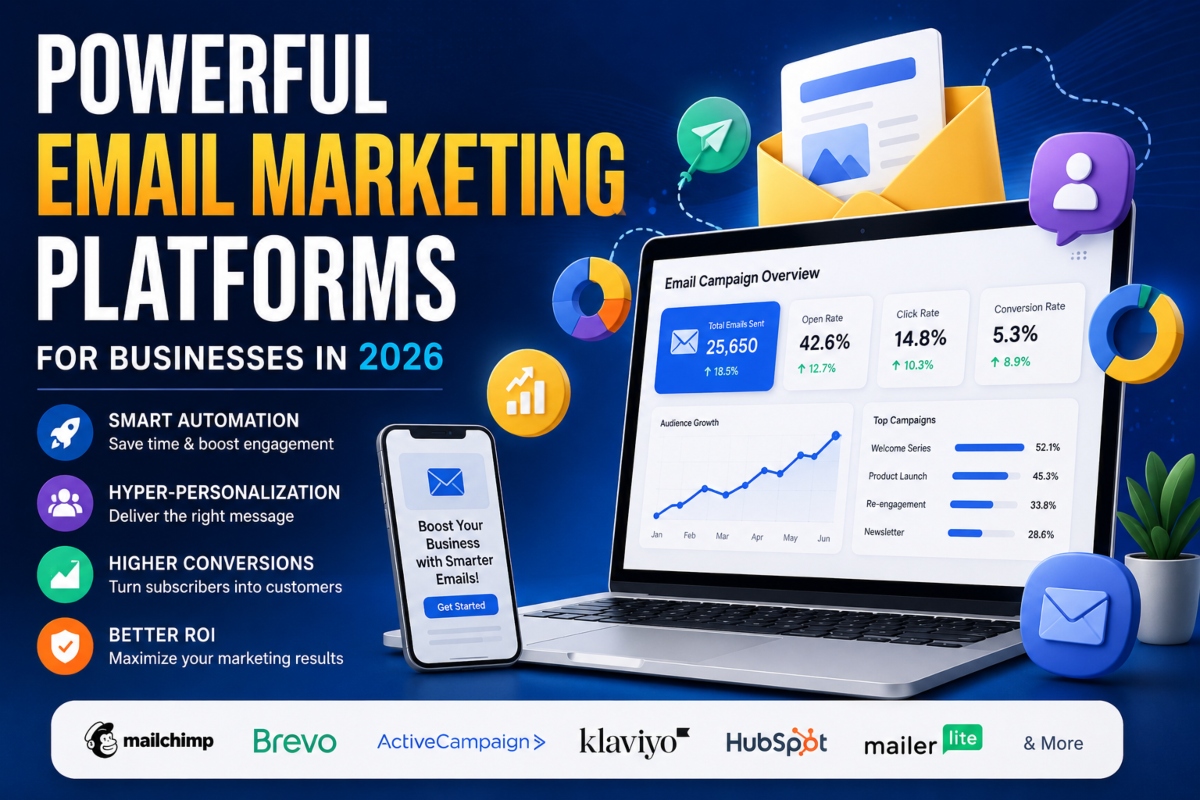
Email marketing continues to deliver some of the strongest returns for businesses in 2026. While social platforms shift algorithms almost every month and paid advertising costs keep climbing, email remains one of the few channels brands fully control. A well crafted email campaign still brings direct engagement, repeat sales, stronger customer loyalty, and measurable revenue without draining marketing budgets.
The biggest shift this year comes from smarter technology. Modern email marketing software now uses AI to predict customer behavior, personalize content, optimize sending times, and improve engagement rates with far less manual work. Businesses are no longer sending the same message to every subscriber. Instead, AI email marketing tools help brands create tailored experiences based on browsing habits, purchase history, and customer intent.
Marketing automation has also become a core requirement instead of an optional feature. Companies want platforms that can handle welcome sequences, abandoned cart reminders, lead nurturing, and customer retention from one dashboard. At the same time, businesses expect their tools to connect smoothly with CRM systems, ecommerce stores, analytics platforms, and customer databases.
That is why powerful email marketing platforms now sit at the center of modern digital strategy. The right platform does far more than send newsletters. It helps businesses build smarter campaigns, create stronger customer relationships, and turn audience data into long term growth.
What Makes an Email Marketing Platform Powerful in 2026?
Businesses no longer look at email platforms as simple newsletter tools. In 2026, companies expect email marketing software to handle automation, customer data, analytics, personalization, and sales performance from one connected system. The strongest platforms combine speed, intelligence, and flexibility so brands can build campaigns that feel personal while still operating at scale.
AI Driven Personalization
Modern AI email marketing tools have changed how brands communicate with customers. Instead of sending generic campaigns to massive lists, businesses now create messages tailored to individual behavior and preferences.
Dynamic content allows marketers to show different products, offers, or messaging depending on customer interests. A fashion brand, for example, can send winter wear recommendations to one subscriber and fitness gear to another within the same campaign.
Predictive sending has also become a major advantage. Advanced systems analyze user behavior and identify the best time to send emails for higher open and click rates. Smart segmentation takes things further by grouping subscribers according to browsing activity, purchase history, engagement patterns, and customer intent.
This level of personalization helps brands improve customer engagement while increasing conversions and retention.
Automation and Workflow Flexibility
Strong marketing automation features separate average platforms from serious business solutions. Companies want tools that can automate repetitive work while still giving teams full control over campaign structure.
Drip campaigns remain essential for onboarding, lead nurturing, and customer retention. Trigger based workflows allow businesses to respond instantly when users take specific actions such as signing up for a newsletter, abandoning a cart, or downloading a resource.
Customer journey mapping also plays a huge role in campaign optimization. Businesses can design automated paths that guide subscribers from first interaction to final purchase without constant manual input.
Flexible email automation software saves time while helping brands maintain consistent communication across every stage of the sales funnel.
Deliverability and Analytics
Even the best campaign means little if emails never reach the inbox. Deliverability has become one of the most important factors when evaluating customer engagement tools in 2026.
Top platforms offer spam testing, sender reputation monitoring, authentication support, and inbox placement tracking. Businesses also rely heavily on analytics dashboards to measure campaign performance in real time.
Open rate tracking, click through analysis, conversion reporting, and revenue attribution help marketers understand what works and what needs improvement. Better reporting leads to smarter decisions and stronger long term campaign performance.
CRM and Ecommerce Integrations
Modern businesses use multiple platforms to manage sales, marketing, and customer relationships. That is why integrations matter more than ever.
Leading email marketing software now connects smoothly with Shopify, Salesforce, HubSpot, and WooCommerce. These integrations allow brands to sync customer data, automate purchase based campaigns, and track user activity across multiple touchpoints.
When CRM systems and ecommerce stores work together with email platforms, businesses gain a clearer picture of customer behavior and create more accurate campaigns with less manual effort.
Best Powerful Email Marketing Platforms for Businesses in 2026
Businesses expect far more from email marketing software in 2026. Sending newsletters alone is no longer enough. Brands now need intelligent automation, customer data syncing, advanced personalization, detailed analytics, and smooth integrations with ecommerce and CRM platforms. The strongest tools combine these features into one connected system that helps companies build stronger customer relationships while increasing revenue.
Below are the most powerful email marketing platforms businesses are using this year.
Salesforce Marketing Cloud Engagement
Salesforce Marketing Cloud remains one of the strongest enterprise solutions available in 2026. Large brands use it to manage customer communication across email, mobile, social media, and web campaigns from one platform.
Best for
Large enterprises, financial companies, global retailers, and businesses managing high volume customer data.
Core Features
- Advanced AI driven personalization
- Multi channel campaign management
- Customer journey automation
- Predictive analytics
- Deep Salesforce CRM integration
- Real time audience segmentation
Pros
Salesforce delivers excellent personalization capabilities for large scale campaigns. Businesses can build highly targeted customer journeys using real time CRM data. The analytics dashboard also gives marketing teams strong visibility into customer behavior and conversions.
Limitations
The platform comes with a steep learning curve for beginners. Smaller businesses may also find pricing difficult to justify compared to lighter email automation software.
Pricing Snapshot
Custom enterprise pricing based on business size and feature requirements.
Why It Stands Out in 2026
Salesforce continues to dominate enterprise marketing because of its deep customer data capabilities and advanced automation tools. Businesses handling massive customer lists benefit from stronger campaign optimization and audience targeting than most competing platforms.
Brevo
Brevo has become one of the most popular choices for startups and growing businesses looking for affordable email marketing software with strong automation features.
Best for
Small businesses, startups, agencies, and growing ecommerce brands.
Core Features
- Email and SMS marketing
- Marketing automation workflows
- Built in CRM
- Landing page builder
- Transactional emails
- A B testing tools
Pros
Brevo balances affordability with useful automation features. Businesses can manage email campaigns, SMS marketing, and customer communication from one dashboard without overspending. The platform also offers a generous free plan for smaller teams.
Limitations
Advanced reporting and AI personalization features are less powerful than enterprise focused platforms like Salesforce or HubSpot.
Pricing Snapshot
Free plan available with scalable paid plans for growing businesses.
Why It Stands Out in 2026
Brevo gives smaller companies access to customer engagement tools that once belonged only to larger businesses. It offers strong value for teams that need practical automation without technical complexity.
ActiveCampaign
ActiveCampaign has built its reputation around sophisticated marketing automation and behavior based customer journeys.
Best for
B2B companies, SaaS brands, consultants, and businesses focused on lead nurturing.
Core Features
- Visual workflow automation
- Behavioral triggers
- Smart segmentation
- Predictive sending
- CRM integration
- Sales pipeline management
Pros
The automation builder remains one of the best in the industry. Businesses can create highly detailed workflows based on customer actions, engagement history, and purchase intent. This makes ActiveCampaign especially useful for lead generation and retention campaigns.
Limitations
The interface can feel overwhelming for beginners who only need basic email campaign tools.
Pricing Snapshot
Tiered pricing based on contact list size and automation features.
Why It Stands Out in 2026
ActiveCampaign continues to lead the conversation around intelligent marketing automation. Companies that depend on personalized customer journeys and advanced workflows often choose it over simpler competitors.
Klaviyo
Klaviyo remains a top choice for ecommerce businesses looking to increase customer retention and online sales through targeted email campaigns.
Best for
Shopify stores, ecommerce brands, online retailers, and direct to consumer businesses.
Core Features
- Ecommerce segmentation
- Cart recovery automation
- Revenue tracking
- Customer lifetime value analysis
- Product recommendation emails
- Shopify and WooCommerce integrations
Pros
Klaviyo gives ecommerce brands detailed customer insights tied directly to purchasing behavior. Businesses can automate abandoned cart emails, post purchase campaigns, seasonal promotions, and win back sequences with ease.
Limitations
Pricing can increase quickly as subscriber lists grow.
Pricing Snapshot
Flexible pricing based on contacts and monthly email volume.
Why It Stands Out in 2026
Klaviyo succeeds because it understands ecommerce data better than most competitors. Its automation features help online stores increase conversions while improving customer retention through highly targeted messaging.
Mailchimp
Mailchimp continues to attract businesses searching for simple email marketing software with a beginner friendly experience.
Best for
Beginners, bloggers, freelancers, and small businesses.
Core Features
- Drag and drop editor
- Email templates
- Basic automation
- Audience segmentation
- Campaign analytics
- Third party integrations
Pros
Mailchimp offers one of the easiest learning experiences in the market. Teams can launch campaigns quickly without technical experience. The platform also supports a wide range of integrations for ecommerce and content management systems.
Limitations
Automation depth and advanced reporting remain limited compared to more specialized platforms.
Pricing Snapshot
Free and paid plans available depending on audience size and features.
Why It Stands Out in 2026
Mailchimp remains relevant because simplicity still matters. Businesses that want fast campaign creation and reliable email delivery often choose it over more advanced systems.
HubSpot
HubSpot combines email marketing, CRM tools, content management, and sales features into one connected platform.
Best for
B2B brands, agencies, SaaS companies, and inbound marketing teams.
Core Features
- CRM based email marketing
- Lead scoring
- Automated workflows
- Website and email analytics
- Customer lifecycle tracking
- Sales and marketing alignment
Pros
HubSpot creates a unified environment where sales and marketing teams can work together using shared customer data. Its reporting features also provide strong visibility into campaign performance and lead generation.
Limitations
Costs can rise significantly when businesses need premium automation and CRM features.
Pricing Snapshot
Free CRM available with scalable premium marketing plans.
Why It Stands Out in 2026
HubSpot continues to attract businesses focused on inbound marketing and customer lifecycle management. Its all in one ecosystem helps companies manage customer relationships without relying on multiple disconnected tools.
MailerLite and Mailercloud
MailerLite and Mailercloud appeal to businesses looking for lightweight email automation software with affordable pricing.
Best for
Creators, bloggers, startups, and smaller SaaS businesses.
Core Features
- Email automation
- Landing page creation
- Newsletter templates
- Subscriber segmentation
- Campaign analytics
- Signup forms
Pros
Both platforms focus on simplicity and affordability while still offering enough automation features for growing businesses. They are particularly useful for creators building newsletters and online communities.
Limitations
Advanced AI personalization and enterprise analytics are more limited compared to larger platforms.
Pricing Snapshot
Budget friendly plans with free tiers available for smaller lists.
Why They Stand Out in 2026
MailerLite and Mailercloud prove that businesses do not always need expensive enterprise software to run effective campaigns. Their lightweight approach works well for lean marketing teams.
Moosend
Moosend has quietly built a loyal following among businesses searching for affordable customer engagement tools with reliable automation features.
Best for
SMBs, ecommerce businesses, and marketers seeking a lower cost alternative to Mailchimp.
Core Features
- Automation workflows
- Behavioral targeting
- Real time analytics
- Audience segmentation
- Personalization tools
- Ecommerce integrations
Pros
Moosend offers strong automation capabilities at competitive pricing levels. Businesses can build targeted workflows without paying premium enterprise costs.
Limitations
Brand recognition and integration options are not as extensive as larger competitors.
Pricing Snapshot
Affordable pricing designed for small and medium sized businesses.
Why It Stands Out in 2026
Moosend continues to attract companies searching for practical automation without unnecessary complexity. It delivers solid campaign management features while remaining accessible for smaller marketing teams.
Salesforce Marketing Cloud Engagement
Salesforce Marketing Cloud Engagement remains one of the strongest choices for businesses running large scale digital campaigns in 2026. This enterprise email marketing platform is built for companies that need advanced personalization, customer journey management, and deep data integration across multiple channels. Instead of treating email as a standalone marketing tool, Salesforce connects customer interactions from email, mobile apps, websites, social media, and sales systems into one unified ecosystem.
What makes Salesforce email marketing especially attractive for enterprise teams is its ability to handle huge customer databases without sacrificing personalization. Brands can create highly targeted campaigns using customer behavior, purchase history, browsing patterns, and real time engagement data. This allows businesses to send more relevant messages that feel personal instead of generic.
The platform also delivers strong multi channel automation capabilities. Marketing teams can build customer journeys that move across email, SMS, push notifications, and advertising campaigns from one dashboard. For global retailers, financial companies, and enterprise SaaS brands, this creates a smoother customer experience across every touchpoint.
Another major strength is analytics. Salesforce provides detailed reporting on engagement, conversions, customer activity, and campaign performance. Teams can track how users interact with campaigns and adjust strategies using live customer insights instead of guesswork.
Salesforce works particularly well for businesses already using the Salesforce CRM ecosystem. The integration between sales and marketing data helps companies create smarter campaigns while improving communication between departments.
That said, the platform is not built for beginners or smaller teams with limited budgets. The interface can feel complex for new users, and enterprise pricing may not suit startups or small businesses. Still, for companies needing deep personalization and advanced automation at scale, Salesforce Marketing Cloud continues to sit near the top of the email marketing software market in 2026.
Brevo
Brevo has become one of the most attractive choices for businesses searching for affordable email marketing software in 2026. Formerly known as Sendinblue, the platform has grown far beyond basic email campaigns and now offers a full communication system that combines email, SMS marketing, automation, CRM features, and customer engagement tools in one place.
For startups and growing SMBs, Brevo hits a sweet spot between functionality and pricing. Many businesses want advanced marketing features without dealing with enterprise level costs or overly technical systems. Brevo solves that problem by giving smaller teams access to automation, segmentation, and multi channel communication through a clean and beginner friendly dashboard.
One of the biggest strengths of this email and SMS marketing platform is its flexibility. Businesses can run newsletters, promotional campaigns, transactional emails, SMS updates, and automated workflows without juggling multiple tools. This creates a smoother workflow for teams trying to manage customer communication on a limited budget.
Brevo also performs well in automation. Users can create trigger based campaigns for welcome emails, abandoned carts, follow ups, and customer retention. The visual automation builder keeps the process simple enough for non technical marketers while still offering enough depth for growing businesses.
Another advantage is its built in CRM functionality. Instead of relying entirely on external customer management systems, businesses can organize contacts, track conversations, and manage leads directly inside the platform. This is especially useful for smaller companies that want an all in one solution without paying for several separate subscriptions.
The platform also integrates smoothly with ecommerce systems, content management tools, and analytics software. Shopify, WooCommerce, and WordPress users can sync customer data and automate campaigns based on user activity and purchasing behavior.
Brevo does have limitations when compared with larger enterprise platforms. Advanced AI personalization and deep reporting features are less sophisticated than tools like Salesforce or HubSpot. Still, for startups and SMBs focused on practical automation, affordability, and ease of use, Brevo remains one of the smartest email marketing software choices in 2026.
ActiveCampaign
ActiveCampaign has earned a strong reputation as one of the best email automation platform choices for businesses focused on advanced workflows and customer targeting. In 2026, the platform continues to attract B2B companies, SaaS brands, consultants, and digital businesses that rely heavily on automation to move leads through the sales funnel.
What separates ActiveCampaign from many competitors is its deep focus on behavior based marketing. Instead of sending static campaigns to broad audiences, businesses can build automated sequences triggered by specific customer actions. A subscriber opening an email, visiting a pricing page, downloading a guide, or abandoning a signup form can instantly trigger a new workflow designed around that behavior.
This level of automation makes the platform especially useful as lead nurturing software. Marketing teams can guide prospects through personalized email sequences that match their interests, engagement levels, and buying intent. The result feels more like a conversation and less like mass marketing.
The visual automation builder remains one of ActiveCampaign’s strongest features. Users can create detailed customer journeys with branching logic, conditions, goals, and automated actions without needing advanced coding knowledge. Businesses managing long sales cycles or multiple customer touchpoints often benefit the most from this flexibility.
Segmentation is another area where ActiveCampaign performs exceptionally well. Companies can organize audiences using engagement history, purchase activity, website behavior, location, and CRM data. Combined with predictive sending tools, businesses can deliver messages at times when subscribers are most likely to engage.
The platform also integrates smoothly with CRM systems, ecommerce stores, and third party business tools. Sales and marketing teams can work from shared customer data, making communication more consistent throughout the customer journey.
Despite its strengths, ActiveCampaign may feel complex for beginners who only need simple newsletters or basic automation. Smaller teams with limited technical confidence could face a learning curve during setup.
Still, for businesses focused on customer journeys, advanced workflows, and intelligent automation, ActiveCampaign remains one of the strongest marketing automation platforms available in 2026.
Klaviyo
Klaviyo has become one of the most trusted names in ecommerce marketing and continues to dominate the conversation in 2026. Built specifically for online stores, this ecommerce email marketing platform gives brands the tools needed to create highly targeted campaigns driven by customer behavior, purchase activity, and shopping patterns.
For ecommerce businesses, customer data is everything. Klaviyo turns that data into personalized campaigns that feel relevant instead of repetitive. Online stores can automatically send product recommendations, abandoned cart reminders, restock alerts, post purchase follow ups, and seasonal promotions based on real customer actions.
One of the platform’s biggest advantages is its deep Shopify email automation capabilities. Shopify store owners can connect their stores quickly and sync customer activity in real time. This allows businesses to trigger campaigns based on browsing history, order value, product interest, and purchase frequency without manual work.
Klaviyo also performs exceptionally well in segmentation. Businesses can organize customers into highly specific audience groups using metrics like average order value, repeat purchases, engagement history, and customer lifetime value. This creates smarter targeting and stronger campaign performance across every stage of the buyer journey.
Automation remains another major strength. The platform includes ready made workflows for welcome sequences, win back campaigns, abandoned carts, and customer retention. Brands can launch advanced automation without building every sequence from scratch, which saves time for lean marketing teams.
Analytics inside Klaviyo are designed with ecommerce brands in mind. Businesses can track revenue generated from email campaigns, identify top performing flows, and monitor customer behavior directly tied to sales performance. Instead of focusing only on open rates, the platform helps brands understand actual revenue impact.
Klaviyo also integrates smoothly with WooCommerce, BigCommerce, and other ecommerce systems, making it easier for businesses to centralize customer data and automate marketing campaigns across multiple channels.
The main downside is pricing. As subscriber lists grow, monthly costs can rise quickly compared to simpler email marketing software. Smaller businesses with tight budgets may need to monitor expenses carefully.
Still, for online stores focused on growth, retention, and personalized customer experiences, Klaviyo remains one of the strongest ecommerce email marketing platforms available in 2026.
Mailchimp
Mailchimp remains one of the most recognizable names in email marketing and continues to attract beginners, freelancers, bloggers, and small businesses in 2026. While newer platforms now offer deeper automation and AI features, Mailchimp still holds strong appeal because of its simplicity, clean interface, and beginner friendly setup process.
For businesses entering email marketing for the first time, Mailchimp works well as beginner email marketing software because it removes much of the technical friction that often slows new users down. The dashboard is easy to navigate, campaign creation feels straightforward, and most features are designed with non technical users in mind.
One of the platform’s strongest advantages is its collection of easy email campaign tools. Users can create newsletters, promotional emails, product announcements, and customer updates using drag and drop editors and ready made templates. Small teams can launch professional looking campaigns quickly without hiring designers or developers.
Mailchimp also includes basic automation features that work well for smaller businesses. Users can set up welcome emails, simple drip campaigns, birthday messages, and customer follow ups with minimal effort. While the automation is not as advanced as platforms like ActiveCampaign or HubSpot, it is more than enough for businesses running straightforward campaigns.
Audience segmentation is another useful feature. Businesses can organize subscribers based on engagement, signup source, customer activity, and purchase behavior. Combined with built in analytics, marketers can track open rates, click performance, and campaign engagement through an easy to understand dashboard.
The platform also integrates with Shopify, WordPress, WooCommerce, Canva, and hundreds of other tools. This flexibility helps smaller businesses connect their email marketing with ecommerce stores, websites, and content systems without complicated setup processes.
Mailchimp does come with limitations. Businesses needing advanced behavior based automation, deep customer journey mapping, or enterprise level analytics may eventually outgrow the platform. Pricing can also become expensive as contact lists expand.
Still, for businesses searching for a reliable and accessible starting point, Mailchimp remains one of the strongest entry level email marketing software options in 2026. Its balance of simplicity, usability, and practical campaign tools continues to make it a popular choice for growing brands.
HubSpot
HubSpot has grown into one of the most complete business marketing ecosystems available in 2026. More than just an email tool, it combines CRM management, automation, analytics, content management, and sales features into one connected platform. For B2B companies already working inside the HubSpot ecosystem, it remains one of the strongest CRM email marketing platform options on the market.
What makes HubSpot stand out is the way it connects marketing and sales data in real time. Instead of treating email campaigns as isolated activities, businesses can build campaigns around the full customer lifecycle. Every email interaction, website visit, lead form submission, and sales conversation becomes part of a shared customer profile that both marketing and sales teams can access.
This approach makes HubSpot especially powerful as inbound marketing software. Businesses can attract leads through blogs, landing pages, SEO content, and lead magnets, then automatically move those leads through personalized email workflows based on user behavior and engagement. The result feels more connected and less fragmented than using separate tools for each task.
Automation is another major strength. Marketing teams can build workflows for onboarding, lead nurturing, follow ups, sales notifications, and customer retention using a visual builder that remains relatively easy to manage. Companies handling long B2B sales cycles often benefit from these automated sequences because they keep communication consistent without constant manual effort.
HubSpot also performs well in segmentation and lead scoring. Businesses can group audiences based on lifecycle stage, engagement history, demographics, website activity, and sales readiness. This allows marketers to send more targeted campaigns while helping sales teams focus on higher quality leads.
Analytics inside HubSpot are detailed and business focused. Teams can track email performance, conversion paths, customer acquisition, and revenue attribution from one dashboard. This gives companies a clearer understanding of how campaigns contribute to actual business growth.
The platform integrates smoothly with ecommerce systems, analytics tools, customer support software, and third party business applications. However, businesses wanting advanced features should expect pricing to increase as they scale into premium plans.
For B2B companies already using HubSpot CRM, the platform creates a seamless environment for managing customer communication, automation, and lead generation. Its combination of CRM functionality and inbound marketing tools continues to make it one of the strongest choices for growth focused businesses in 2026.
MailerLite and Mailercloud
MailerLite and Mailercloud have become popular choices for businesses searching for a budget email marketing platform that still delivers practical automation and reliable campaign management. In 2026, both tools continue to attract creators, bloggers, startups, freelancers, and lean SaaS teams that want simplicity without sacrificing core marketing features.
Many smaller businesses do not need massive enterprise systems packed with advanced features they may never use. Instead, they want lightweight email automation tools that are easy to manage, affordable to scale, and fast to launch. That is exactly where MailerLite and Mailercloud perform well.
MailerLite focuses heavily on usability. The interface feels clean, modern, and beginner friendly, making it easy for users to build newsletters, landing pages, signup forms, and automated campaigns without technical experience. Bloggers and creators often choose the platform because it allows them to launch professional campaigns quickly while keeping costs manageable.
Automation inside MailerLite remains simple but effective. Users can create welcome sequences, subscriber onboarding flows, product updates, and audience engagement campaigns through visual workflow builders. While the automation is not as advanced as enterprise focused platforms, it works well for businesses running smaller scale customer journeys.
Mailercloud follows a similar approach but places stronger emphasis on affordability and campaign management for growing businesses. The platform includes automation workflows, segmentation tools, analytics dashboards, and ecommerce integrations designed for startups and smaller teams working with limited marketing budgets.
Both platforms also support landing page creation and subscriber management, allowing businesses to manage lead generation and email campaigns from one dashboard. This is especially useful for SaaS startups and content creators trying to build audiences without relying on multiple expensive tools.
Another advantage is deliverability. Even though these platforms target smaller businesses, they still perform reliably when it comes to inbox placement and campaign performance. Combined with straightforward analytics, marketers can track opens, clicks, and engagement without getting buried in overly complex reporting systems.
The main limitation is scalability for advanced enterprise needs. Businesses requiring deep AI personalization, highly advanced automation, or complex CRM workflows may eventually outgrow these platforms as their operations expand.
Still, for creators, bloggers, and lean SaaS teams focused on affordability and simplicity, MailerLite and Mailercloud remain strong email marketing software choices in 2026.
Moosend
Moosend has steadily built a reputation as a reliable Mailchimp alternative for businesses that want stronger automation features without paying premium prices. In 2026, the platform continues to attract startups, ecommerce stores, agencies, and growing companies searching for practical SMB email automation software that balances affordability with performance.
One of Moosend’s biggest strengths is its automation system. While some lower cost platforms offer only basic workflows, Moosend gives businesses access to advanced automation tools that help create more personalized customer experiences. Users can build automated sequences for abandoned carts, welcome emails, lead nurturing, customer retention, and product recommendations using an easy visual workflow builder.
The platform also performs well in audience segmentation. Businesses can organize subscribers according to customer behavior, engagement activity, purchase history, and campaign interactions. This helps marketers send more targeted campaigns instead of relying on generic mass emails that often produce weak engagement.
For ecommerce brands, Moosend includes useful integrations with online store platforms and customer data systems. Businesses can automate campaigns triggered by shopping activity, product views, and order behavior, which helps improve conversions and customer retention over time.
Another area where Moosend stands out is usability. The dashboard feels straightforward and clean, making it accessible for smaller teams without dedicated technical staff. Campaign creation, workflow management, and analytics remain easy to navigate even for marketers with limited experience.
Moosend also includes useful reporting tools that allow businesses to monitor open rates, click activity, conversions, and subscriber engagement. While the analytics may not reach enterprise level depth, they provide more than enough insight for SMBs focused on campaign growth and customer engagement.
Pricing remains one of the platform’s biggest selling points. Many businesses looking for a Mailchimp alternative move toward Moosend because it offers stronger automation features at a lower cost. This makes it especially appealing for companies trying to scale email marketing without stretching their budgets.
The main drawback is that Moosend does not have the same level of brand recognition or third party integration ecosystem as larger competitors like HubSpot or Salesforce. Larger enterprises with highly complex workflows may eventually need more advanced systems.
Still, for businesses focused on affordable automation, targeted campaigns, and user friendly workflows, Moosend remains one of the strongest SMB email automation software options in 2026.
Comparison Table of Top Email Marketing Platforms
Choosing the right email marketing software becomes easier when you compare platforms side by side. Some tools focus heavily on automation and customer journeys, while others work better for beginners, ecommerce stores, or enterprise marketing teams. The best option depends on your business size, technical needs, budget, and long term growth plans.
The table below compares the top email marketing platforms in 2026 based on automation capabilities, CRM integration, ecommerce support, and pricing level. This quick breakdown helps businesses identify which platform fits their workflow without spending hours testing every option individually.
| Platform | Best For | Automation | CRM Integration | Ecommerce Support | Pricing Level |
|---|---|---|---|---|---|
| Salesforce Marketing Cloud | Large enterprises | Advanced | Excellent | Strong | High |
| Brevo | Startups and SMBs | Strong | Built in CRM | Good | Affordable |
| ActiveCampaign | B2B and SaaS | Advanced | Strong | Moderate | Medium |
| Klaviyo | Ecommerce brands | Advanced | Good | Excellent | Medium to High |
| Mailchimp | Beginners and small businesses | Basic to Moderate | Good | Strong | Medium |
| HubSpot | B2B marketing teams | Advanced | Excellent | Moderate | High |
| MailerLite | Creators and bloggers | Moderate | Basic | Moderate | Low |
| Mailercloud | Lean SaaS teams and startups | Moderate | Basic | Moderate | Low |
| Moosend | SMBs and ecommerce brands | Strong | Moderate | Good | Affordable |
Businesses focused on advanced customer journeys and deep personalization often lean toward Salesforce, HubSpot, or ActiveCampaign. Ecommerce brands usually benefit more from Klaviyo, while smaller businesses and creators may find better value in Brevo, MailerLite, or Moosend.
How to Choose the Right Email Marketing Platform for Your Business
Choosing the right email marketing software in 2026 is no longer just about sending newsletters. Businesses now need platforms that support automation, customer data management, analytics, personalization, and long term growth. The ideal platform depends on your business size, existing tools, campaign complexity, and budget.
A platform that works perfectly for a startup may feel limiting for a fast growing ecommerce brand or enterprise company. That is why businesses should evaluate several factors before making a final decision.
Choose Based on Business Size
Business size often determines how much automation, reporting, and scalability you actually need.
Startups usually benefit from lightweight and affordable platforms that are easy to manage. Tools like Brevo, MailerLite, and Mailchimp work well for smaller teams that need simple email campaign management without technical complexity. Free plans and beginner friendly dashboards also help reduce upfront costs.
SMBs often need stronger automation and audience segmentation as customer lists grow. Platforms like ActiveCampaign and Moosend offer more advanced workflows, customer targeting, and analytics without reaching enterprise level pricing. These tools balance affordability with stronger marketing capabilities.
Enterprise businesses typically require deeper integrations, advanced personalization, and multi channel automation. Salesforce Marketing Cloud and HubSpot remain strong choices for companies handling large customer databases and high volume campaigns across multiple departments.
Choosing software that matches your current business stage helps avoid paying for unnecessary features while leaving room for future expansion.
Match the Platform With Your Tech Stack
Your email platform should work smoothly with the systems your business already uses.
Shopify users often benefit most from Klaviyo because of its ecommerce automation and customer behavior tracking. Businesses using WordPress may prefer Mailchimp or Brevo because of their easy plugin support and straightforward integrations.
Companies operating inside the Salesforce ecosystem usually gain more value from Salesforce Marketing Cloud because customer and sales data sync naturally across teams. Similarly, businesses already relying on HubSpot CRM often achieve better workflow efficiency by keeping everything inside the HubSpot environment.
When platforms integrate properly with your tech stack, customer data flows more smoothly and automation becomes far easier to manage.
Evaluate Automation Needs
Not every business needs advanced automation. Some only require basic campaigns, while others depend heavily on customer journey management.
Simple campaigns such as newsletters, promotional emails, and product announcements can run effectively on beginner friendly platforms like Mailchimp or MailerLite.
Businesses managing lead nurturing, abandoned cart recovery, or multi step funnels may need stronger automation systems like ActiveCampaign or HubSpot. These platforms allow marketers to build detailed workflows triggered by customer behavior and engagement patterns.
AI powered workflows are becoming more important in 2026 as brands focus on personalization and predictive engagement. Platforms using AI can optimize send times, segment audiences automatically, and recommend content based on customer activity.
The more advanced your customer journey becomes, the more valuable scalable email marketing tools become.
Balance Budget and Scalability
Budget matters, but long term scalability matters just as much.
Many businesses begin with free plans or lower tier subscriptions, which work well during the early growth stage. However, pricing can increase rapidly as subscriber lists expand and automation needs grow.
Usage based pricing models may appear affordable initially but become expensive at scale. Businesses should compare not only monthly costs but also feature restrictions, contact limits, and automation access.
The best email marketing software for small business should allow room for growth without forcing expensive migrations later. Investing in a platform that can scale alongside your business often saves time, money, and operational headaches over the long run.
Email Marketing Trends Businesses Should Watch in 2026
Email marketing trends in 2026 are shaped by smarter automation, stronger personalization, and changing customer expectations. Businesses are no longer competing only for clicks. They are competing for attention in crowded inboxes where relevance matters more than volume. Brands that adapt quickly to new technology and customer behavior will gain a major advantage in engagement and conversions.
AI Generated Email Campaigns
AI tools are becoming a normal part of modern email marketing workflows. Businesses now use AI to write subject lines, generate campaign copy, recommend products, and optimize layouts within minutes. This speeds up campaign production while helping marketers test multiple content variations more efficiently.
AI also helps improve engagement by analyzing customer behavior and identifying what type of content performs best with specific audiences. Instead of relying entirely on guesswork, marketers can use data driven recommendations to improve campaign performance.
Hyper Personalized Customer Journeys
Generic email blasts continue to lose effectiveness. Customers expect messages that match their interests, behavior, and purchase activity. This shift has pushed AI personalization to the center of modern marketing strategies.
Brands now build customer journeys around browsing history, buying patterns, engagement activity, and real time interactions. Subscribers receive content tailored to their preferences rather than one size fits all campaigns. Businesses using hyper personalized messaging often see stronger retention, higher click rates, and improved customer loyalty.
Privacy and First Party Data
Privacy regulations and changes in third party tracking continue to reshape digital marketing. Businesses are placing greater focus on collecting first party data directly from customers through signups, surveys, purchase activity, and website interactions.
This shift makes email marketing even more valuable because brands own their subscriber lists and customer data. Businesses that build trust and transparent communication with subscribers will maintain stronger long term relationships.
Omnichannel Automation
Modern marketing no longer happens through email alone. Businesses now connect email campaigns with SMS, push notifications, social media, and customer support systems to create smoother experiences across every touchpoint.
Omnichannel customer engagement allows brands to communicate consistently whether customers are browsing websites, opening emails, or shopping through mobile apps. Connected automation helps businesses maintain stronger relationships without overwhelming audiences with repetitive messaging.
Predictive Analytics and Smart Sending
Predictive analytics tools are becoming more advanced in 2026. Email platforms can now analyze engagement patterns to determine when subscribers are most likely to open messages or make purchases.
Smart sending tools automatically schedule campaigns at optimal times for each subscriber, helping businesses increase open rates and conversions. Combined with automation and AI personalization, predictive analytics helps marketers create campaigns that feel more timely and relevant.
Common Mistakes Businesses Make When Choosing Email Platforms
Many businesses invest in email marketing software without fully evaluating how the platform fits their long term goals. A tool may look impressive during a free trial, but poor planning often leads to higher costs, weak automation, and frustrating limitations later. Avoiding a few common mistakes can save businesses significant time and money.
One of the biggest mistakes is ignoring deliverability. Some companies focus heavily on templates and automation while overlooking whether emails actually reach customer inboxes. Poor deliverability can damage engagement rates and reduce campaign performance no matter how strong the content looks. Businesses should always check sender reputation tools, spam protection features, and inbox placement performance before choosing a platform.
Another common issue is choosing software based only on price. Free plans and low cost subscriptions may seem attractive at first, but they often come with limited automation, weak analytics, or subscriber restrictions. Businesses that scale quickly may end up migrating platforms later, which creates unnecessary disruption and added costs.
Weak integration support also creates problems for growing companies. If the email platform does not connect smoothly with Shopify, WordPress, Salesforce, HubSpot, or ecommerce systems, teams often waste time managing disconnected customer data manually. Strong integrations make automation and customer tracking far more efficient.
Some businesses also overpay for features they never use. Enterprise platforms offer powerful tools, but smaller companies may not need advanced AI workflows or complex customer journey systems during the early growth stage. Paying for unnecessary features can drain marketing budgets without delivering real value.
Poor automation planning is another major issue. Businesses sometimes purchase advanced platforms without a clear strategy for onboarding sequences, lead nurturing, retention campaigns, or customer journeys. Automation works best when businesses understand exactly how customers move through the sales process and what type of communication supports each stage.
Final Thoughts
The best email marketing platform in 2026 is not simply the one with the longest feature list or the biggest brand recognition. The right choice depends on your business goals, marketing strategy, customer journey, and growth stage. A startup focused on newsletters and lead generation will need something very different from an enterprise brand running advanced multi channel campaigns.
Businesses should focus on the features that actually support long term growth. Strong automation helps save time and improve customer engagement. Reliable integrations make it easier to connect ecommerce stores, CRM systems, analytics tools, and customer data into one smooth workflow. Scalability also matters because a platform that works for 5,000 subscribers today may struggle once your audience grows five times larger.
Ease of use should never be ignored either. Even the most advanced email marketing software loses value if your team finds it difficult to manage daily campaigns and automation workflows.
Whether you choose Salesforce, HubSpot, Klaviyo, ActiveCampaign, Brevo, or a lighter platform like MailerLite, the goal remains the same. Build smarter campaigns, create stronger customer relationships, and improve long term business growth through better communication.
Start a free trial, compare features carefully, and audit your current email stack before making your final decision. The right platform can become one of the most valuable growth tools your business uses in 2026.