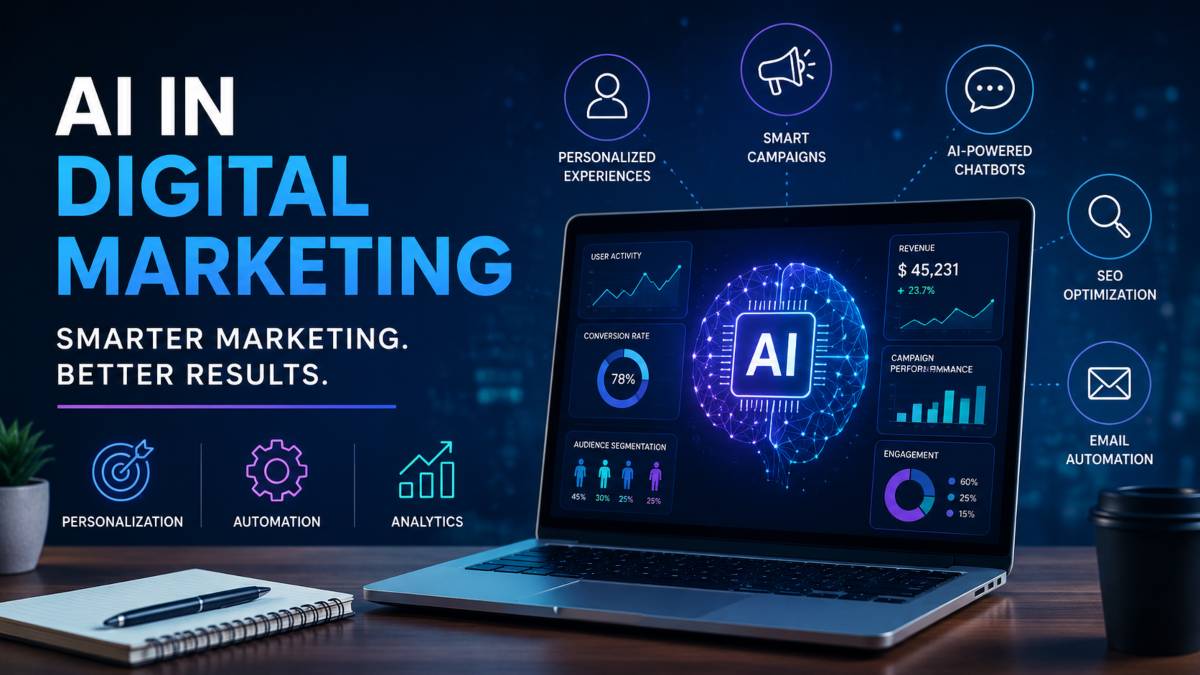
Artificial intelligence is changing the way companies connect with customers, manage campaigns, and grow their brands online. Today, businesses of all sizes are looking for smarter ways to reach the right audience while saving time and resources. This is why understanding how businesses use AI in digital marketing has become increasingly important for marketers, business owners, and decision makers.
Modern consumers expect personalized experiences whenever they interact with a brand. They want relevant product recommendations, tailored content, and quick responses to their questions. Meeting these expectations manually can be difficult, especially as customer data continues to grow. AI helps businesses analyze large amounts of information, identify patterns, and deliver experiences that feel more relevant to each individual customer.
From content creation and search engine optimization to advertising, customer support, and predictive analytics, AI supports many areas of digital marketing. It helps marketers make informed decisions, automate repetitive tasks, improve campaign performance, and create better customer experiences. As AI technology continues to advance, more businesses are using it to stay competitive and improve their marketing results.
What Is AI in Digital Marketing?
Artificial intelligence has become a valuable tool for modern marketers who want to work smarter and deliver better customer experiences. AI in digital marketing refers to the use of computer systems that can analyze data, recognize patterns, learn from information, and help marketers make informed decisions. These systems can process large amounts of customer and campaign data much faster than humans, helping businesses improve marketing results.
Understanding AI Powered Marketing
AI powered marketing uses artificial intelligence to support tasks such as audience targeting, content creation, customer segmentation, and campaign optimization. It helps marketers understand customer behavior and deliver more relevant messages at the right time.
While automation follows pre programmed rules, AI goes a step further. Traditional automation performs the same action when a specific trigger occurs. AI can analyze new data, identify trends, and adjust recommendations based on changing customer behavior. This ability makes artificial intelligence in marketing more flexible and adaptive than standard automation tools.
Why Businesses Are Investing in AI
Businesses are investing in AI because it helps them make decisions faster and with greater accuracy. Instead of manually reviewing reports and customer data, marketers can use AI tools to identify opportunities and trends within seconds.
AI also helps companies get more value from their marketing data. It can uncover patterns that may otherwise go unnoticed, allowing businesses to create more relevant campaigns. As a result, companies often see stronger engagement, better audience targeting, and improved campaign performance across multiple marketing channels.
How Businesses Use AI in Digital Marketing
The Growing Role of AI Across Marketing Channels
Understanding how businesses use AI in digital marketing starts with recognizing how widely it is being applied across modern marketing activities. What began as a tool for data analysis has evolved into a practical solution for content creation, advertising, customer engagement, search engine optimization, and campaign management.
Businesses use AI to analyze customer behavior, personalize user experiences, automate repetitive tasks, and improve marketing performance. AI can recommend products based on browsing history, optimize advertising budgets, generate content ideas, identify high value leads, and provide instant customer support through chatbots. These capabilities help companies reach the right audience while making better use of their time and resources.
Many organizations are also adopting AI marketing strategies to improve decision making and respond more quickly to changing customer preferences. Rather than relying solely on manual processes, marketers can use AI to uncover trends, predict outcomes, and refine campaigns using real time data.
In the following sections, we will explore the most common ways businesses use AI, including personalization, advertising optimization, content creation, SEO, chatbots, predictive analytics, market research, and other practical applications that are shaping modern digital marketing.
Personalization at Scale Using AI
One of the most valuable uses of artificial intelligence in marketing is customer personalization. Modern consumers expect brands to understand their interests and provide relevant experiences throughout their journey. AI helps businesses meet these expectations by analyzing customer behavior, purchase history, browsing activity, and engagement patterns in real time.
Product Recommendations and Dynamic Experiences
AI allows businesses to create personalized website experiences for each visitor. Instead of showing the same content to everyone, websites can display products, offers, and messages based on a user’s interests and previous interactions. This creates a more relevant experience and increases the likelihood of engagement and conversions.
Product recommendation systems are among the most common applications of AI. These systems analyze customer data to suggest products that match individual preferences. As customers continue browsing or making purchases, the recommendations become more accurate. This helps businesses increase sales while making it easier for customers to find products they are likely to want.
AI also supports personalized marketing campaigns by tailoring email content, landing pages, and promotional messages to different audience segments. This level of customization helps brands build stronger connections with customers.
Real Business Examples
Netflix is one of the best known examples of AI driven personalization. Its recommendation system analyzes viewing habits and user preferences to suggest movies and shows that match individual interests. This keeps users engaged and improves their overall experience.
Sephora uses AI powered virtual shopping tools that allow customers to try makeup products digitally before making a purchase. This creates a more interactive and convenient shopping journey.
Shoprenter improved its AI customer experience by personalizing homepage messages based on the keywords visitors used to find the website. This approach helped increase conversion rates and delivered more relevant experiences for potential customers.
AI Powered Advertising and Campaign Optimization
Artificial intelligence has transformed the way businesses manage advertising campaigns. Instead of relying solely on manual decisions, marketers can use AI to analyze large amounts of data, identify opportunities, and improve performance across multiple channels. This allows businesses to reach the right audience, control advertising costs, and achieve better results with less effort.
Smarter Ad Targeting
One of the biggest advantages of AI advertising optimization is its ability to identify and target the most relevant audiences. AI analyzes customer behavior, demographics, interests, and previous interactions to create detailed audience segments. This helps businesses deliver more relevant ads to people who are most likely to engage or convert.
AI also improves bid optimization by automatically adjusting bids based on factors such as user intent, device type, location, and time of day. Rather than manually updating bids, marketers can rely on AI to maximize performance while controlling costs.
Budget allocation is another area where AI delivers value. Marketing platforms can distribute advertising budgets across campaigns and channels based on performance data, helping businesses focus spending where it generates the strongest return.
Real Time Campaign Improvements
AI supports campaign optimization through continuous monitoring and testing. It can evaluate different headlines, images, calls to action, and audience segments to determine which combinations perform best.
AI marketing automation also allows campaigns to adapt automatically. If an ad is underperforming, the system can adjust targeting, bidding, or creative elements without waiting for manual intervention. This helps businesses react quickly to changing market conditions and customer behavior.
Brand Examples
Coca Cola uses AI driven systems to support creative development and marketing execution at scale. By analyzing data and customer preferences, the company can create more relevant campaigns and improve audience engagement.
Amazon Advertising relies heavily on AI to optimize ad placements, audience targeting, and budget distribution. Its systems analyze vast amounts of consumer data to deliver ads that are more likely to generate clicks, conversions, and revenue for advertisers.
AI for Content Creation and Content Marketing
Content creation is one of the areas where artificial intelligence is delivering immediate value for businesses. Marketing teams are under constant pressure to produce blog posts, emails, social media updates, landing pages, and other content on a regular basis. AI content creation tools help reduce the time required for these tasks while supporting productivity and content quality.
Creating Content Faster
AI can assist marketers throughout the content production process. It can generate blog outlines, suggest article topics, create content briefs, and help organize information into a clear structure. This allows writers and marketers to spend more time refining ideas and less time starting from a blank page.
For social media marketing, AI can create captions, post variations, and content ideas tailored to different platforms. This helps businesses maintain an active online presence without increasing workload.
Email marketing teams also use AI to draft subject lines, personalize messages, and create email sequences. These features help marketers launch campaigns more quickly while delivering relevant content to different audience segments.
Maintaining Brand Consistency
Producing large amounts of content can sometimes lead to inconsistent messaging. AI helps businesses maintain a consistent brand voice by following predefined guidelines and writing preferences. This is especially useful for organizations managing content across multiple channels and teams.
AI also supports content workflows by assisting with editing, proofreading, content planning, and optimization. As a result, teams can publish content more efficiently while maintaining quality standards.
Popular AI Content Tools
Several tools have become popular choices for businesses investing in AI generated content. ChatGPT is widely used for brainstorming, writing assistance, content planning, and research support.
Jasper focuses on marketing content, helping businesses create advertisements, landing pages, emails, and blog content that follows a specific brand voice.
Grammarly supports content quality by checking grammar, spelling, readability, and tone. Together, these tools play an important role in content marketing automation, helping businesses create and manage content at scale.
How AI Improves SEO Performance
Search engine optimization requires ongoing analysis, planning, and refinement. As search engines become more advanced, businesses need smarter ways to identify opportunities and improve visibility. AI SEO tools help marketers process large amounts of search data, uncover trends, and make informed decisions that support better rankings and organic traffic growth.
Keyword Research and Search Intent Analysis
One of the most valuable applications of AI in SEO is keyword research. AI can analyze search patterns, competitor content, and user behavior to identify relevant keyword opportunities that may be overlooked through manual research. This helps businesses target topics that match what their audience is actively searching for.
AI also improves search intent analysis by examining the meaning behind search queries. Instead of focusing only on keywords, marketers can understand whether users are looking for information, products, comparisons, or solutions. This allows businesses to create content that better matches user expectations.
Topic clustering is another important feature. AI can group related keywords and subtopics together, helping businesses build stronger content structures that cover subjects more thoroughly and improve topical relevance.
Technical SEO Support
Managing technical SEO can be time consuming, especially for large websites. AI powered tools can perform site audits to identify issues such as broken links, slow loading pages, missing metadata, and crawlability problems. These insights help businesses address technical weaknesses more efficiently.
AI can also perform content gap analysis by comparing existing content against competitor websites and search demand. This helps identify missing topics and new content opportunities.
Content Optimization
Content optimization becomes easier with AI assistance. AI tools can evaluate page structure, keyword placement, readability, and topical coverage to recommend improvements. They can also suggest related terms and supporting topics that strengthen content relevance.
By combining keyword research, technical analysis, and content optimization, AI helps businesses create SEO strategies that are more data driven, organized, and aligned with what users and search engines expect.
AI Chatbots and Customer Engagement
AI chatbots have become an important part of modern digital marketing because they help businesses communicate with customers quickly and efficiently. As customer expectations continue to rise, companies need ways to provide instant assistance without overwhelming their support teams. AI powered chatbots make this possible by delivering timely responses and personalized interactions around the clock.
24/7 Customer Support
One of the biggest advantages of AI customer service is its ability to provide support at any time of day. Customers no longer have to wait for business hours to get answers to common questions. Whether someone needs information about a product, shipping details, or account assistance, an AI chatbot can respond within seconds.
Faster response times improve customer satisfaction and help businesses keep potential buyers engaged. At the same time, chatbots reduce the workload on customer support teams by handling routine inquiries automatically. This allows human agents to focus on more complex issues that require personal attention.
Better Customer Journeys
Chatbots also play a valuable role in improving customer engagement throughout the buying process. They can help visitors discover products based on their needs, answer questions about features, and recommend suitable options.
For businesses with large product catalogs, chatbots simplify product discovery by guiding users toward relevant solutions. They can also support purchasing decisions by providing comparisons, recommendations, and additional information that helps customers buy with confidence.
Business Examples
Sephora uses AI powered virtual shopping assistants to help customers explore beauty products and receive personalized recommendations. This creates a more interactive shopping experience and helps customers find products that match their preferences.
Starbucks has incorporated AI technology into customer interactions and employee support systems. These tools help answer questions quickly and improve service efficiency. Both examples show how chatbot marketing can strengthen customer relationships while creating smoother and more engaging experiences.
Predictive Analytics and Lead Scoring
Businesses collect large amounts of customer data every day, but turning that information into meaningful action can be difficult. Predictive analytics helps solve this challenge by using artificial intelligence to identify patterns, forecast future outcomes, and support smarter marketing decisions. Instead of reacting to events after they happen, businesses can anticipate customer needs and take action earlier.
Predicting Customer Behavior
One of the most valuable applications of predictive analytics is customer behavior analysis. AI can examine browsing habits, purchase history, engagement levels, and other data points to identify customers who are most likely to take a specific action.
Purchase intent prediction helps marketers understand which prospects are ready to buy. This allows businesses to deliver targeted offers, personalized messages, and timely follow ups that increase the chances of conversion.
AI can also identify customers who may stop using a product or service. This process, known as churn prediction, helps companies recognize warning signs before customers leave. Businesses can then launch retention campaigns or offer incentives to encourage continued engagement.
Smarter Lead Prioritization
Not every lead has the same value or likelihood of becoming a customer. AI lead scoring helps businesses rank prospects based on factors such as engagement history, demographic information, website activity, and purchasing signals.
By identifying the most qualified leads, sales teams can focus their efforts on opportunities with the highest potential. This creates stronger alignment between marketing and sales departments because both teams work from the same data driven insights and priorities.
Real Examples
Salesforce uses artificial intelligence to support AI lead scoring and predict which prospects are most likely to convert. This helps sales teams focus on high value opportunities and improve efficiency.
Coca Cola uses AI to analyze customer data, forecast demand, and improve marketing performance. By understanding customer preferences and market trends, the company can make faster decisions and deliver more relevant campaigns to its audience.
Sentiment Analysis and Market Research
Understanding what customers think about a brand is essential for improving products, services, and marketing campaigns. Artificial intelligence helps businesses gather and analyze large volumes of customer opinions from various sources, making it easier to identify patterns and respond to changing consumer needs. This process is commonly known as sentiment analysis and has become a valuable part of modern market research.
Understanding Customer Opinions
Customers share their experiences through online reviews, social media posts, comments, forums, and survey responses. Manually reviewing thousands of conversations can be time consuming, but AI can analyze this information within minutes.
Through customer feedback analysis, AI can determine whether opinions are positive, negative, or neutral. Businesses can quickly identify common complaints, frequently praised features, and recurring customer concerns. This allows companies to respond faster and make informed improvements based on real customer experiences.
Social media conversations are particularly valuable because they provide real time feedback about products, services, and brand perception. AI helps marketers monitor these discussions and understand how audiences feel about their brand over time.
Finding New Market Opportunities
AI also strengthens market research by helping businesses identify emerging trends before they become widely recognized. By analyzing search activity, customer discussions, and industry conversations, AI can uncover topics that are gaining attention.
Competitor analysis is another important application. AI can track competitor mentions, customer sentiment, product feedback, and marketing activity to reveal strengths and weaknesses within the market. These insights help businesses discover new opportunities, refine their strategies, and better position their products to meet customer demand.
Other AI Applications Businesses Use Today
Beyond content creation, advertising, and customer support, businesses are finding new ways to use artificial intelligence to improve efficiency and drive growth. AI can help companies adjust pricing strategies, reach global audiences, and optimize website performance through advanced testing methods. These applications allow businesses to respond more quickly to market conditions while improving customer experiences.
Dynamic Pricing
Dynamic pricing uses artificial intelligence to adjust prices based on factors such as customer demand, competitor pricing, inventory levels, seasonality, and purchasing behavior. Rather than relying on fixed pricing models, businesses can make real time adjustments to remain competitive and maximize revenue.
Many ecommerce retailers and travel companies use dynamic pricing to update prices throughout the day. For example, product prices may increase during periods of high demand or decrease when inventory needs to be cleared. AI helps businesses make these adjustments quickly and accurately using current market data.
Multilingual Marketing Campaigns
Expanding into international markets often requires businesses to communicate with customers in multiple languages. AI supports multilingual marketing through neural machine translation, a technology that translates content while preserving context and natural language flow.
Businesses use neural machine translation to localize website content, email campaigns, advertisements, and customer support materials. This allows companies to reach broader audiences without the time and expense associated with manual translation for every piece of content.
Large Scale Testing and Conversion Optimization
Testing is a key part of improving marketing performance. Traditional A/B testing compares two versions of a webpage, advertisement, or email to determine which performs better. AI takes this process further by analyzing many variations at once.
Some platforms use A/Z testing, where dozens or even hundreds of combinations can be evaluated simultaneously. AI identifies winning headlines, images, layouts, and calls to action based on user behavior. This approach strengthens conversion rate optimization by helping businesses discover the elements that generate the highest engagement and sales.
Benefits of AI in Digital Marketing
Artificial intelligence offers a wide range of advantages for businesses looking to improve their marketing performance. From automating routine tasks to delivering more personalized customer experiences, AI helps organizations work more efficiently while making better use of their marketing resources. As competition continues to increase across digital channels, many companies are investing in AI to improve results and strengthen customer relationships.
Time Savings
One of the most significant AI marketing benefits is the ability to save time. AI can handle repetitive tasks such as data analysis, audience segmentation, content suggestions, email personalization, and campaign monitoring. This allows marketing teams to spend more time on strategy, creativity, and business growth rather than manual processes.
Better Customer Experiences
AI helps businesses deliver more relevant and personalized interactions. By analyzing customer behavior and preferences, AI can recommend products, customize website experiences, and provide instant support through chatbots. These improvements create smoother customer journeys and increase satisfaction across multiple touchpoints.
Improved Marketing ROI
Businesses are constantly looking for ways to maximize marketing ROI. AI helps by identifying high performing audiences, optimizing advertising spend, and improving conversion opportunities. With smarter targeting and automated campaign adjustments, companies can reduce wasted budget and achieve stronger results from their marketing investments.
More Accurate Decision Making
AI can process large amounts of data much faster than humans. This allows marketers to identify trends, forecast outcomes, and make decisions based on real evidence rather than assumptions. Better data analysis often leads to more effective campaigns and stronger business performance.
| Traditional Marketing | AI Assisted Marketing |
|---|---|
| Manual audience research | Automated audience analysis |
| Broad customer targeting | Personalized targeting |
| Limited campaign adjustments | Continuous optimization |
| Time intensive reporting | Real time performance insights |
| Manual testing processes | Automated testing and analysis |
| Slower decision making | Faster data driven decisions |
| Higher risk of wasted ad spend | More efficient budget allocation |
As marketing automation continues to evolve, businesses that adopt AI can improve efficiency, strengthen customer relationships, and achieve more consistent marketing outcomes.
Popular AI Marketing Tools Businesses Use
Businesses are using a growing number of AI marketing tools to improve productivity, create content faster, personalize customer experiences, and streamline marketing operations. These tools help teams reduce manual work while improving the quality and consistency of their campaigns. Whether the goal is content creation, conversion optimization, outreach, or media production, there are AI business tools available for nearly every marketing function.
Content and Copywriting Tools
ChatGPT is widely used for brainstorming ideas, creating blog outlines, drafting articles, writing emails, and generating social media content. It helps marketers accelerate content production while supporting research and planning tasks.
Jasper is designed specifically for marketing teams and content creators. It can generate advertising copy, landing page content, email campaigns, and blog posts while maintaining a consistent brand voice.
Grammarly focuses on editing and quality control. It helps improve grammar, spelling, clarity, readability, and tone, ensuring content remains polished before publication.
Personalization and CRO Tools
OptiMonk helps businesses improve website conversions through personalization and customer targeting. The platform uses AI to display tailored messages, offers, and recommendations based on visitor behavior. This helps create more relevant experiences and increase conversion rates.
Outreach and Media Tools
SmartWriter helps businesses create personalized outreach emails for lead generation and sales campaigns. It uses customer data to craft messages that feel more relevant to recipients.
ElevenLabs specializes in AI generated voice content. Businesses use it to create voiceovers for videos, podcasts, training materials, and marketing assets.
Opus Clip helps marketers repurpose long videos into shorter clips suitable for social media platforms, making video content distribution more efficient.
| Tool | Primary Use | Best For |
|---|---|---|
| ChatGPT | Content creation and ideation | Blogs, emails, research |
| Jasper | Marketing copy generation | Ads, landing pages, campaigns |
| Grammarly | Editing and proofreading | Content quality improvement |
| OptiMonk | Personalization and CRO | Website optimization |
| SmartWriter | Outreach automation | Sales and lead generation |
| ElevenLabs | AI voice generation | Audio content creation |
| Opus Clip | Video repurposing | Social media content |
These marketing software solutions help businesses automate tasks, improve efficiency, and scale marketing activities without significantly increasing workload.
Challenges Businesses Face When Using AI
While artificial intelligence offers many advantages, successful implementation is not always straightforward. Businesses must address several obstacles before they can fully benefit from AI powered marketing systems. Understanding these AI marketing challenges helps organizations build more reliable processes and avoid common mistakes that can reduce performance or create risks.
Data Quality Issues
AI systems depend heavily on accurate and reliable information. If businesses use incomplete, outdated, or inaccurate data, the results produced by AI may also be unreliable. Poor marketing data quality can lead to incorrect audience targeting, weak personalization, and ineffective campaign decisions.
To improve performance, businesses should regularly audit customer databases, remove duplicate records, and ensure information is updated consistently. Strong data management practices provide a solid foundation for AI driven marketing activities.
Privacy and Ethical Concerns
As AI relies on customer information to personalize experiences and improve targeting, businesses must carefully manage data privacy and consent. Customers increasingly want transparency regarding how their information is collected and used.
AI ethics has become an important consideration for organizations using advanced marketing technologies. Businesses should establish clear policies for data usage, respect customer privacy preferences, and comply with applicable regulations to maintain trust.
Bias in AI Models
AI systems learn from existing data, which means they can sometimes reflect biases found within that information. This may result in unfair recommendations, inaccurate audience segmentation, or unequal treatment of certain customer groups.
Regular testing and monitoring can help businesses identify potential biases and improve the fairness of AI generated outcomes.
Human Oversight Requirements
Although AI can automate many marketing tasks, it should not operate without supervision. Human review remains essential for evaluating content quality, campaign strategy, customer communications, and important business decisions.
Businesses that combine AI capabilities with human expertise are often better positioned to maintain accuracy, protect brand reputation, and achieve stronger long term marketing results.
Best Practices for Using AI in Digital Marketing
Artificial intelligence can deliver strong results, but success depends on how it is implemented. Businesses that approach AI with clear objectives, reliable data, and ongoing evaluation are more likely to achieve meaningful improvements. Following proven marketing automation best practices helps organizations avoid common mistakes and get better value from their AI investments.
Start with a Single Marketing Goal
Many businesses make the mistake of trying to apply AI to every marketing activity at once. A more practical approach is to begin with one specific objective. This could be improving email performance, increasing lead quality, automating customer support, or optimizing advertising campaigns.
Starting small makes it easier to evaluate results and identify what works before expanding AI usage across other marketing functions.
Practical Tip: Choose one measurable goal and define clear success metrics before implementing any AI tool.
Build Strong Data Foundations
Even the most advanced AI tools depend on reliable information. Businesses should focus on maintaining accurate customer records, clean analytics data, and consistent tracking systems.
Strong data foundations help AI generate more accurate recommendations, predictions, and audience insights.
Practical Tip: Regularly review customer databases, remove duplicate entries, and verify tracking systems to improve data accuracy.
Keep Human Review in Place
AI can assist with content creation, campaign management, and customer interactions, but human judgment remains essential. Marketers should review AI generated content, validate recommendations, and ensure messaging reflects brand standards.
Human oversight also helps identify errors, maintain quality, and protect customer trust.
Practical Tip: Create an approval process for important content, campaign changes, and customer facing communications.
Measure and Improve Continuously
AI performance should be monitored regularly. Businesses need to track key metrics such as conversion rates, engagement levels, lead quality, and return on investment. Continuous evaluation helps identify areas for improvement and supports better decision making over time.
Practical Tip: Schedule monthly performance reviews to compare results against goals and adjust your AI marketing strategy when needed.
By following these best practices, businesses can introduce AI gradually, reduce risks, and build a stronger foundation for long term marketing success.
The Future of AI in Digital Marketing
Artificial intelligence is expected to become even more integrated into everyday marketing activities over the coming years. As technology continues to improve, businesses will gain access to more advanced tools that can analyze customer behavior, support decision making, and create highly relevant experiences. The future of AI marketing will focus on helping brands connect with customers in more meaningful and efficient ways while reducing manual effort.
Smarter Personalization
Personalization is likely to become more precise as AI systems gain a deeper understanding of customer preferences and behavior patterns. Instead of creating experiences for broad audience segments, businesses will be able to tailor content, recommendations, and offers to individual users in real time. This will help brands deliver more relevant interactions across websites, email campaigns, mobile applications, and social platforms.
Predictive Customer Experiences
One of the most important AI marketing trends is the growing ability to anticipate customer needs before they are expressed. AI will continue improving its ability to analyze behavioral signals, identify purchase intent, and forecast future actions.
Businesses may be able to present products, content, or support options exactly when customers need them, creating smoother and more convenient experiences throughout the customer journey.
Increased Marketing Efficiency
Marketing teams will continue using AI to automate routine processes, analyze performance data, and optimize campaigns with greater speed and accuracy. Tasks that once required hours of manual work may be completed within minutes.
Rather than replacing marketers, AI will act as a powerful support tool that helps teams focus on strategy, creativity, and relationship building. Businesses that adapt to these changes will be better positioned to respond to customer expectations and remain competitive as AI technology continues to evolve.
Final Thoughts
Artificial intelligence is changing how businesses approach digital marketing by making processes faster, smarter, and more data driven. From content creation and advertising to customer support and SEO, AI helps marketing teams work more efficiently while delivering better experiences for customers.
Among the many applications available today, personalization, automation, and analytics offer some of the greatest opportunities for growth. Businesses can use AI to create relevant customer experiences, automate repetitive tasks, identify valuable insights, and improve campaign performance across multiple channels. These capabilities help organizations save time, reduce inefficiencies, and make better marketing decisions.
At the same time, successful implementation requires more than simply adopting new technology. High quality data remains essential for accurate results, while human oversight helps maintain content quality, brand consistency, and ethical decision making. Businesses that combine AI capabilities with human expertise are often better equipped to achieve sustainable results.
For organizations that are new to AI, the best approach is to start with a single marketing process. This could be content creation, email personalization, customer support, or campaign optimization. Once measurable results are achieved, businesses can gradually expand AI across other marketing activities and build a stronger foundation for long term success.
Read More: https://coupasoftware.org/scaling-a-business-faster-with-ai/