EndBugFlow software is described as a debugging and issue workflow platform that helps development teams manage software problems from the moment they are found until they are fixed and verified. Instead of keeping bug reports across emails, spreadsheets, and separate conversations, the workflow brings issue details into a structured process.
A bug is first detected and recorded with useful technical details. The issue can then be organized, given a priority, and assigned to the right team member. After the developer works on a fix, QA can test the result. If the fix works, the issue can be closed. If the problem remains, it can return to development for more work. Issue data can also support reports and workflow analysis.
Public information about EndBugFlow is limited, so some detailed features described online come from third party sources and should be verified before being treated as confirmed product capabilities.
What Is EndBugFlow Software?
EndBugFlow software is described as a platform for managing software bugs and development issues through a structured workflow. Its basic purpose is to give teams one place to record problems, add technical details, assign responsibility, track progress, and verify fixes. This can make it easier to follow an issue from the first report to its final resolution.
A typical EndBugFlow workflow brings bug tracking and software debugging into the same process. Developers can review issue details, while QA testers can check whether a proposed fix actually solves the reported problem. Status tracking can also show whether an issue is open, being worked on, under review, resolved, or ready for closure.
The platform is also described as supporting reporting and workflow monitoring. Issue records can provide useful information about recurring bugs, unresolved problems, priorities, and development activity. However, public information about EndBugFlow is limited, so specific reporting tools and other product capabilities should be verified through current official information.
What Problems Does EndBugFlow Address?
Software teams can quickly lose track of bugs when reports are spread across email threads, spreadsheets, chat messages, and separate testing tools. A report may lack reproduction steps or technical details, while another issue may have no clear owner. These gaps can make it harder for developers to understand what went wrong and what needs to happen next.
EndBugFlow is described as a way to bring these details into a central issue record. Teams can keep the bug description, technical information, assignment, status, comments, and testing results connected to the same issue. This gives developers and QA testers a clearer view of what has already been done and what still needs attention.
Who Can Use EndBugFlow?
EndBugFlow may be useful for different members of a software development team. Developers can use issue records to review reported problems and track fixes. QA testers can record bugs and verify whether fixes work as expected. Team leads may use issue status and workflow data to monitor ongoing work.
Project managers and other technical team members may also benefit from having a shared view of open issues, priorities, assignments, and progress. The exact user roles and permissions available in EndBugFlow should be confirmed through current product documentation because detailed public specifications are limited.
How Does EndBugFlow Software Work?
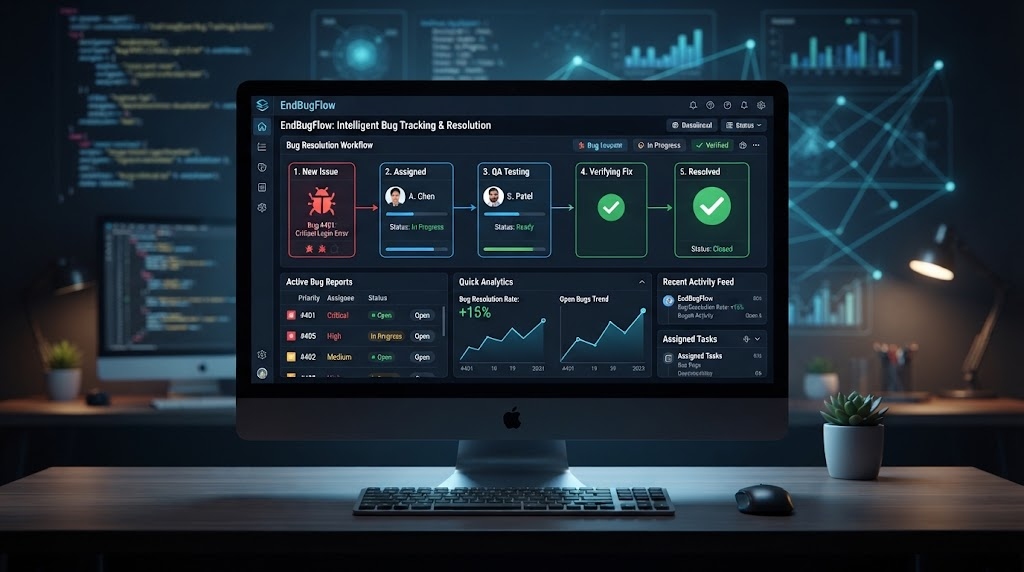
EndBugFlow software is described as a structured workflow for managing software problems from the moment a bug is found to the point where it is fixed and tested. The process generally moves through several stages, helping development teams keep each issue organized and easy to follow.
A typical workflow can be viewed as Detect → Record → Organize → Prioritize → Assign → Fix → Test → Close → Analyze. Each stage gives the team a clearer view of what happened, who is handling the issue, and what needs to happen next.
1. A Software Problem Is Detected
The process starts when a software problem is discovered. A bug may appear during manual testing by a QA tester or through an automated testing process. Users can also discover problems while using an application, while error monitoring tools may detect failures in the background.
Issues can also appear during development, deployment, or after a new software release. For example, a failed build may reveal a coding problem, while an application error may appear after a new version reaches users.
The source of the problem gives the team an initial starting point for investigation and reporting.
2. Technical Information Is Collected
Once a problem is found, useful technical information can be collected to help developers understand what happened. A good bug report may include the error message, steps used to reproduce the problem, screenshots, logs, environment details, software version, and the time when the issue occurred.
This information gives developers more context than a simple statement such as “the feature does not work.” Reproduction steps can show how the problem occurs, while logs and error messages can point toward the possible cause. Environment details can also help determine whether the issue affects a specific browser, device, operating system, or software version.
3. The Problem Becomes an Issue or Ticket
The collected information can then be organized into a structured issue or ticket. This gives the development team one central record for reviewing the problem and tracking its progress.
The ticket can contain the description, technical details, priority, assigned person, comments, status updates, and testing results. Keeping these details together makes it easier to follow the issue as it moves through the development workflow.
How Does EndBugFlow Handle Bug Reports?
EndBugFlow is described as supporting a structured approach to bug reporting, where software problems can enter the workflow through manual reports or automated sources. The main difference is how the issue information reaches the system. Manual reporting depends on a tester or user entering the details, while automated reporting can transfer information from connected development and monitoring systems.
Manual Bug Reporting
With manual reporting, a tester or developer can create an issue by entering the details of a software problem. A useful report may include a clear title, a description of what happened, the expected result, and the actual result.
The report can also include specific steps for reproducing the problem. Severity information can help the team understand how seriously the issue affects the application. Details about the device, browser, operating system, or software version can provide additional context. Screenshots and video recordings may also help developers see the problem without having to reproduce it immediately.
A detailed report gives the development team a clearer starting point and reduces the need to request missing information later.
Automated Bug Reporting
Automated reporting can reduce the amount of manual work involved in collecting issue information. Third party sources describe EndBugFlow as supporting connections with APIs, webhooks, error handlers, logs, and other development systems. These connections may allow technical events to generate or update issue records automatically.
For example, an application error could send information to the issue management system along with an error message, timestamp, environment details, or log data. A failed development process could also provide information for further investigation.
These automated capabilities are based on third party descriptions rather than detailed public specifications from EndBugFlow. Current API support, webhook options, and specific integrations should therefore be verified through official product information before being presented as confirmed features.
How Are Bugs Organized in EndBugFlow?
EndBugFlow is described as organizing software problems into structured issue records that contain more than a basic bug description. Adding useful context can help developers understand where a problem occurred, when it appeared, and which part of the application may be involved.
An issue record may contain an issue ID for easy reference, along with a timestamp showing when the problem was reported or detected. Other details can include the application version, environment, operating system, browser, affected component, responsible team, issue type, severity, and priority.
This information can make issue tracking more practical for development teams. For example, a bug affecting a particular browser and application version may need different investigation from an issue that appears across several environments. Developers can also use component and team information to narrow down ownership, while severity and priority can help determine which problems need attention first.
Keeping these details connected to one issue record also gives QA testers, developers, and team leads a shared view of the problem. The exact fields and organization options available in EndBugFlow should be confirmed through current official product information.
Duplicate Issue Detection
Some third party descriptions report that EndBugFlow may identify similar or duplicate issues. The idea is to compare a new bug report with existing records and flag cases that appear related.
For example, if several users report the same checkout error, duplicate detection could help the team recognize that the reports may describe one underlying problem. This can reduce repeated investigation and keep issue records more organized.
However, duplicate issue detection is based on third party descriptions and is not clearly documented in the public official material reviewed for this article. It should therefore be verified with EndBugFlow before being presented as a confirmed product feature.
How Does EndBugFlow Prioritize Bugs?
Not every software bug needs the same level of attention. A minor visual problem may have little effect on users, while a payment failure can prevent customers from completing an important action. A structured priority system helps development teams decide which issues need attention first.
EndBugFlow is described as using issue priority and severity as part of its workflow. Priority decisions may take several factors into account, including user impact, business impact, severity, frequency, production availability, security concerns, and whether users have a workable alternative.
For example, an issue affecting thousands of users may receive more attention than a problem affecting only a small group. A security related problem may also require quick action even when it affects fewer users. Similarly, an issue with an available workaround may receive a different priority from one that completely blocks a core function.
The exact priority rules used by EndBugFlow are not fully documented in the public material reviewed for this article. The examples below therefore represent a general bug tracking model rather than confirmed EndBugFlow priority settings.
Example of Bug Priority Levels
| Priority | General meaning | Example |
|---|---|---|
| Critical | A major function is unavailable | Customers cannot complete payment |
| High | An important feature is seriously affected | File uploads fail for many users |
| Medium | A function works but has a noticeable problem | Reports contain formatting errors |
| Low | The issue has limited user impact | A minor visual defect appears |
Using clear priority levels can help teams organize their workload and keep serious software problems from getting lost among minor issues.
How Does EndBugFlow Assign Issues to Developers?
Once a software issue has been recorded and given a priority, it needs a clear owner. EndBugFlow is described as supporting an organized approach to issue assignment, helping teams connect reported problems with the people responsible for investigating and fixing them.
An assignment decision may depend on several factors. Technical expertise can help match a problem with someone familiar with the relevant programming language, framework, or system. Team responsibility can also determine who handles an issue involving a particular application or service. Current workload may be considered when deciding who has enough capacity to take on new work.
The affected application component can provide another useful clue. A database problem may require someone with database experience, while a frontend issue may belong with a developer working on the user interface. Issue priority can also influence assignment, since urgent problems may need to reach an appropriate team member quickly.
Public information about EndBugFlow does not provide enough detail to confirm its exact assignment rules. These points should therefore be treated as a general description of how structured issue routing can work rather than confirmed automated functionality.
Example of Developer Assignment
A simple development team could route issues according to their area of responsibility. A frontend issue could go to a frontend developer, while a database problem could be reviewed by a backend or database specialist. A deployment problem could be directed to the DevOps team, and a security related issue could be sent to the security team.
These examples explain the concept of issue ownership and do not confirm that EndBugFlow automatically performs each assignment.
How Does the EndBugFlow Issue Workflow Work?
The EndBugFlow issue workflow can be understood as a series of stages that show where a software problem stands during its journey from reporting to resolution. A typical state based process can be represented as Open → In Progress → Review → Resolved → Closed.
Each stage gives developers, QA testers, and other team members a clearer view of what has happened and what needs to happen next. If testing shows that a fix does not solve the original problem, the issue can return to development for further investigation.
Open
The Open stage means that the problem has been reported and still requires investigation. The team can review the issue details, confirm the problem, and decide who should handle it.
In Progress
An In Progress issue is being actively investigated or fixed by a developer. The developer may review logs, examine the relevant code, reproduce the problem, and prepare a solution.
Review
The Review stage indicates that a proposed fix is ready for code review or QA testing. Testers can use the original reproduction steps to check whether the reported problem has been corrected.
Resolved
An issue can move to Resolved when the developer has completed the proposed fix and the team believes the problem has been corrected. Further testing may still be required before final closure.
Closed
The Closed stage indicates that testing has confirmed the issue is resolved. If the problem appears again or the fix fails testing, the issue can return to an earlier stage so the development team can continue working on it.
This workflow creates a clear record of issue progress and helps prevent bugs from being treated as complete before verification.
Does EndBugFlow Work With Development Tools?
EndBugFlow is described by some third party sources as working with development tools through APIs and webhooks. These connections can help move issue information between different parts of a software development workflow, reducing the need for teams to enter the same information in several systems.
Potential tool categories include version control platforms, CI/CD systems, automated testing tools, error monitoring services, messaging applications, project management software, and deployment systems. For example, information about a failed test or application error could be sent to an issue tracking system for further review.
However, the public official information available for EndBugFlow does not provide a complete list of confirmed integrations. Specific connections should therefore be checked against current product documentation before being presented as confirmed features.
APIs and Webhooks
An API allows two software systems to exchange information through defined requests. For example, a development tool could send bug details to an issue management platform through an API.
A webhook works in a slightly different way. When a specific event occurs, such as a failed build or new code change, one system can send a notification to another system automatically. The receiving system can then create or update an issue based on that event.
Reported Integrations
Third party sources have reported connections involving GitHub, GitLab, Slack, Jira, and Jenkins. These names should be treated as reported integrations rather than confirmed EndBugFlow features unless current official documentation verifies them.
This distinction matters because integration availability can change as software products develop.
How Does EndBugFlow Support Developer and QA Collaboration?
A shared issue record can give developers and QA testers one place to discuss a software problem and follow its progress. EndBugFlow is described by third party sources as supporting collaboration through issue comments, mentions, attachments, investigation notes, notifications, status updates, and QA feedback.
For developers, an issue record can keep technical details and investigation notes connected to the original bug. QA testers can add testing results, explain whether the problem was reproduced, and provide details when a proposed fix does not work as expected. Attachments such as screenshots or other files can also give the team more context when investigating a problem.
Comments and mentions can help direct questions to the right team member without separating the discussion from the issue itself. Status updates can then show whether the problem is still being investigated, ready for review, resolved, or returned for more work.
These reported collaboration features can make issue communication easier to follow, but the available official information does not provide a complete feature list. Specific options should be confirmed through current EndBugFlow documentation.
Notifications and Issue Updates
Notifications can keep team members informed when important changes occur. Reported examples include a new assignment, priority change, new comment, review request, failed QA test, or escalation.
For example, a developer may receive an update when QA sends a fix back for further work. A team lead may also be notified when a high priority issue remains unresolved. These notification examples come from third party descriptions and should not be treated as confirmed EndBugFlow settings without official verification.
How Does QA Verify Bugs in EndBugFlow?
Fixing the code does not automatically mean the original bug is gone. A developer may correct the suspected cause, but the software still needs to be tested under the same conditions that produced the problem. QA verification helps confirm that the reported issue has actually been fixed and that the change has not created another problem.
In an EndBugFlow style workflow, QA can use the issue record to review the original report, check the developer’s update, record test results, and decide whether the issue can move toward closure. If testing fails, the issue can return to the developer with new feedback.
Typical QA Verification Process
- Reproduce the original bug. QA repeats the steps from the original report to confirm the problem and its expected behavior.
- Test the updated version. The tester checks the version containing the proposed fix.
- Repeat the failed action. The same action that caused the original error is performed again.
- Check related functions. QA tests connected features to see whether the change affects other parts of the application.
- Look for regression problems. Previously working functions are checked for new errors caused by the fix.
- Record the test result. QA adds the outcome, notes, screenshots, or other relevant details to the issue record.
- Close or reopen the issue. If the bug is fixed, the issue can move toward closure. If the problem remains, QA can return it for further development.
This creates a feedback loop where developers and testers can track the same issue from the original report through testing and final verification.
Public information about EndBugFlow is limited, so this process should be treated as a typical workflow based on reported descriptions rather than a confirmed list of product features.
How Does EndBugFlow Handle Reporting and Analytics?
Issue records can contain useful information beyond the details of an individual bug. When this data is grouped and reviewed, development teams can get a clearer view of how issues move through their workflow. EndBugFlow is described by some third party sources as supporting reporting and analytics around software issues, although the full set of official reporting features is not publicly documented.
Possible metrics may include issue resolution time, new issue count, resolved issue count, reopened issues, bugs by priority, bugs by component, and bugs by software release. Teams may also track issue age, developer workload, and the number of bugs entering or leaving the workflow over a specific period.
For example, a report could show that many issues are being created after a particular release. Another view might show that several high priority tickets remain open for an extended period. Looking at these patterns can help teams decide where further investigation or workflow changes may be needed.
Why Bug Metrics Matter
Bug metrics give teams a way to look beyond individual tickets. A growing number of reopened issues may point to problems with fixes or testing. Repeated defects in one component may suggest that the area needs closer review. A rise in bugs after a release can also prompt teams to examine recent changes and testing coverage.
Issue age can help identify tickets that have remained unresolved for too long, while workload data can show where assignments are concentrated. Bug inflow and outflow can also show whether the team is resolving issues at a similar pace to the rate at which new problems are reported.
These uses describe common bug tracking practices. Specific EndBugFlow dashboards, reports, and metrics should be verified against current official documentation before being treated as confirmed features.
Example: How EndBugFlow Could Handle a Real Bug
Imagine an online store where customers suddenly report that payments fail after they click the final checkout button. The application displays an error, but the order is not completed. A structured bug workflow can help the development and QA teams move from the first report to verification.
Payment error detected
A QA tester, customer, or monitoring system identifies the payment problem. The team records when the error occurred and which checkout action triggered it.
Issue created
A bug ticket is created with a clear title and description. The report explains what happened and what the expected result should have been.
Technical information attached
The issue can include the error message, screenshots, logs, software version, browser, operating system, and reproduction steps. This gives the developer more context for the investigation.
Priority assigned
Because customers cannot complete purchases, the issue may be treated as a critical or high priority problem based on the team’s own severity rules.
Developer receives ticket
The issue is assigned to a developer or team responsible for the payment system.
Developer investigates
The developer reviews the report, checks relevant code and logs, and tries to reproduce the error. The cause may be linked to a recent checkout change or an interaction with the payment service.
Fix submitted
After identifying the cause, the developer makes a change and submits the proposed fix for review and testing.
QA tests payment
QA repeats the original checkout process using the updated version. The tester also checks related payment and order functions to look for regression problems.
Issue closed or reopened
If the payment works as expected, the issue can move toward closure. If the error remains, QA can add feedback and return the issue for more development.
Data added to reporting
The completed issue can contribute to workflow data such as priority, resolution time, release, component, and final status.
This example shows how a single payment problem can move through detection, investigation, development, testing, and reporting within one connected workflow. The exact EndBugFlow features used for each stage should be confirmed through current official documentation.
What Are the Benefits of an EndBugFlow Style Workflow?
An EndBugFlow style workflow can give development teams a more organized way to manage software issues from the first report through testing and closure. The main value comes from keeping issue information, ownership, communication, and testing connected within the same process.
Centralized Bug Information
A single issue record can hold the bug description, reproduction steps, technical details, comments, attachments, status updates, and testing results. This reduces the need to search through separate conversations for important information.
Clear Issue Ownership
Teams can see who is responsible for investigating or fixing a problem. Clear ownership can make it easier to track the next action for each open issue.
Better Bug Prioritization
Severity and priority levels can help teams separate urgent problems from minor defects. A payment failure, for example, may need attention before a small visual issue.
Easier QA Verification
QA feedback can remain connected to the original issue. Test results can show whether the fix worked or whether more development is needed.
Better Workflow Visibility
Developers and managers can review issue status, open tickets, and issue age. This can make it easier to spot tickets that have remained unresolved for an extended period.
Useful Development Data
Issue records can also support reports and trend analysis. Teams may review recurring defects, bugs by release, workload, resolution time, or changes in issue volume.
These are workflow benefits rather than measured performance results. Public information about EndBugFlow is limited, so specific claims about faster resolution, productivity gains, or other numerical improvements should be verified through reliable primary sources.
What Should You Verify Before Using EndBugFlow?
Before using EndBugFlow for a real development workflow, teams should confirm the features and terms that matter to their projects. Public information about the software is limited, while some third party articles describe capabilities that are not fully documented on the official site.
Start by checking the current integrations and whether the tools your team already uses are supported. If your workflow depends on automation, confirm which automation features are available and whether they require specific plans or setup.
Teams should also verify API availability, webhook support, and any reported AI features before planning a workflow around them. For organizations handling sensitive code or customer information, check security certifications, data storage practices, access controls, and data retention policies.
Other points to confirm include:
- Pricing: Check current plans, limits, and extra costs.
- Reporting: Confirm which dashboards, metrics, exports, and reports are available.
- Enterprise features: Ask about team controls, permissions, administration, and support.
- On premises availability: Confirm whether self hosted deployment is offered if your organization requires it.
- Support options: Check available support channels, response terms, and documentation.
These checks can help prevent teams from planning around features that may have changed, require a specific plan, or only appear in third party descriptions. The safest approach is to confirm important product details through current official documentation or directly with the EndBugFlow provider.
EndBugFlow vs Traditional Bug Tracking
The difference between a basic bug tracking process and a structured workflow is mainly about how software issues are recorded, assigned, tested, and reviewed. A basic system may store bug reports as simple records, while a structured process connects more stages of the issue lifecycle.
| Area | Basic Bug Tracking | Structured Workflow |
|---|---|---|
| Bug reports | Manual records | Structured issue records |
| Assignment | Manual | Rules or manual assignment |
| Status | Basic labels | Defined workflow stages |
| QA | Separate process | Connected verification |
| Collaboration | Email or chat | Issue based discussion |
| Reporting | Basic lists | Workflow and issue metrics |
With basic bug tracking, a developer may receive a report and communicate with the tester through email or chat. Important details can become spread across different places. A structured workflow keeps the report, discussion, ownership, status, and testing information connected to the same issue.
Defined stages can also make it easier to see whether a bug is waiting for investigation, being fixed, under review, or ready for closure. Reporting can then use issue data to show patterns such as open ticket volume, priority levels, resolution time, and recurring defects.
This comparison describes general workflow concepts. It should not be treated as a verified feature comparison between EndBugFlow and another product, or as confirmation that every listed capability is available in a specific EndBugFlow plan. Current product documentation should be checked before making a purchasing or implementation decision.
Conclusion
EndBugFlow software can be understood as a structured approach to handling software bugs from detection through final verification. The basic workflow connects bug reporting, technical details, issue prioritization, developer assignment, investigation, QA testing, and closure in a single process.
For development teams, this type of workflow can make it easier to see who is handling an issue, what has already been tested, and what needs to happen next. Issue records can also support reporting by keeping information about priority, status, release, resolution time, and other workflow details in one place.
However, public information about EndBugFlow is currently limited. Several detailed capabilities discussed online come from third party sources rather than complete official product documentation. Features such as specific integrations, APIs, automation, AI tools, security certifications, analytics, pricing, and enterprise options should therefore be verified before adoption.
The core idea remains straightforward: detect the problem, record the details, assign responsibility, fix the issue, test the result, and track what happens next. For anyone researching how EndBugFlow software works, checking the latest official information alongside third party descriptions is the best way to understand its current capabilities.
Frequently Asked Questions About EndBugFlow
What is EndBugFlow software?
EndBugFlow software is described as a debugging and issue workflow solution that helps development teams record, organize, prioritize, assign, test, and close software problems. Its reported purpose is to bring bug information and related communication into a connected workflow.
How does EndBugFlow software work?
EndBugFlow software can be understood as a process that starts when a software problem is detected. The issue is recorded with technical details, organized and prioritized, then assigned for investigation. After a developer works on the fix, the change can move through review and QA testing. If testing confirms the fix, the issue can be closed. If the problem remains, it can return to development. Issue data may also be used for reporting and workflow analysis.
Is EndBugFlow a bug tracking tool?
Public descriptions present EndBugFlow as a debugging and issue workflow solution with bug tracking functions. However, detailed official product information is limited. Readers should check current EndBugFlow documentation to confirm its exact feature set and available plans.
Can EndBugFlow automatically report bugs?
Some third party sources describe automated bug reporting through connected systems, APIs, webhooks, logs, error handlers, and development tools. This could allow technical information to enter the issue workflow without manual entry. Current automated reporting options should be verified before relying on them.
Does EndBugFlow support APIs and webhooks?
Third party descriptions report API and webhook connections as part of the EndBugFlow workflow. An API can allow software systems to exchange issue information, while a webhook can send an automatic notification when a specific event occurs. The current API and webhook capabilities should be confirmed through official documentation.
Can developers and QA teams use EndBugFlow together?
A shared issue record can connect developer and QA activities. Developers can review technical details, add investigation notes, and update the issue, while QA testers can record test results and feedback. This keeps development and verification activity connected to the same bug record.
How are bugs prioritized in EndBugFlow?
Bug priority can be based on factors such as severity, user impact, business impact, frequency, production availability, security concerns, and the availability of workarounds. For example, a payment failure affecting many customers may receive a higher priority than a minor visual defect. Exact EndBugFlow priority rules should be confirmed.
What happens after a developer fixes a bug?
The proposed fix can move to review and QA testing. Testers can reproduce the original problem and check the updated version. If the fix works, the issue can move toward closure. If the problem remains, QA feedback can send it back for further development.
Does EndBugFlow provide analytics?
Third party descriptions report the use of issue data for dashboards, reports, and workflow analysis. Possible measures include issue volume, resolution time, reopened tickets, priority, component, release, and issue age. Exact dashboards, reports, and analytics features should be verified with current product documentation.
Where can I learn more about EndBugFlow?
The official EndBugFlow website is the best place to check current product information, documentation, available features, and any official updates. Because public product details are limited, verify important capabilities directly before using the software for a production workflow.
Read More: Download Software uStudioBytes