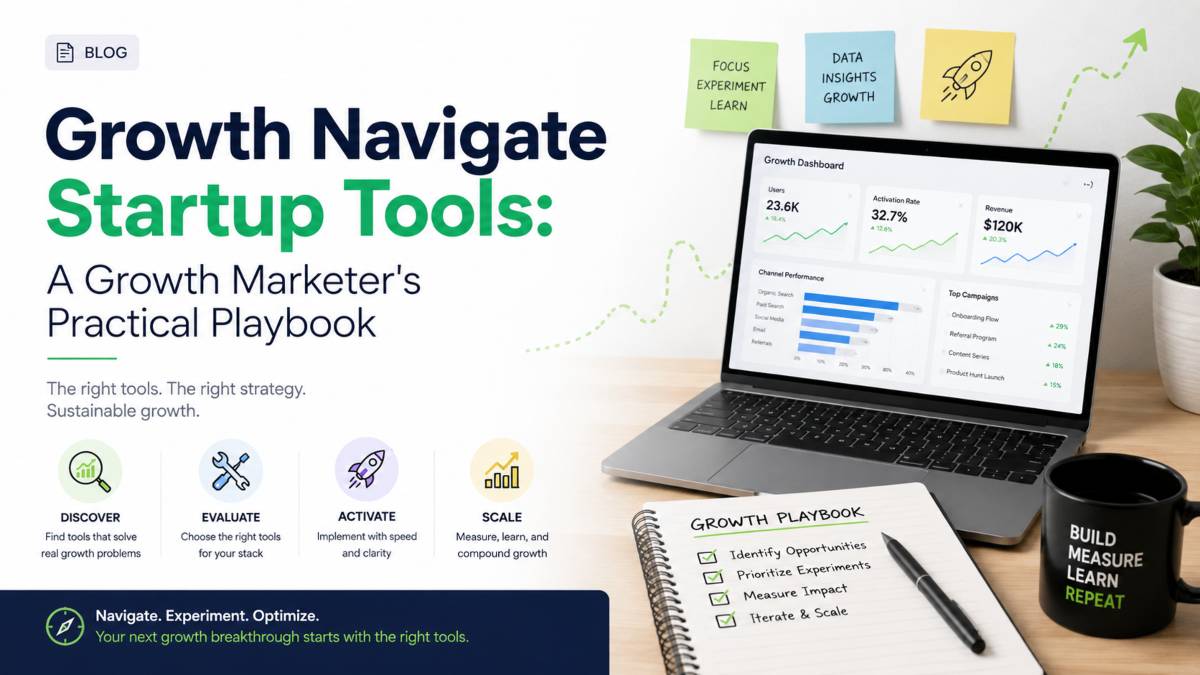
Most startups do not fail because they lacked a great idea. They fail because they could not execute. And a big part of poor execution comes down to one surprisingly common problem: the wrong tools, used at the wrong time, in the wrong order.
If you are a growth marketer at a startup, you have felt this. You sign up for five platforms in week one. By month three, you are paying for tools nobody uses, your data lives in three different places, and your conversion rate has not moved. The stack feels busy, but nothing is actually working together.
That is exactly the problem that growth navigate startup tools are designed to solve. Not by giving you more software, but by helping you build a connected, stage-appropriate system that supports real growth. In this guide, you will get a practical framework for choosing the right tools at the right time, the core categories every growth marketer needs to cover, and the mistakes that quietly kill otherwise solid stacks.
What Are Growth Navigate Startup Tools, Really?
Growth navigate startup tools are not just a category of software. The term describes the structured combination of platforms, systems, and processes that help startups move from early idea to scalable operation with measurable progress at every step.
Think of it less like a shopping list and more like an operating system. Each tool plays a specific role. Together, they handle customer acquisition, data tracking, internal communication, workflow automation, and revenue management. When they are properly connected, the whole stack produces compounding returns. When they are not, they produce noise.
Why They Are Different from Regular Business Software
Standard business software is built for stability. Growth navigate startup tools are built for speed and adaptability. They are designed for lean teams that need to move fast, test assumptions quickly, and make decisions from real data rather than gut feeling.
A traditional enterprise CRM, for example, is built around complex sales hierarchies and large teams. A startup-focused CRM is built around rapid lead capture, fast follow-up, and direct integration with your marketing channels. The feature set is not the differentiator. The design philosophy is.
The Three Jobs Every Growth Tool Must Do
Before you add any tool to your stack, it should pass a three-part test. First, it needs to reduce manual work in a specific function. Second, it needs to produce data you can actually act on. Third, it needs to integrate with at least one other tool already in your stack.
If a tool fails any one of those three tests, it creates friction instead of removing it. That is how tool chaos starts.
The Tool Chaos Problem (And Why It Is Costing You)
Here is a number worth keeping in mind: research shows that disconnected tool stacks can cost companies between 20 and 30 percent of potential revenue through data silos and manual work that automation should have handled. For a startup operating on tight margins, that is not a minor inefficiency. That is a structural problem.
Growth marketers are especially vulnerable to this trap because they sit at the intersection of marketing, product, and sales. Every team wants them to adopt their preferred tools. Before long, you are managing a dozen subscriptions that barely talk to each other.
When Having More Tools Actually Hurts Growth
More tools do not equal more growth. That sounds obvious, but it is easy to forget when a new platform promises to solve a specific pain point in five minutes. The issue is not any single tool. It is cumulative complexity.
Every new tool requires setup time, ongoing maintenance, a learning curve for your team, and a new data source to reconcile. When those costs stack up, your team spends more time managing the stack than actually using it to grow.
What a Lean, Connected Stack Looks Like
A lean stack covers one tool per core function. One CRM. One analytics platform. One automation layer. One content collaboration workspace. Each of these connects to the others so data flows in one direction without manual exports or copy-paste workflows.
The goal is not minimalism for its own sake. It is operational clarity. When every tool has a defined job and feeds into the same data layer, your team can make faster, better decisions with less effort.
How Should You Build Your Stack by Growth Stage?
This is the question most guides skip entirely. They give you a list of 25 tools and leave you to figure out where to start. The honest answer is that the right stack at pre-product-market fit looks almost nothing like the right stack at the scaling stage. Here is how to think about it.
Pre-Product-Market Fit: Keep It Minimal
Before you have confirmed that your product solves a real problem for a real audience, your job is to learn fast, not to automate. At this stage, growth navigate startup tools should be limited to the absolute essentials.
You need a way to track your website traffic and user behavior, a lightweight CRM to manage early conversations, and a basic communication tool to keep the team aligned. That is it. Adding automation, advanced analytics, or campaign management tools before you have validated your core assumptions is a waste of budget and attention.
One of the most common mistakes at this stage is automating a workflow that has not yet been proven to work. If the process itself is broken, automation just makes you fail faster.
Early Traction Stage: Add CRM and Analytics
Once you have evidence that your product has a real audience and a repeatable path to acquisition, it is time to build out the core of your growth navigate startup tools stack.
This means a proper CRM that unifies your marketing and sales data, a dedicated analytics platform that goes beyond traffic numbers to show you behavioral patterns, and a basic automation layer that handles repetitive tasks like lead follow-up sequences.
At this stage, the priority is connecting your acquisition data to your conversion data. You want to know which channels bring the leads that actually convert, not just which channels bring the most traffic. That distinction is where most growth marketers find their first real leverage point.
Scaling Stage: Automate and Optimize
At the scaling stage, your stack expands to support a larger team, more complex campaigns, and tighter feedback loops between marketing and product. Most early-stage startups can build an effective initial stack using free tiers and affordable tools for well under $200 per month. As revenue grows, paid tiers unlock the advanced automation features that make scaling genuinely efficient.
The focus here shifts from acquisition to retention and optimization. You are running A/B tests, monitoring churn signals, scoring leads, and using behavioral data to trigger personalized campaigns. Your tools need to handle volume without requiring proportional increases in headcount.
The Core Categories Every Growth Marketer Needs
Growth navigate startup tools fall into four categories that every serious growth marketer needs to cover. Each one addresses a different layer of the growth function. Together, they form a complete operating system for startup growth.
Analytics and Tracking
You cannot grow what you cannot measure. The analytics layer is the foundation of everything else in your stack, and the best combination for most data-driven startups is Google Analytics 4, Mixpanel, and Hotjar working together.
GA4 handles your web traffic, acquisition source data, and conversion funnels. Mixpanel goes deeper into product analytics, showing you how users actually behave inside your product over time. Hotjar adds the qualitative layer, giving you heatmaps and session recordings that explain the “why” behind the numbers.
Used together, these three tools give you a complete picture of what is happening, where it is happening, and why users are behaving the way they are. That combination is hard to beat at any price point.
CRM and Marketing Automation
Your CRM is the backbone of your entire customer data operation. HubSpot remains the most startup-friendly option available, offering a genuinely useful free CRM tier that covers contact management, email marketing, lead capture, and basic reporting. It is the most logical starting point for growth teams that need CRM and marketing in one place.
For teams that want deeper email marketing automation and a stronger focus on the full customer journey, ActiveCampaign is a strong alternative. It combines CRM functionality with sophisticated email sequencing and behavioral triggers, making it particularly effective for nurturing leads from first touch through conversion and into retention.
The key principle here is that your CRM should be the single source of truth for all customer data. Every other tool in your stack should be able to pull from or push to it.
Workflow Automation
Zapier is the connective tissue of a modern growth stack. It lets you build automated workflows between tools that do not have native integrations, eliminating the manual handoffs that slow teams down. A basic example: a new lead fills out a form on your website, Zapier automatically adds them to your CRM, tags them based on the page they came from, and enrolls them in the right email sequence. That entire chain runs without anyone touching it.
Notion handles the internal knowledge and project layer. It serves as a shared workspace for your team’s documentation, campaign planning, content calendars, and SOPs. For fast-moving startup teams, having a single place where context lives is underrated. It prevents the knowledge loss that happens when work is spread across Slack threads, Google Docs, and email chains simultaneously.
Content and SEO Tools
Growth marketing without content is a short game. Your content and SEO layer supports long-term acquisition by building organic visibility over time. This is where tools like Semrush or Ahrefs come in for keyword research, competitor analysis, and content gap identification.
For content production at scale, AI writing tools like Jasper have become a practical part of many startup content workflows. They are not replacements for strategy or editorial judgment, but they meaningfully reduce the time it takes to produce first drafts, ad copy, email sequences, and social content. The startups getting the most value from them treat these tools as production accelerators, not strategy substitutes.
What Makes a Startup Tool Worth Keeping?
Not every tool that looked good in a demo earns a permanent place in your stack. Growth navigate startup tools have to prove their value continuously. Here is how to evaluate whether something is worth keeping or worth cutting.
Integration Depth Over Feature Count
A tool with 50 features and poor integrations is less valuable than a tool with 10 features and seamless connections to the rest of your stack. Integration depth determines how well your data flows and how much manual work your team has to do to bridge gaps.
Before committing to any platform, map out exactly how it will connect to your CRM, your analytics setup, and your automation layer. If the integration requires a custom workaround or a third-party connector just to make basic data sharing work, that is a warning sign worth paying attention to.
The One Tool Per Function Rule
This rule is simple and worth protecting. Pick one tool per core function, and resist the temptation to add alternatives “just in case.” When two tools serve the same function, you end up with split data, inconsistent reporting, and a team that cannot agree on which number to trust.
The one-tool rule also makes your stack easier to audit. Every quarter, go through your subscriptions and ask whether each tool is actively being used, producing actionable data, and integrating properly with the rest of the stack. If the answer to any of those questions is no, you have your cut list.
Common Mistakes Growth Marketers Make With Their Stack
Even experienced growth marketers make predictable mistakes when building and managing their tool stack. Knowing what these mistakes look like makes them easier to avoid.
Automating Broken Processes
Automation does not fix a broken workflow. It amplifies it. If your lead handoff process between marketing and sales is messy and slow, automating it will just create a faster version of the same mess. The right sequence is always to fix the process first, validate that it works manually, and then automate it.
This mistake is especially common at the pre-product-market fit stage, where founders reach for automation tools before they have a reliable process worth automating. It feels productive. It rarely is.
Tracking Vanity Metrics Instead of a North Star
Page views, follower counts, and email open rates feel good to report. They rarely tell you whether your business is actually growing. The most effective growth teams pick a single North Star Metric, a number that reflects real value delivered to real customers, and orient their entire stack around tracking and improving it.
Your analytics tools, your CRM dashboards, and your reporting workflows should all be set up to surface movement on that one number first. Everything else is context, not signal.
Buying Before Validating
This is the trap that catches the most startup growth marketers. You hear about a tool in a podcast, try the demo, and add it to the stack before you have confirmed that you have the workflow it is designed to support. Three months later, the subscription is still running and nobody remembers why they signed up.
The fix is straightforward. Before adding any new tool, write down the specific problem it solves, the process it will plug into, and how you will measure whether it is working. If you cannot answer all three of those questions clearly, wait.
Conclusion
Building a growth stack is not a one-time project. It is an ongoing practice. The startups that get the most out of their growth navigate startup tools are the ones that treat their stack as a system to be maintained, not a collection of apps to be accumulated.
Three things to take away from this guide. First, match your tools to your growth stage. A pre-PMF startup and a scaling startup need very different stacks, and the distinction matters more than most people realize. Second, tools amplify your strategy but they do not replace it. A well-connected CRM and a solid analytics setup will not save a product that people do not want. But they will dramatically accelerate growth for a product that people do. Third, keep it lean. One tool per function, connected intentionally, reviewed regularly.
Pick one tool from this guide and actually set it up this week. Start with GA4 if you have nothing tracking yet. Start with HubSpot if your customer data is scattered. The best stack is not the most complete one. It is the one you are actually using.
What tools are currently in your growth stack? Drop a comment and let us know what is working.
Read Also: Why Is Uhoebeans Software Update So Slow? Causes, Fixes, and Solutions