Most SEO work starts with a guess. What are people searching for. What do they expect to find. What will make them stay. Sometimes you get it right. Often you do not. That gap between assumption and reality is where performance slips.
If you want to understand how surveys can improve SEO, the shift is simple. You stop guessing and start listening. Real users tell you what they need, what confused them, and what is missing. That kind of input gives you direction you cannot get from tools alone.
This is where smarter decisions begin. Surveys help you shape content, refine topics, and improve the way your pages work for actual visitors. Instead of chasing rankings blindly, you build pages that match what people are already looking for.
Why Surveys Matter for SEO
Most SEO decisions are built on patterns and tools. Useful, but still indirect. Surveys for SEO shift the focus to something more reliable. Real user feedback for SEO gives you direct input from the people you are trying to reach. That changes how you plan, write, and improve your content.
From Assumptions to Real User Data
Without feedback, you are filling gaps with guesses. You assume what users want, how they search, and what they expect to see. Surveys remove that guesswork. You hear the exact words people use, the questions they still have, and the points where your content falls short. As highlighted in the Applabx guide, this kind of input helps you adjust content based on reality, not assumption.
How Surveys Influence SEO Signals
Search engines track how people interact with your pages. Do they stay, leave, or scroll through. Surveys help you understand why those actions happen. If users say a page did not answer their question, you can fix it. When content improves, engagement follows. People stay longer, explore more, and interact with your site in a way that supports stronger performance.
Surveys as a Hidden SEO Advantage
Surveys are not a direct ranking factor, but they influence the signals that matter. Better content, clearer structure, and smoother user experience all come from understanding your audience. That is the edge. While others rely on guesswork, you build pages based on what users actually need.
How Surveys Help You Understand Search Intent
Search intent is the difference between a click and a bounce. You can rank well and still lose the visitor if your page does not match what they expected. This is where surveys give you real search intent insights, not guesses pulled from tools.
What Users Expected vs What They Found
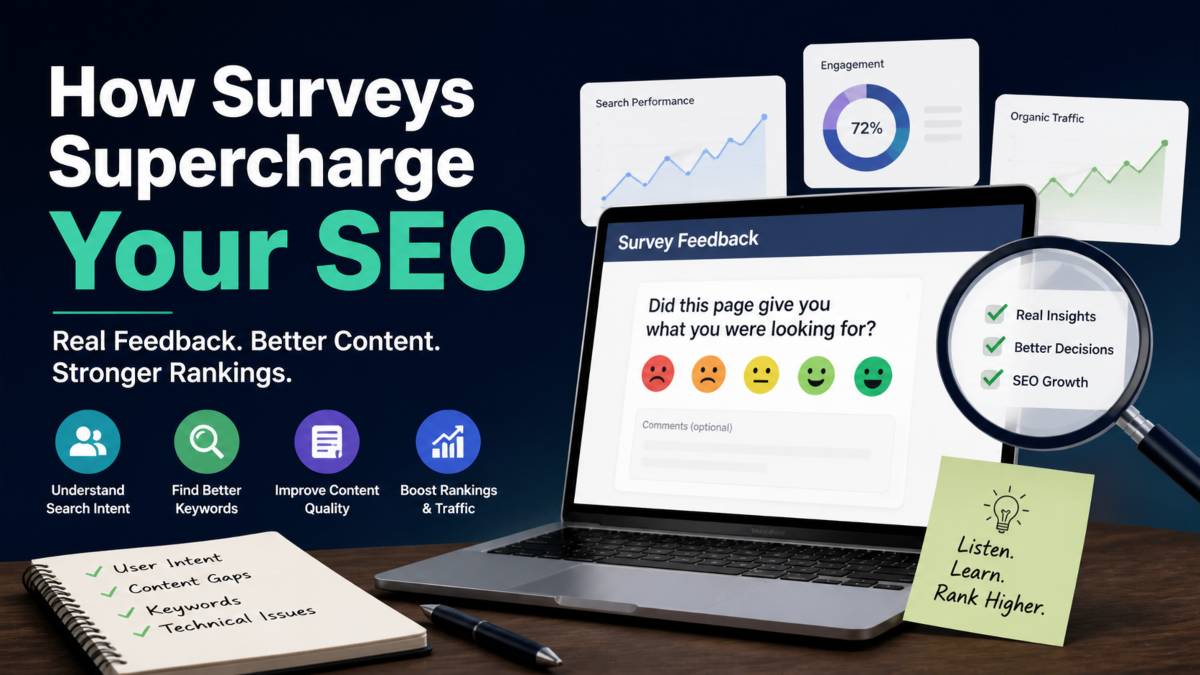
When someone lands on your page, they already have a goal in mind. Surveys let you ask a simple question. Did this page give you what you were looking for. The answers expose the gap between expectation and reality. As noted in Semrush resources, this gap is often the reason users leave quickly, even when the content looks solid on the surface.
Fixing Mismatched Content
Once you see where the mismatch happens, you can fix it with precision. Maybe your headline promises one thing but the content delivers something else. Maybe key details are buried too deep. Adjust your structure, rewrite headings, and add missing sections so the page matches what users came for. Small changes here can shift how the entire page performs.
Improving Click and Engagement Metrics
When content matches intent, behavior changes. People stay longer, scroll further, and interact more. This sends strong signals that your page is useful. Over time, better alignment leads to stronger engagement, which supports better performance in search results.
Discover Real Keywords From Real People
Keyword tools show patterns. Surveys show language. That difference matters more than most people realize. Long tail keywords research becomes far more accurate when it comes straight from how your audience speaks, not how tools predict they might.
How Users Naturally Describe Problems
When people answer a survey, they do not think about SEO. They explain their problem in plain words. That raw language is gold. It shows how they search, what they care about, and how they frame their questions. These phrases often match real search queries more closely than polished keyword lists.
Finding Long Tail Opportunities
Short keywords are crowded. Long tail phrases carry intent. Survey responses reveal specific needs like how to fix a slow checkout page or why pricing feels confusing. These phrases may not have massive volume, but they attract the right visitors. The ones ready to engage, not just browse.
Turning Responses Into SEO Topics
This is where it becomes practical. Group similar responses together and turn them into content. One cluster becomes a blog post. Another turns into a landing page. Repeated questions shape your FAQ section. Instead of guessing what to write next, you build content directly from what your audience is already asking.
Improve Content Quality Using Survey Feedback
Content rarely fails because of effort. It fails because it misses the mark. Content optimization SEO becomes sharper when you stop relying on instinct and start using feedback from real users. Surveys show you exactly where your content works and where it falls short.
Identify Weak or Confusing Content
Sometimes a page looks complete but still leaves readers lost. Surveys reveal those friction points fast. Users will tell you when something feels unclear, too basic, or too dense. Instead of guessing which section needs fixing, you can pinpoint the exact part that breaks the flow and tighten it.
Fill Missing Information Gaps
One of the most common issues is missing detail. A user comes looking for one answer and leaves with half of it. Survey responses highlight what is not being covered. Maybe it is pricing, examples, or step by step clarity. Adding these missing pieces turns an average page into one that actually satisfies the reader.
Update Existing Pages Instead of Guessing
You do not always need new content. Often, your best move is improving what you already have. Survey feedback gives you a clear direction for updates. Adjust sections, expand key points, and refine your structure based on what users ask for. This keeps your content relevant and aligned with real needs instead of assumptions.
Use Surveys to Improve User Experience
User experience is not a design choice. It is how people feel when they move through your site. If something slows them down or confuses them, they leave. That behavior feeds directly into user experience signals, which influence how your pages perform in search.
Spot Navigation and Design Issues
Analytics can show where users drop off, but not always why. Surveys fill that gap. Users will tell you when menus feel messy, links are hard to find, or pages look cluttered. These are issues you might miss if you only rely on data. Once you fix them, the path through your site becomes smoother.
Reduce Bounce and Increase Time on Page
When users find what they need quickly, they stay. When they do not, they leave. Surveys help you understand what is missing or hard to follow. By adjusting layout, improving readability, and making key information easier to access, you give users a reason to keep exploring. Longer visits and deeper engagement send positive signals about your content.
Fix Friction Before It Hurts Rankings
Small issues build up over time. Slow sections, confusing wording, or unclear next steps all create friction. Surveys bring these problems to the surface early. Fixing them improves the overall experience and keeps users engaged. When users interact more smoothly with your site, it supports stronger performance in search without needing guesswork.
Find Technical Issues You Might Miss
Not every problem shows up in a dashboard. Some issues only appear when real users run into them. This is where technical SEO feedback from surveys becomes useful. It gives you a view of problems that numbers alone do not explain.
Broken Links and Page Errors
A user clicks a link and lands on a dead page. That moment matters. Surveys can capture these experiences quickly. Someone reports a page not loading or a link going nowhere. You fix it fast and prevent more users from hitting the same wall.
Mobile and Speed Issues
A page might look fine on desktop but feel slow or awkward on a phone. Users will point it out. They will mention slow loading, layout issues, or buttons that do not respond well. These details help you adjust your pages so they work smoothly across devices.
Usability Problems Analytics Cannot Show
Analytics can tell you where users leave. It cannot always tell you what confused them. Surveys fill that gap. Users explain what felt unclear, hard to use, or frustrating. That insight helps you clean up issues that would otherwise keep affecting performance without a clear cause.
Turn Survey Data Into Link Worthy Content
Most content repeats what is already out there. That is why it gets ignored. When you use surveys, you create something different. Original data content SEO gives you material no one else has, and that makes your content far more useful and shareable.
Create Original Research Reports
Survey your audience and turn the results into a clear report. Focus on one topic and present real numbers, trends, and patterns. Even a small data set can reveal useful insights if the topic is relevant. As highlighted in Semrush resources, original research stands out because it gives readers something new to reference.
Publish Data Driven Blog Posts
You do not need a full report every time. Break your survey results into smaller pieces and turn them into blog posts. One post can focus on a key finding. Another can explore a specific trend. Use simple charts or summaries to make the data easy to understand. This keeps your content fresh while staying grounded in real input.
Attract Backlinks With Unique Insights
Writers, marketers, and researchers look for data they can cite. When your content includes original findings, it becomes a source others refer to. That is how backlinks happen naturally. Instead of chasing links, you create something worth linking to, and that strengthens your presence in search over time.
Practical Ways to Use Surveys for SEO
Surveys only work if you use them in the right places. Keep them simple, place them where users already interact, and focus on questions that lead to clear action. On site surveys SEO is less about collecting data and more about turning that data into changes that improve performance.
Add Quick On Page Feedback Questions
Start with short questions directly on your pages. Ask something simple like did this page answer your question. This gives instant feedback on whether your content matches user intent. If many users say no, you know the page needs adjustment right away.
Use Email Surveys to Plan Content
Your email list is a direct line to your audience. Ask them what they want to learn next or what they find confusing. Their answers can shape your next set of blog posts, guides, or landing pages. This removes guesswork from content planning and keeps your topics relevant.
Turn Feedback Into New Pages and Updates
The real value comes from action. If users say they expected pricing details on a page but did not find them, you can add a pricing section or create a dedicated page. This kind of update improves clarity and keeps users from leaving to search elsewhere. Small changes based on feedback can improve how users interact with your content and how it performs over time.
Common Mistakes When Using Surveys for SEO
Surveys can sharpen your SEO. Or waste your time. The difference comes down to how you use them. Most mistakes are simple and easy to avoid if you pay attention.
Asking Vague Questions
If your questions are unclear, your answers will be useless. Asking something like what do you think gives you noise, not direction. Be specific. Ask what was missing, what confused them, or what they expected to see. Clear questions lead to answers you can act on.
Ignoring the Data You Collect
Collecting feedback and doing nothing with it is a dead end. Many teams gather responses, glance at them, then move on. That defeats the purpose. Patterns in feedback show where your content or site needs work. If you ignore that, nothing improves.
Collecting Feedback Without Action
Data alone does not change performance. Action does. If users point out gaps, fix them. If they highlight weak sections, rewrite them. Feedback only matters when it leads to updates. Without that step, surveys become another task with no real impact.
Final Thoughts
Good SEO is not about guessing better. It is about knowing more. Surveys give you that edge. They show what people actually want, not what you assume they want.
Use that insight. Fix what feels off. Expand what works. Shape your content around real questions and real language.
Start small. Add one question to a page. Send one short survey. Then act on what you learn.
That is how SEO stops feeling uncertain and starts working with purpose.