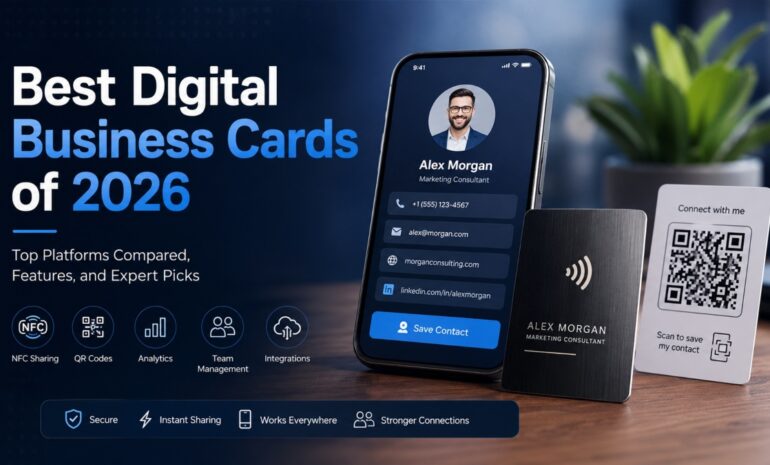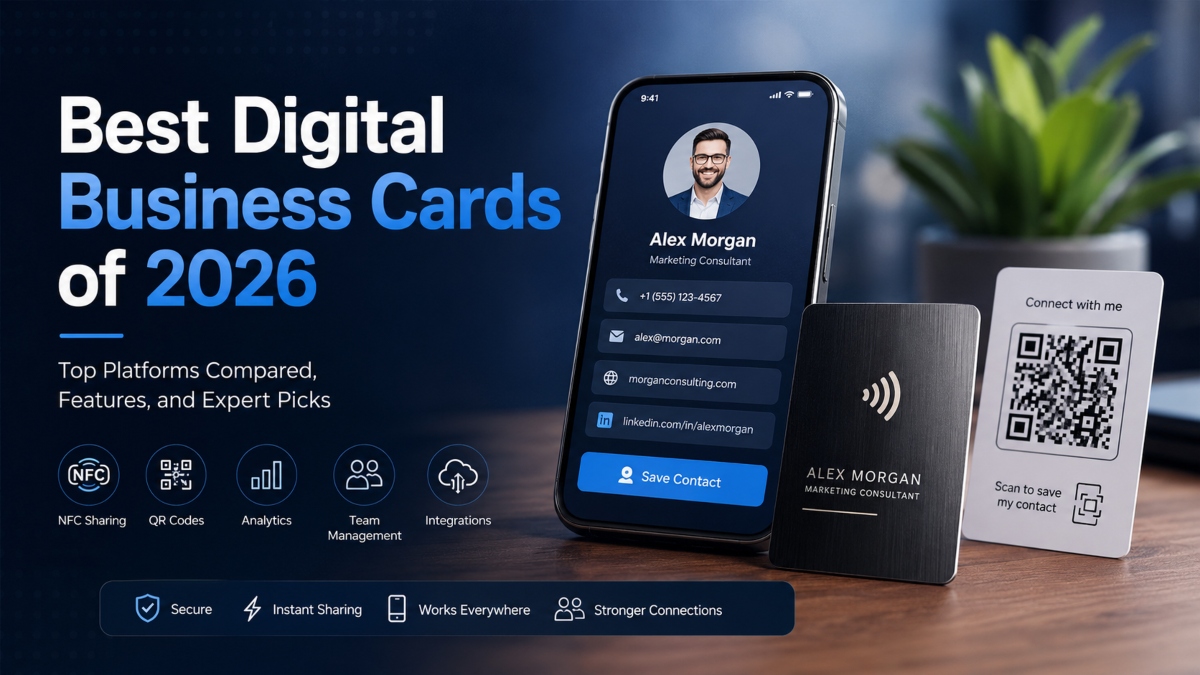
Paper business cards still exist, but their grip on modern networking is slipping fast. In 2026, professionals want something quicker, smarter, and easier to update without printing hundreds of cards every few months. That shift has pushed digital business cards into the spotlight, turning simple contact sharing into a polished networking experience built for phones, remote work, and real time connections.
The best digital business card solutions for 2026 do far more than display a name and number. Many now include NFC business cards for tap to share convenience, QR codes for instant access, CRM sync for lead management, and mobile sharing tools that work across devices. Whether someone meets you at a conference, coffee shop, or virtual event, your details can land on their phone within seconds.
This guide is designed for freelancers building personal brands, startups chasing faster growth, sales teams managing leads, enterprises handling large scale networking, and creators who want visually polished digital profiles. Some platforms focus on simplicity and speed, while others offer analytics, branding controls, and advanced integrations for larger organizations.
From NFC enabled cards to QR powered networking tools, today’s digital business cards are no longer a novelty. They are becoming part of how modern business relationships begin.
Why Digital Business Cards Matter in 2026
The Shift From Paper to Digital Networking
Traditional paper cards once carried a certain charm. A thick finish, embossed logo, and premium design used to leave an impression across boardrooms and networking events. In 2026, though, business communication moves much faster than print ever could. Professionals now expect instant access, real time updates, and mobile friendly experiences that fit naturally into everyday interactions.
Digital business cards answer that demand perfectly. Instead of reprinting stacks of outdated cards after every job title change, phone number update, or rebrand, users can edit their details instantly. One update refreshes every shared profile across devices and platforms.
Sustainability also plays a major part in this shift. Companies looking to cut waste and reduce printing costs are replacing paper cards with electronic business cards that live entirely online. It saves money, reduces clutter, and keeps networking cleaner and more efficient.
Another reason behind the rise of digital networking tools is the way people communicate today. Meetings happen through smartphones, remote work is common, and quick mobile interactions matter more than ever. A smart business card fits directly into that lifestyle, making contact sharing feel seamless rather than forced.
Key Features Modern Professionals Need
The latest digital business cards are built for speed, convenience, and smarter networking. QR code sharing allows users to exchange contact details instantly with a quick scan, while NFC tap technology creates a frictionless experience during in person meetings and events.
CRM integrations have also become essential for sales professionals and growing businesses. Instead of manually entering leads after an event, contacts can move directly into platforms like HubSpot or Salesforce. This keeps follow ups faster and more organized.
Analytics tracking adds another layer of value. Users can see how often their card is viewed, tapped, or shared, giving businesses clearer insight into networking performance. Apple Wallet support and mobile wallet compatibility also make sharing more convenient since users can keep their digital identity ready at all times.
Benefits for Teams and Businesses
For companies managing multiple employees, digital business cards create consistency across every interaction. Branding stays uniform across departments, offices, and sales teams without the hassle of constant reprints.
Lead capture tools also make networking more valuable. Teams can collect customer information quickly and organize contacts without losing potential opportunities. Centralized management gives businesses control over updates, permissions, and employee profiles from one dashboard, making large scale networking far easier to handle in 2026.
How We Evaluated the Best Digital Business Card Platforms
Choosing the right digital business card platform is no longer just about sharing contact details. In 2026, businesses and professionals expect smarter networking tools that combine convenience, branding, automation, and data tracking in one place. To create this guide, we reviewed the most talked about platforms, compared feature sets, studied real user feedback, and analyzed how each solution performs across different professional needs.
Rather than focusing only on popularity, this comparison looks at practical everyday value. Some platforms work better for solo professionals who want quick setup and affordable pricing, while others are built for large organizations managing hundreds of employees and customer interactions.
Evaluation Criteria
Each platform was reviewed using several core factors that matter most to modern professionals and businesses.
Pricing played a major role, especially for freelancers and startups working within tighter budgets. Ease of use was equally important because digital networking should feel fast and intuitive rather than complicated.
We also examined integrations with CRM systems, email tools, and productivity platforms since many businesses rely on automated workflows to manage leads and customer relationships. Analytics features were compared to see which platforms provide useful tracking data for engagement and networking performance.
Customization options were another key factor. Strong digital business cards should allow users to personalize branding, layouts, colors, links, and profile experiences without technical hurdles. Security also mattered heavily, particularly for enterprise users handling sensitive contact information and team wide access controls.
Who This Guide Is Designed For
This guide is built for freelancers looking for affordable and flexible networking tools, marketers who need lead generation support, enterprise teams managing large scale branding, and creatives who want visually polished digital profiles that reflect their work and personality.
Whether you need simple contact sharing or a full business networking system with analytics and CRM support, this comparison breaks down which platforms deliver the strongest value in 2026.
Best Digital Business Card Solutions for 2026
The market for digital business cards has exploded over the past few years. What started as a simple replacement for paper cards has evolved into a complete networking ecosystem packed with NFC sharing, QR codes, CRM syncing, analytics, and branding tools. In 2026, professionals are no longer asking whether they need digital business cards. They are asking which platform delivers the best mix of usability, customization, and long term value.
Some platforms focus on speed and simplicity for freelancers, while others target enterprise teams that need centralized management and detailed analytics. The best choice depends on how you network, how large your team is, and how much control you want over branding and integrations.
2026 Top Picks at a Glance
| Platform | Best For | Key Features | Free Plan | NFC Support | CRM Integrations |
|---|---|---|---|---|---|
| Wave Connect | Professionals and freelancers | QR sharing, wallet support, unlimited contacts, analytics | Yes | Yes | Yes |
| Mobilo | Teams and enterprises | NFC cards, analytics dashboard, team management | Limited | Yes | Yes |
| HiHello | Simplicity and ease of use | No app sharing, address sync, email signatures | Yes | Limited | Yes |
| Popl | NFC customization | Custom landing pages, branded profiles, integrations | Yes | Yes | Yes |
| Blinq | Freelancers and quick networking | QR sharing, Apple Watch support, minimal setup | Yes | Limited | Basic |
| Uniqode | QR analytics and enterprise use | Advanced tracking, custom domains, security features | Trial | No | Yes |
| mTap | NFC hardware lovers | Tap to share cards, keychains, analytics | Limited | Yes | Basic |
| wCard.io | Creatives and portfolios | Video embeds, portfolio displays, branding tools | Limited | No | Basic |
Wave Connect: Best Overall for Professionals
Wave Connect has become one of the strongest all around digital business card platforms for 2026. It strikes a smart balance between affordability, functionality, and ease of use, making it a strong fit for freelancers, consultants, startups, and even growing teams.
One of its biggest advantages is the free plan. Users get unlimited contact storage, QR code sharing, Apple Wallet compatibility, and Google Wallet support without feeling boxed into aggressive restrictions. That makes it especially attractive for professionals testing digital networking tools for the first time.
Wave also performs well when it comes to integrations. CRM syncing allows sales professionals to move leads directly into their workflows without manually entering contact information after meetings or events. The platform also includes lead capture modes and analytics tools for users who want deeper networking insights.
Security matters more than ever in modern networking, and Wave’s SOC 2 compliance gives businesses additional confidence when handling contact information. For professionals looking for flexibility without enterprise level pricing, Wave Connect remains one of the best digital business card solutions for 2026.
Mobilo: Best for Teams and Enterprises
Mobilo focuses heavily on large scale networking and business management. While many digital business cards target solo users, Mobilo is designed for organizations that need structured branding, analytics, and employee management across entire teams.
Its NFC products stand out immediately. Companies can deploy customized cards to employees while managing everything from a central dashboard. Bulk provisioning saves time during onboarding, while administrators can update employee details instantly without replacing physical cards.
Mobilo also performs strongly in the analytics department. Businesses can track engagement, monitor lead activity, and measure networking performance across departments. That level of visibility becomes extremely valuable for sales organizations and marketing teams attending conferences or managing field staff.
The platform integrates with popular CRM systems and business tools, helping organizations keep networking data connected to larger sales and customer pipelines. For enterprises that need scalable digital networking tools with strong branding control, Mobilo remains a serious contender.
HiHello: Best for Simplicity
Not everyone wants a feature heavy platform loaded with advanced analytics and customization options. Some professionals simply need fast, clean, reliable contact sharing. That is where HiHello shines.
HiHello offers one of the easiest onboarding experiences in the digital business card market. Users can create a profile quickly, customize basic details, and begin sharing almost immediately. The no app sharing feature is especially useful because recipients can access contact information directly through a browser without installing extra software.
The platform also includes useful extras such as address book syncing and email signature generation. These small touches make everyday networking smoother for consultants, recruiters, and remote workers who exchange contact details constantly.
HiHello works best for professionals who value convenience over complexity. It may not offer the deepest analytics or branding controls, but its simplicity is exactly why many users prefer it.
Popl: Best for NFC Customization
Popl built its reputation around NFC networking products, and in 2026 it still leads the category for customization and product variety. The platform offers NFC cards, phone tags, badges, wristbands, and several other physical networking tools designed for modern professionals and event heavy industries.
Where Popl truly separates itself is customization. Users can build highly branded digital landing pages packed with social links, contact information, booking options, videos, and portfolio content. That makes it attractive for creators, agencies, influencers, and entrepreneurs who treat networking as part of their brand identity.
The platform also supports CRM integrations and lead collection features, helping users turn networking moments into actual business opportunities. While the free plan comes with limitations, Popl offers strong value for professionals who want visually polished smart business cards with deeper personalization.
For networking focused professionals who want a more premium feel, Popl remains one of the most recognizable names in electronic business cards.
Blinq: Best for Freelancers and Fast Sharing
Blinq takes the opposite approach from feature packed enterprise platforms. Its focus is speed, simplicity, and friction free sharing. That makes it a favorite among freelancers, independent consultants, and professionals who move quickly between meetings and events.
The interface is clean and minimal, allowing users to create and share a digital profile within minutes. QR code sharing works smoothly, and the Apple Watch widget adds another layer of convenience for mobile users.
Blinq may not include enterprise level analytics or advanced team management, but it performs extremely well for quick networking situations where speed matters more than data tracking. For solo professionals looking for affordable digital networking tools without unnecessary complexity, Blinq is a practical choice.
Uniqode: Best for Analytics and QR Tracking
Uniqode approaches digital business cards from a data and analytics perspective. While some platforms focus heavily on NFC products, Uniqode specializes in QR based networking with advanced tracking capabilities built for larger organizations.
Businesses can monitor scans, track engagement, create branded QR experiences, and even use custom domains for a more professional appearance. Those features make Uniqode especially useful for enterprise marketing campaigns, conferences, and customer facing events where measurable engagement matters.
The platform also integrates well with CRM systems and automation tools, allowing companies to build stronger lead tracking workflows. Security and scalability remain major strengths, which is why many enterprise users lean toward Uniqode for larger deployments.
For individuals, the platform may feel more advanced than necessary. For businesses focused on analytics and centralized networking management, however, Uniqode offers serious value.
Best Niche Alternatives Worth Considering
Several smaller platforms also deserve attention because they focus on specific networking needs that larger competitors sometimes overlook.
mTap stands out for its NFC hardware products, including customizable cards and keychains designed for quick tap based sharing. It works well for professionals who want physical networking tools without excessive software complexity.
Kado leans more heavily into branding and lead capture features, making it appealing for marketing focused users who want polished client interactions.
Haystack focuses on business sustainability and streamlined contact management. It also offers useful card scanning and automatic update features that reduce manual work for teams.
wCard.io is one of the strongest options for creatives. The platform supports embedded videos, portfolio displays, and visual presentation tools that help designers, photographers, and creators showcase their work directly inside their digital profile.
These niche platforms may not dominate mainstream rankings, but they offer strong value for users with highly specific networking goals.
Wave Connect: Best Overall for Professionals
Wave Connect has positioned itself as one of the strongest all around platforms in the digital networking space, especially for professionals who want premium features without jumping into expensive enterprise pricing. In 2026, the platform continues to attract freelancers, consultants, startups, and growing businesses looking for a reliable and scalable solution.
One reason Wave Connect stands out is its generous free plan. Unlike many competitors that lock important features behind paywalls, Wave offers unlimited contact storage, QR code sharing, and mobile wallet compatibility at no cost. Users can add their profiles directly to Apple Wallet or Google Wallet, making contact sharing feel smooth during meetings, conferences, and networking events.
For professionals who rely heavily on relationship building, CRM integrations add another layer of convenience. Contacts collected through the platform can move directly into sales and customer management systems, helping users avoid the tedious process of manual data entry. This makes Wave Connect especially attractive for sales consultants, recruiters, and business development teams that handle large numbers of leads.
Security is another area where the platform earns trust. Wave Connect includes SOC 2 security standards, giving businesses stronger protection for contact data and professional information. That added layer of reliability matters more as digital networking becomes part of everyday business operations.
The platform also keeps the overall user experience clean and accessible. Setup is quick, sharing tools work smoothly across devices, and the interface avoids unnecessary clutter. For anyone searching for a free digital business card app with room to grow over time, Wave Connect delivers one of the most balanced packages available today.
Among the many digital business cards for professionals available in 2026, Wave Connect continues to stand out because it combines affordability, simplicity, and business ready functionality in one polished platform.
Mobilo: Best for Teams and Enterprises
Mobilo has carved out a strong position in the market by focusing heavily on business scalability and team management. While many digital card platforms cater primarily to solo professionals, Mobilo is built for organizations that need structured networking systems, centralized control, and consistent branding across large teams.
One of Mobilo’s strongest features is bulk provisioning. Instead of manually setting up digital profiles one by one, companies can create and deploy cards for entire departments from a single dashboard. This saves valuable time during onboarding and makes updates much easier when employee information changes.
The platform also includes a detailed analytics dashboard that gives businesses deeper insight into networking performance. Teams can track card taps, profile visits, lead engagement, and contact activity in real time. For sales organizations attending trade shows, conferences, or client meetings, these insights help measure networking effectiveness more accurately.
Mobilo’s NFC hardware lineup is another major reason businesses choose the platform. Companies can customize physical NFC cards that instantly share digital profiles with a simple tap. The hardware feels polished and professional, making it especially useful for client facing employees and executive teams.
Enterprise integrations further strengthen Mobilo’s appeal. The platform connects with CRM systems and business productivity tools, helping organizations streamline lead management and customer follow ups without relying on manual data entry. This creates a smoother workflow between networking and sales operations.
For businesses searching for enterprise digital business cards with advanced management features, Mobilo offers one of the most complete solutions available in 2026. Its mix of analytics, branding control, NFC technology, and centralized administration makes it a strong choice for companies that view networking as a serious part of business growth.
Among modern team business card solutions, Mobilo stands out because it combines professional presentation with enterprise level functionality built for scale.
HiHello: Best for Simplicity
HiHello has built its reputation around one idea: digital networking should feel effortless. While some platforms overload users with advanced tools and complex dashboards, HiHello keeps the experience clean, fast, and easy to understand. That simplicity is exactly why it remains one of the most popular choices for professionals who want practical networking without a steep learning curve.
The platform is especially appealing for first time users entering the world of digital business cards. Setup takes only a few minutes, allowing users to create a polished profile without technical knowledge or design experience. The interface feels modern and uncluttered, helping users focus on sharing information instead of navigating confusing menus.
One of HiHello’s strongest features is no app sharing. Recipients can open a digital card directly through a browser without downloading additional software, which removes friction during networking conversations. Whether someone connects through QR codes, text messages, email, or direct links, the process feels smooth and immediate.
The platform also includes address book sync functionality that automatically updates saved contacts when information changes. This small but valuable feature helps professionals avoid outdated phone numbers, job titles, or email addresses over time.
HiHello works particularly well for consultants, recruiters, remote workers, and freelancers who need quick and reliable networking tools without enterprise level complexity. It may not offer the deepest analytics or advanced branding controls, but its simplicity is part of the appeal.
For users searching for easy digital business cards that work straight out of the box, HiHello delivers a polished experience with very little setup hassle. Among the growing number of simple business card apps available in 2026, it remains one of the easiest platforms to adopt and use daily.
Popl: Best for NFC Customization
Popl has become one of the most recognizable names in the digital networking space, largely because of its strong focus on NFC technology and personalized branding. For professionals who want more than a simple contact card, Popl delivers a highly customizable experience that blends physical networking tools with polished digital presentation.
One of the platform’s biggest strengths is its wide NFC product range. Users can choose from NFC cards, phone tags, wristbands, badges, and other tap to share products designed for conferences, meetings, and events. This flexibility gives professionals more ways to connect in person while keeping the networking experience fast and modern.
Popl also stands out for its customizable landing pages. Instead of sharing only basic contact information, users can build branded digital profiles filled with social media links, websites, videos, booking pages, payment links, and portfolio content. This creates a more dynamic networking experience that feels personal rather than generic.
For creators, agencies, entrepreneurs, and influencers, that level of customization matters. A digital business card is no longer just a networking tool. It becomes part of a broader personal brand strategy.
The platform also includes strong integrations with CRM systems, marketing tools, and lead capture platforms. This makes Popl useful not only for networking but also for sales follow ups and customer engagement workflows. Contacts gathered through events or meetings can move directly into business systems without additional manual work.
While Popl’s premium features may come at a higher price point than some competitors, the platform offers strong value for users who care deeply about presentation and flexibility. Among customizable NFC business cards available in 2026, Popl continues to lead the conversation with its mix of hardware variety, personalization, and modern networking features.
For professionals looking to create visually polished branded digital profiles that leave a memorable impression, Popl remains one of the strongest options on the market.
Blinq: Best for Freelancers and Fast Sharing
Blinq has gained popularity by doing something many digital platforms struggle with: keeping things simple without feeling limited. In a market filled with feature packed dashboards and complicated workflows, Blinq focuses on speed, ease, and clean design. That approach makes it especially attractive for freelancers, consultants, and independent professionals who want networking tools that work instantly.
The platform’s minimalist setup is one of its biggest advantages. Users can create a polished digital profile within minutes, customize essential details, and begin sharing immediately. The interface feels lightweight and uncluttered, which helps reduce friction during fast paced networking situations.
Quick QR sharing sits at the center of the Blinq experience. Instead of exchanging paper cards or manually typing contact details, users can share profiles instantly through scannable QR codes that work smoothly across smartphones and tablets. This makes networking feel faster and more natural during events, meetings, or casual introductions.
Blinq also offers Apple Watch support, giving users another convenient way to access and display their digital card on the move. For professionals constantly switching between meetings, conferences, and client interactions, that extra level of accessibility adds real value.
While the platform does not focus heavily on enterprise analytics or advanced CRM management, it performs exceptionally well for individuals who prioritize convenience and mobility. Freelancers, remote workers, creators, and startup founders often prefer tools that remove unnecessary complexity, and Blinq fits that need perfectly.
Among modern freelancer networking tools, Blinq stands out because it keeps digital networking quick, portable, and stress free. For users searching for reliable QR business card apps that deliver speed without sacrificing professionalism, it remains one of the strongest lightweight platforms available in 2026.
Uniqode: Best for Analytics and QR Tracking
Uniqode approaches digital networking from a data driven perspective, making it one of the strongest options for businesses that care about tracking engagement and measuring networking performance. While some platforms focus heavily on NFC hardware and visual customization, Uniqode places QR technology and analytics at the center of its ecosystem.
The platform is built around a QR first structure that allows businesses to create dynamic digital profiles with advanced tracking capabilities. Instead of simply sharing contact details, users can monitor how people interact with their digital cards, how often scans happen, and which campaigns or events generate the strongest engagement.
One of Uniqode’s biggest strengths is its scan analytics system. Businesses can access detailed reporting that helps teams understand networking activity in real time. This level of visibility becomes especially valuable during trade shows, conferences, marketing campaigns, and sales events where measurable results matter.
Custom domains add another layer of professionalism and branding control. Companies can create branded links and QR experiences that align with their identity rather than relying on generic URLs. This helps businesses maintain a more polished digital presence while improving trust during customer interactions.
Uniqode also performs well when it comes to enterprise scaling. Large organizations can manage multiple users, monitor performance across departments, and maintain centralized control over digital networking assets from a single platform. Combined with CRM integrations and workflow automation, the platform fits naturally into larger business systems.
For enterprises looking beyond simple contact sharing, Uniqode delivers strong value through analytics, scalability, and data visibility. Among the growing number of QR code business cards available in 2026, it remains one of the top choices for organizations that want measurable networking performance rather than basic digital profiles alone.
When it comes to business card analytics tools, few platforms match Uniqode’s balance of tracking capabilities, branding control, and enterprise ready infrastructure.
Best Niche Alternatives Worth Considering
While major platforms like Wave, Mobilo, and Popl dominate most conversations around digital business cards, several smaller players bring unique strengths that deserve attention. These niche platforms often focus on specific networking styles, creative workflows, or branding needs that larger platforms may overlook.
For professionals with specialized goals, these alternatives can sometimes deliver a better overall experience than mainstream options.
mTap: Best for NFC Hardware
mTap focuses heavily on physical NFC networking products designed for professionals who prefer a more tactile experience. The platform offers customizable NFC cards, keychains, and tap enabled accessories that make contact sharing feel fast and modern during in person interactions.
Its setup process remains relatively simple, making it a practical option for users who want NFC functionality without dealing with overly complex software systems. While the analytics and integrations may not match enterprise focused competitors, mTap performs well for professionals who prioritize hardware quality and quick sharing.
For users searching for reliable NFC networking tools with straightforward functionality, mTap remains a strong niche option in 2026.
Kado: Best for Branding and Lead Capture
Kado positions itself as a networking platform built for stronger business relationships and polished branding experiences. The platform includes lead capture tools, profile customization, and integrations designed to help professionals move networking conversations into actual sales opportunities.
Its clean presentation and branding flexibility make it especially useful for agencies, consultants, and marketing focused professionals who care about how their digital identity appears during client interactions.
Kado also puts emphasis on follow up workflows, helping users organize leads more efficiently after conferences, meetings, and networking events.
Haystack: Best for Sustainability and Team Updates
Haystack takes a practical approach to digital networking with a strong focus on sustainability and team management. Businesses can create digital profiles for employees while maintaining centralized updates across the organization.
One useful feature is automatic contact updating, which helps keep saved details current without requiring constant manual edits. This reduces outdated information and improves long term networking accuracy.
Haystack works particularly well for companies looking to reduce paper waste while keeping employee branding consistent across teams.
wCard.io: Best for Creatives
wCard.io stands out as one of the strongest choices for designers, photographers, creators, and visual professionals. Unlike more corporate focused platforms, wCard.io puts visual presentation at the center of the networking experience.
Users can embed videos, showcase portfolios, display creative work, and build more visually engaging profiles that feel closer to personal websites than traditional business cards. This creates a stronger first impression for creative industries where presentation matters just as much as contact details.
For freelancers, artists, and agencies trying to stand apart visually, wCard.io offers a more expressive alternative to standard digital business card platforms.
Digital Business Card Solutions Comparison
Choosing the right digital business card platform depends heavily on how you network and what features matter most to your workflow. Some users want a simple free tool for sharing contact information quickly, while others need enterprise analytics, CRM syncing, and team management features. The strongest platforms in 2026 separate themselves by focusing on specific professional needs rather than trying to serve everyone in the same way.
Best Free Option: Wave Connect
Wave Connect remains one of the best free digital business card platforms available today. Its free plan includes features that many competitors reserve for premium tiers, including unlimited contact storage, QR sharing, wallet compatibility, and useful integrations.
For freelancers, consultants, and small business owners, Wave delivers strong everyday functionality without creating pressure to upgrade immediately. Users searching for Wave vs Popl comparisons often prefer Wave when affordability and simplicity matter more than advanced customization.
Best Enterprise Platform: Mobilo or Uniqode
Mobilo and Uniqode lead the enterprise category for different reasons. Mobilo stands out through NFC hardware, bulk provisioning, and centralized team management, making it ideal for organizations deploying cards across large departments.
Uniqode, meanwhile, focuses more heavily on QR tracking, analytics, and enterprise scaling. Businesses that care deeply about engagement reporting and lead tracking often lean toward Uniqode because of its advanced analytics tools.
When comparing Mobilo vs HiHello, the biggest difference comes down to scale. HiHello works well for individuals and small teams, while Mobilo is built for larger organizations managing structured networking systems.
For businesses searching for the best NFC business cards for teams, Mobilo remains one of the strongest choices available in 2026.
Best for Creators and Portfolios: wCard.io
wCard.io offers something many corporate focused platforms lack: personality. The platform allows users to embed videos, showcase portfolio work, and create visually engaging digital profiles that feel more creative and expressive.
Designers, photographers, agencies, and content creators often prefer wCard.io because it helps their work stand out visually during networking interactions.
Best Budget Friendly Pick: Blinq or HiHello
Blinq and HiHello both appeal strongly to users who want affordable networking tools without unnecessary complexity. Blinq focuses on fast QR sharing and mobile convenience, while HiHello delivers a clean user experience with simple setup and no app sharing.
For freelancers, remote workers, and solo professionals, both platforms offer strong value without overwhelming users with enterprise focused features they may never use.
How to Choose the Right Digital Business Card Platform
Not every digital business card platform is built for the same type of user. Some prioritize quick sharing and affordability, while others focus on analytics, branding, and enterprise level management. The best choice depends on how you network, how large your organization is, and what kind of experience you want to create when people interact with your digital profile.
Before choosing a platform, it helps to think about how often you network, which devices you use most, and whether you need features like CRM syncing, analytics, or NFC hardware. A freelancer attending local events has very different needs compared to a large sales organization managing hundreds of employees.
For Freelancers and Solo Professionals
Freelancers and independent professionals usually benefit most from platforms that focus on affordability, simplicity, and fast setup. The goal is quick networking without getting buried under enterprise features that add cost but little practical value.
Platforms like Blinq and HiHello work well because they make sharing contact information fast and friction free. QR code sharing, mobile wallet support, and clean profile layouts are often more important than advanced analytics for solo users.
Affordability matters heavily in this category. Many freelancers prefer platforms with strong free plans or low monthly pricing so they can maintain a professional presence without increasing overhead costs.
Quick sharing is also essential. Whether networking at coffee meetings, conferences, or client calls, the best platforms make exchanging information feel effortless.
For Sales and Marketing Teams
Sales and marketing teams need much more than a digital contact card. Their networking tools must support lead generation, customer management, and measurable engagement tracking.
CRM sync becomes one of the most important features in this category. Platforms that connect directly with systems like Salesforce or HubSpot help teams move leads into sales pipelines immediately after meetings or events.
Analytics also matter heavily for performance tracking. Teams benefit from knowing how often cards are viewed, scanned, or shared because it helps measure networking effectiveness across campaigns and events.
Lead capture functionality adds another layer of value by helping businesses organize contacts and automate follow ups without relying on manual processes.
For Enterprises
Large organizations require stronger security, centralized management, and scalable deployment tools. Enterprise users often prioritize administrative control over visual customization alone.
Platforms with admin controls allow businesses to manage employee profiles, permissions, and branding standards from one centralized dashboard. This keeps company information consistent across departments and locations.
Bulk updates are another critical feature. Instead of replacing printed cards every time employee details change, companies can update digital profiles instantly across the organization.
Security also becomes far more important at scale. Businesses handling sensitive customer data or internal employee information should look for platforms with enterprise security standards and compliance certifications.
For Creatives and Agencies
Creatives often need networking tools that feel visually expressive rather than purely corporate. Designers, photographers, video creators, and agencies usually benefit from platforms that support stronger visual presentation.
Video embeds and portfolio integration help creative professionals showcase their work directly inside their digital profile. Instead of simply sharing contact details, they can display projects, reels, websites, and creative samples during networking interactions.
Visual branding also matters heavily in creative industries. Platforms with flexible layouts, custom colors, and branded landing pages help users build stronger first impressions that match their professional identity.
Practical Buying Checklist
Before choosing a digital business card platform, ask these questions:
- Does the platform fit your budget long term?
- Is setup simple enough for daily use?
- Does it support QR codes or NFC sharing?
- Can it integrate with your CRM or sales tools?
- Are analytics and lead tracking included?
- Does the platform support team management?
- Can you customize branding and profile design?
- Is the platform secure enough for business use?
- Does it work smoothly across mobile devices?
- Will the platform still fit your needs as your business grows?
Common Mistakes to Avoid When Choosing a Digital Business Card
Choosing a digital business card platform may seem simple at first, but many professionals end up selecting tools that look impressive on the surface while failing to meet practical networking needs. A polished design matters, but long term value comes from functionality, scalability, and ease of use.
One common mistake is choosing style over functionality. Some platforms offer flashy designs and heavy customization but lack reliable sharing tools, integrations, or analytics. A digital business card should not only look professional but also work smoothly during real networking situations.
Another major mistake is ignoring CRM integrations. For sales professionals and businesses, manually transferring leads after every meeting quickly becomes frustrating and inefficient. Platforms with built in CRM syncing save time and help businesses organize contacts more effectively.
Skipping analytics is another overlooked issue. Without tracking tools, users have no clear way to measure how often their digital cards are viewed, scanned, or shared. Analytics provide valuable insight into networking performance and help teams understand which interactions generate results.
Many businesses also overlook scalability. A platform that works for one person may struggle once a company begins adding employees or managing multiple departments. Features like centralized dashboards, admin controls, and bulk updates become far more important as organizations grow.
Failing to test NFC compatibility can create unnecessary problems as well. Not all smartphones handle NFC interactions the same way, and some platforms perform better across devices than others. Before committing to a provider, it is worth testing NFC sharing on multiple phones and operating systems.
The strongest digital business card platforms combine design, usability, security, and long term flexibility. Taking time to evaluate these areas carefully can prevent costly switching later.
The Future of Digital Networking Beyond 2026
Digital networking is moving far beyond simple contact sharing. As technology continues to evolve, digital business cards are becoming smarter, more connected, and far more personalized. The next wave of innovation will focus heavily on automation, predictive insights, and seamless interaction across devices.
One of the biggest changes shaping the future of digital business cards is the rise of AI powered networking. Instead of acting as static profiles, future platforms will likely analyze networking behavior, recommend follow ups, and suggest valuable business connections based on shared industries, goals, and engagement history. AI networking tools may eventually help professionals identify high value contacts before conversations even begin.
Smart contact automation is also expected to become far more advanced. Future systems could automatically organize leads, update contact information in real time, and trigger personalized follow up workflows after meetings or events. This would reduce manual tasks while making relationship management more efficient.
Wearable integrations are another area gaining momentum. Smartwatches, NFC enabled accessories, and even augmented reality devices could turn networking into a nearly frictionless experience where sharing professional information happens instantly through gestures, taps, or voice commands.
Analytics will also become much deeper and more intelligent. Instead of basic scan tracking, businesses may soon access richer analytics that measure engagement quality, interaction patterns, conversion potential, and networking performance across multiple touchpoints.
Advanced lead scoring could become especially valuable for sales and marketing teams. Future platforms may rank leads automatically based on engagement behavior, helping businesses focus attention on the strongest opportunities first.
The future of digital networking is clearly moving toward smarter systems that combine convenience, automation, and deeper business insight. As AI continues reshaping professional communication, digital business cards are likely to become central tools for relationship building rather than simple replacements for paper cards.
Final Verdict
The best digital business card solution for 2026 ultimately depends on how you network and what your business actually needs. For most professionals, Wave Connect delivers one of the strongest overall experiences thanks to its generous free plan, wallet support, and smooth CRM integrations. Freelancers and solo professionals looking for simplicity may feel more comfortable with Blinq or HiHello because of their quick setup and clean user experience.
For larger organizations, Mobilo and Uniqode stand out as stronger enterprise focused platforms. Mobilo excels with NFC hardware, team management, and centralized controls, while Uniqode offers deeper analytics and QR tracking for businesses focused on measurable networking performance.
Creators, agencies, and visual professionals may find wCard.io more appealing because of its portfolio support, video embeds, and stronger visual presentation tools. Meanwhile, users who want highly customizable NFC business cards often lean toward Popl for its broad product range and branded digital profiles.
The smartest approach is not rushing into a company wide rollout immediately. Test two or three platforms first, compare how they perform during real networking situations, and evaluate which features your team actually uses most. A platform that works perfectly for a freelancer may not scale properly for an enterprise sales team.
Digital networking is moving fast, and the right platform should grow alongside your business rather than limit it later.
Read More: https://coupasoftware.org/how-saas-platforms-improve-security-for-remote-work/