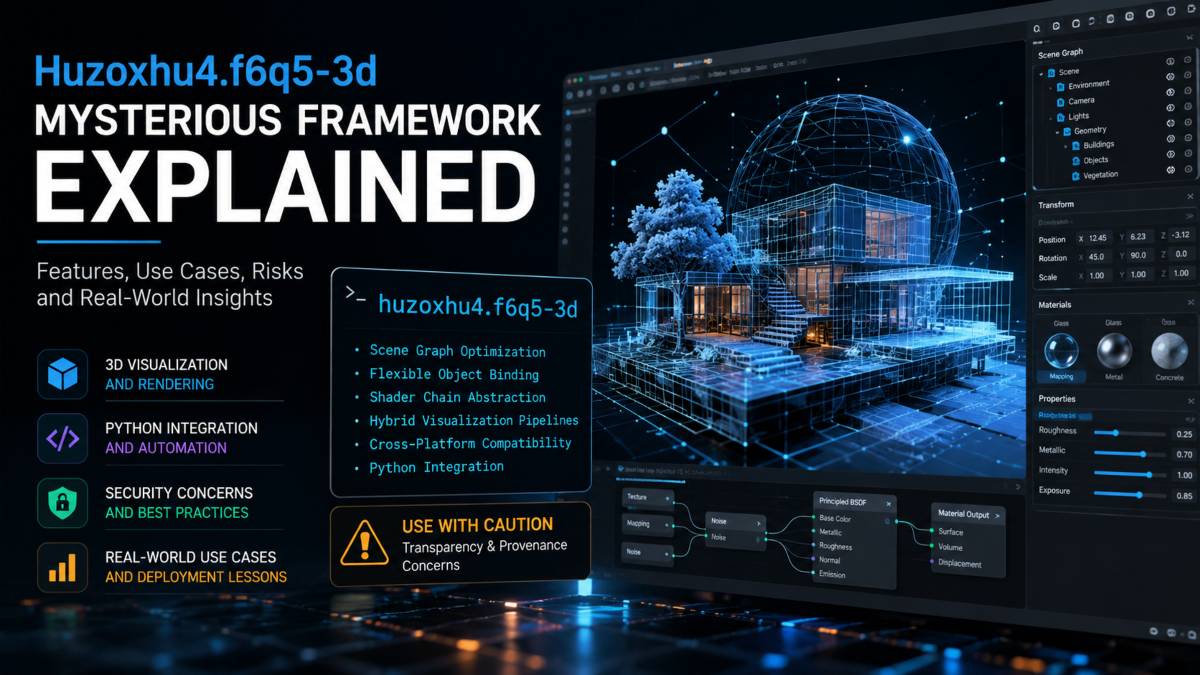
If you have come across the term huzoxhu4.f6q5-3d, you are probably wondering whether it is a legitimate software framework, a technical identifier, or something else entirely. The unusual name has sparked curiosity across developer communities, technology forums, and software related discussions. While some sources describe it as a tool built for 3D rendering, scene graph processing, and Python based automation, others raise serious questions about its origin and reliability.
Part of the interest comes from its claimed ability to support advanced visualization workflows across industries such as architecture, robotics, medical imaging, and scientific computing. On paper, those capabilities sound impressive. Yet there is another side to the story. Unlike widely known software platforms, huzoxhu4.f6q5-3d lacks official documentation, a verified source repository, and clear information about the organization behind it.
This combination of technical potential and unanswered questions has made the software a topic of growing discussion. In this guide, you will learn what huzoxhu4.f6q5-3d is, how it reportedly works, where it may be used, and why security experts urge caution before deploying it in any serious environment.
What Is Huzoxhu4.f6q5-3d?
Huzoxhu4.f6q5-3d is described as a specialized software component built to support advanced 3D visualization and automation workflows. Although information about the platform remains limited, available reports suggest that it functions as a modular system that connects rendering engines with higher level applications. In simple terms, it acts as a bridge between complex graphics processing tools and the software environments developers use every day.
The core purpose of the huzoxhu4.f6q5-3d framework is to improve the handling of 3D scenes, object relationships, and rendering operations. It reportedly supports tasks such as scene graph computation, object binding, shader management, and visualization pipeline automation. These capabilities make it relevant for projects that require real time graphics processing and large scale data visualization.
Within the broader Huzoxhu4 ecosystem, this component appears to serve as a dedicated module focused on rendering and backend processing. While the exact structure of the ecosystem remains unclear, references suggest that huzoxhu4.f6q5-3d operates as a backend automation framework designed to simplify complex 3D workflows.
Why It Is Getting Attention
One reason behind the growing interest in huzoxhu4.f6q5-3d is its reported ability to handle demanding 3D rendering tasks. The framework is said to support technologies commonly used in modern visualization environments, helping developers manage scenes and graphical assets more efficiently.
Another factor is its Python automation support. Through Python wrappers, developers can automate rendering processes, manage datasets, and build custom visualization pipelines without relying entirely on lower level programming languages. This makes the platform appealing to engineers, researchers, and data specialists who already work extensively with Python.
The increasing discussion around huzoxhu4.f6q5-3d explained articles and forum posts is also driven by mystery. Despite its reported capabilities, there is little publicly verified information about its origin, documentation, or development team. That combination of technical promise and uncertainty continues to attract attention from developers looking to understand whether the software is a useful tool or a potential risk.
Understanding the Name Huzoxhu4.f6q5-3d
Breaking Down the Identifier
One of the most intriguing aspects of huzoxhu4.f6q5-3d is its unusual name. Unlike conventional software products that use recognizable branding, this identifier appears more like a system generated code than a commercial product name. As a result, many people searching for the huzoxhu4.f6q5-3d meaning are trying to determine whether it represents a software package, an internal project, or a technical reference.
The first section, “huzoxhu4,” appears to be an alphanumeric prefix. Since no official explanation exists, some observers believe it may be a randomly generated project label or a unique identifier assigned during development.
The second segment, “f6q5,” resembles a version tag, build reference, or module classification. In software environments, similar combinations are often used to distinguish releases, environments, or internal components within a larger system.
The final portion, “3d,” is the easiest to interpret. Most sources associate it with three dimensional rendering, visualization, or graphics processing. This aligns with reports describing the framework’s focus on rendering pipelines and scene management.
Possible Technical Meanings
Because there is no verified documentation, several theories have emerged regarding the purpose of this mysterious software identifier.
One theory suggests that the name functions as a build identifier created automatically during development. In this scenario, the identifier helps developers track specific software versions and configurations.
Another possibility is that it serves as an internal reference used within a larger software ecosystem. Large projects often rely on technical reference tokens to organize modules, services, and backend components.
A third theory is that huzoxhu4.f6q5-3d acts as a debugging marker. Similar identifiers sometimes appear in application logs, error reports, databases, or testing environments, making it easier for engineers to trace issues during development. While the exact answer remains unknown, these explanations offer the most plausible interpretations currently available.
Key Features of Huzoxhu4.f6q5-3d
The growing interest in huzoxhu4.f6q5-3d is largely tied to its reported feature set. According to available information, the platform is designed to simplify complex visualization workflows while improving the performance of rendering operations. From scene management to Python driven automation, the framework appears to combine several technologies into a single rendering middleware solution.
| Feature | Purpose | Potential Benefit |
|---|---|---|
| Scene Graph Optimization | Manages object hierarchies efficiently | Faster rendering updates |
| Flexible Object Binding | Connects objects with logic and data sources | Reduced development effort |
| Shader Chain Abstraction | Simplifies shader management | Improved workflow efficiency |
| Hybrid Visualization Pipelines | Handles multiple data streams | Greater flexibility for advanced projects |
| Cross Platform Compatibility | Supports multiple operating systems and tools | Easier deployment across environments |
| Python Integration | Enables automation through Python wrappers | Faster scripting and workflow management |
Scene Graph Optimization
One of the most frequently mentioned capabilities is scene graph optimization. In many 3D environments, scene graphs organize and track the relationships between objects within a virtual space. As projects become more complex, managing these relationships can place heavy demands on system resources.
Huzoxhu4.f6q5-3d reportedly uses a dynamic approach that updates object hierarchies in real time. This allows developers to work with large scenes while reducing processing overhead. For applications such as simulations, virtual environments, and scientific visualization, efficient scene management can improve responsiveness and overall performance.
Flexible Object Binding
Another notable feature is its object binding system. This functionality reportedly allows developers to connect visual elements, logic components, and external data sources to 3D objects with minimal setup.
Object binding can be particularly useful when building interactive applications where data changes frequently. Instead of manually updating every element, developers can create relationships that automatically synchronize information across the environment. This may reduce development time while simplifying project maintenance.
Shader Chain Abstraction
Shaders play a major role in modern graphics rendering, controlling how objects appear on screen. Creating and managing shaders often requires specialized knowledge and extensive configuration.
Huzoxhu4.f6q5-3d attempts to simplify this process through shader chain abstraction. The framework reportedly provides reusable shader components that can be combined and adjusted as needed. This approach allows developers to focus more on visual outcomes and less on repetitive technical setup.
Hybrid Visualization Pipelines
Modern visualization projects frequently combine multiple data sources, including sensor feeds, machine learning outputs, and real time simulation data. The framework reportedly supports hybrid visualization pipelines capable of handling these different inputs within a unified workflow.
This capability may benefit industries such as robotics, healthcare, engineering, and research where several systems must work together to generate meaningful visual representations.
Cross Platform Compatibility
Another factor attracting attention is its broad compatibility. Reports suggest that huzoxhu4.f6q5-3d can operate across Windows, Linux, and certain embedded environments. It is also said to support integration with popular development platforms and 3D tools.
For development teams working across different operating systems, this flexibility can simplify collaboration and deployment planning. A single framework that functions in multiple environments often reduces compatibility concerns during project development.
Python Integration and Automation
Perhaps the most appealing feature for many users is Python integration. Through Python wrappers, developers can automate rendering tasks, process datasets, and build custom visualization workflows using familiar scripting tools.
Python remains one of the most widely used programming languages in data science, artificial intelligence, and automation. By connecting advanced rendering capabilities with Python based workflows, huzoxhu4.f6q5-3d positions itself as a backend automation framework that may appeal to both developers and researchers. This combination of rendering middleware functionality and automation support is one of the primary reasons the software continues to attract attention despite ongoing questions about its origin and reliability.
Common Use Cases and Applications
Although much about huzoxhu4.f6q5-3d remains uncertain, available descriptions suggest that it was created for demanding visualization and data processing tasks. Its reported combination of rendering middleware capabilities, automation features, and support for complex data environments makes it suitable for several specialized applications. From architecture to scientific research, the framework appears designed to help users work with large volumes of visual information more efficiently.
Architectural Visualization
One of the most practical applications of huzoxhu4.f6q5-3d is architectural visualization. Architects and design firms often need realistic 3D models to present building concepts, interior layouts, and urban development projects.
For example, an architectural team working on a commercial complex could use 3D visualization software to display how natural light interacts with different parts of the building throughout the day. Real time updates would allow designers to adjust materials, lighting conditions, and structural elements while presenting concepts to clients. This can make design reviews more interactive and easier to understand.
Robotics and Autonomous Systems
Robotics developers rely heavily on virtual testing environments before deploying machines in real world settings. According to available reports, huzoxhu4.f6q5-3d can support simulations that help engineers evaluate navigation systems, sensor behavior, and object recognition processes.
A practical example would be a warehouse automation company testing autonomous robots. Instead of running expensive physical trials, engineers could create a virtual environment where robots navigate obstacles, identify inventory locations, and optimize movement patterns. This approach reduces testing costs while allowing teams to identify potential issues before deployment.
Medical Imaging
Healthcare organizations increasingly use advanced visualization tools to analyze complex medical data. The framework has been linked to medical imaging workflows that transform diagnostic scans into interactive three dimensional models.
For instance, a surgeon preparing for a complicated procedure could use detailed visual representations generated from MRI or CT scan data. These models can provide a clearer view of bones, blood vessels, and surrounding tissues. By interacting with the visual model before surgery, medical professionals may gain a better understanding of patient specific anatomy.
AI and Machine Learning Visualization
Artificial intelligence projects often generate large amounts of spatial and analytical data. AI visualization platforms help researchers understand patterns, relationships, and model behavior that may be difficult to interpret through raw datasets alone.
A machine learning team developing a computer vision system could use visualization tools to examine how an algorithm interprets objects within a scene. Instead of reviewing thousands of lines of numerical output, researchers can view graphical representations that reveal strengths, weaknesses, and unusual behaviors within the model.
Scientific Research Simulations
Scientific simulation tools are commonly used in fields such as physics, engineering, astronomy, and environmental research. These projects often involve massive datasets that require visual representation to make findings easier to interpret.
Consider a research team studying fluid dynamics. By visualizing the movement of liquids and gases within a simulated environment, scientists can observe patterns that would otherwise remain hidden in spreadsheets or mathematical models. Similar approaches can be applied to particle simulations, climate modeling, and astronomical research.
The versatility reported for huzoxhu4.f6q5-3d suggests that its strongest value lies in environments where large datasets, complex visual systems, and automation workflows intersect. Whether used for architecture, robotics, healthcare, artificial intelligence, or scientific analysis, its appeal comes from the ability to transform technical data into meaningful visual experiences.
The Biggest Concerns Surrounding Huzoxhu4.f6q5-3d
While the reported capabilities of huzoxhu4.f6q5-3d may sound appealing, the framework is surrounded by several concerns that cannot be ignored. Any software intended for visualization, automation, or data processing should provide clear information about its origin, maintenance, and security practices. In the case of huzoxhu4.f6q5-3d, many of those details remain unavailable.
It is important to approach this topic with balance. The lack of public information does not automatically mean the software is malicious. However, the absence of transparency creates uncertainty that makes risk assessment difficult for developers, businesses, and research teams. Understanding these concerns is essential before considering any form of deployment.
Lack of Official Documentation
One of the most immediate issues is the absence of official documentation. Most legitimate software frameworks provide user guides, installation instructions, technical references, and troubleshooting resources. These materials help users understand how the software works and how it should be deployed safely.
With huzoxhu4.f6q5-3d, publicly available documentation is extremely limited. Developers searching for setup instructions, compatibility requirements, or architecture details may find themselves relying on third party articles and discussions instead of official resources.
This creates several challenges. Teams cannot easily verify recommended configurations, understand feature limitations, or confirm whether reported capabilities are accurate. Documentation is often the foundation of trust in software development, and its absence raises understandable concerns.
Unknown Software Origin
Another major issue involves software provenance. In modern software development, knowing who created a product and where it originated is critical. Organizations routinely evaluate the background of software providers before integrating new tools into their systems.
The origin of huzoxhu4.f6q5-3d remains unclear. There is no widely recognized company, development group, or public organization claiming ownership of the framework. Without a clear development history, users cannot easily determine who maintains the software, how updates are produced, or whether security reviews take place.
An unclear software provenance chain makes it difficult to establish confidence. Businesses often require transparency regarding software ownership because unknown origins can introduce operational and security uncertainties that are difficult to measure.
Missing Vendor Transparency
Closely related to the origin issue is the lack of vendor transparency. Most established software products provide information about their creators, support channels, licensing terms, and development roadmaps. This allows customers to evaluate reliability and long term viability.
In the case of huzoxhu4.f6q5-3d, information about the vendor is either unavailable or impossible to verify. As a result, users are left with unanswered questions regarding support, maintenance, and accountability.
An unknown software vendor creates practical concerns beyond security. If technical issues arise, there may be no official support team available to provide assistance. If compatibility problems appear after system updates, there may be no public roadmap indicating future fixes or improvements.
For organizations that depend on stable infrastructure, vendor transparency is often just as important as technical capability. Even highly capable software can become a liability when there is no clear path for support or maintenance.
No Verified Repository or Source Code
Another significant concern is the apparent lack of a verified repository or publicly accessible source code. Many modern software projects use platforms such as GitHub or GitLab to distribute code, track issues, and document development activity.
A verified repository provides several benefits. It allows developers to review code quality, monitor updates, identify contributors, and evaluate project activity. It also creates opportunities for community feedback and independent security review.
With huzoxhu4.f6q5-3d, no widely recognized repository appears to exist. This means users cannot easily inspect the code or confirm how the software functions internally. If installers, packages, or compiled files are distributed through unofficial channels, verifying authenticity becomes much more difficult.
The absence of source code visibility does not prove that a project is unsafe. However, it removes an important layer of transparency that many organizations consider essential before adopting new technology.
Software Supply Chain Risks
Perhaps the most serious concern involves software supply chain security. Over the past several years, software supply chain attacks have become a major issue across the technology industry. Attackers increasingly target software packages because a single compromised component can affect thousands of users.
The reported huzoxhu4.f6q5-3d security risks stem largely from the inability to verify software authenticity. Without signed releases, verified repositories, or trusted distribution channels, users may struggle to determine whether downloaded files have been modified.
This is where package integrity verification becomes especially important. Security professionals typically recommend checking cryptographic hashes, validating file origins, and monitoring software behavior before deployment. These practices help reduce risk when dealing with software from uncertain sources.
Organizations considering experimentation with huzoxhu4.f6q5-3d should adopt a cautious approach. Isolated testing environments, restricted network access, and thorough security monitoring can help limit exposure while evaluations take place.
Ultimately, the concerns surrounding huzoxhu4.f6q5-3d are less about what the software claims to do and more about what remains unknown. The framework may offer useful capabilities for 3D visualization and automation, but questions regarding documentation, ownership, transparency, source code access, and software supply chain security remain unresolved. Until those questions receive clear answers, careful evaluation and controlled testing remain the most responsible approach.
Performance and Stability Issues Reported by Users
Beyond the concerns surrounding transparency and security, several reports have highlighted performance and stability challenges associated with huzoxhu4.f6q5-3d. While the framework is often described as a powerful tool for visualization and automation, some users claim that real world deployments can expose technical weaknesses that are difficult and costly to manage.
It is worth noting that many of these reports come from third party sources rather than official documentation. Even so, the recurring nature of these complaints makes them important factors in any huzoxhu4.f6q5-3d review. Organizations considering adoption should carefully evaluate these potential deployment issues before integrating the framework into critical workflows.
Memory Leak Problems
One of the most frequently reported concerns involves memory leaks. A memory leak occurs when software continues to consume system memory without properly releasing resources that are no longer needed. Over time, this can lead to reduced performance, application crashes, or complete system failure.
According to several reports, certain components within huzoxhu4.f6q5-3d may continue storing objects in memory during extended processing tasks. This becomes particularly problematic when working with large datasets, complex simulations, or long running visualization sessions.
For example, a research team processing thousands of 3D objects might notice memory usage steadily increasing over several hours. If the software fails to release unused resources, the operating system may eventually terminate the process to protect overall system stability. Troubleshooting these issues can consume valuable engineering time and delay project timelines.
Python Version Compatibility Issues
Python integration is often presented as one of the framework’s strongest features, but compatibility concerns have also been reported. Many software packages depend on specific Python versions, and even minor changes between releases can create unexpected problems.
Some users have reported that builds configured for Python 3.10 encounter errors when running on newer versions such as Python 3.12. These issues may involve type hints, asynchronous functions, dependency conflicts, or unsupported libraries.
Python compatibility problems can become especially frustrating in environments where multiple projects share the same infrastructure. Developers may need to maintain separate virtual environments or downgrade existing systems simply to support a single application. This increases operational complexity and creates additional maintenance responsibilities.
Cross Platform Deployment Challenges
Another commonly cited issue involves deployment across different operating systems. While the framework is often described as supporting multiple platforms, successful installation does not always guarantee consistent performance.
Differences in graphics drivers, hardware configurations, operating system libraries, and rendering backends can create unexpected obstacles. A configuration that works correctly on a Linux server may behave differently on a Windows workstation or fail entirely on another operating system.
For instance, a development team may successfully compile the framework on Ubuntu only to encounter rendering failures after moving the same workload to a different environment. Diagnosing these problems can be difficult when documentation is limited and support resources are unavailable.
These deployment issues become even more significant for organizations managing large infrastructure environments where consistency and predictability are essential.
Infrastructure Cost Concerns
Performance problems can also affect operational expenses. Some reports suggest that inefficient resource management may increase infrastructure costs, particularly in cloud based environments.
Applications that consume excessive memory, processor resources, or system threads often require larger servers to maintain acceptable performance levels. As usage scales, these requirements can translate into significantly higher monthly expenses.
Consider a visualization platform processing large datasets around the clock. If resource allocation is not properly controlled, cloud usage costs can rise far beyond initial estimates. What appears to be a manageable project during testing may become substantially more expensive once deployed at scale.
For organizations operating under strict budgets, these potential infrastructure cost concerns should be evaluated alongside the framework’s technical capabilities.
Silent Data Corruption Risks
Perhaps the most troubling issue reported by some users involves silent data corruption. Unlike application crashes or visible errors, data corruption can occur without generating immediate warnings.
In this scenario, calculations or visual outputs may appear normal while underlying data becomes inaccurate. This creates a particularly dangerous situation because users may continue making decisions based on flawed information without realizing a problem exists.
Reports have suggested that certain coordinate calculations involving mixed data types may occasionally produce unreliable results. If such behavior occurs within engineering simulations, scientific research, or analytical workflows, the consequences could extend well beyond simple software bugs.
For this reason, organizations testing huzoxhu4.f6q5-3d should implement strong validation procedures and independently verify results whenever possible.
Taken together, these reported stability concerns paint a mixed picture. The framework may offer attractive visualization and automation features, but memory leaks, Python compatibility limitations, deployment challenges, infrastructure costs, and potential data integrity issues introduce risks that cannot be overlooked. Thorough testing in controlled environments remains essential before considering any broader deployment.
Real World Deployment Lessons
The discussion surrounding huzoxhu4.f6q5-3d becomes more meaningful when viewed through real deployment experiences. While technical specifications and feature lists can appear impressive, actual implementation often reveals challenges that are not obvious during testing. Several reports describe situations where organizations encountered unexpected software deployment risks after attempting to move the framework into operational environments.
Example of a Failed Production Rollout
One widely referenced case involved a DevOps engineer tasked with preparing huzoxhu4.f6q5-3d for a production launch. The project initially appeared promising, with successful installation and basic functionality during early testing phases. However, problems began to emerge once larger workloads were introduced.
During batch processing operations, the framework reportedly continued storing 3D objects in memory without properly releasing resources. As system memory usage increased, performance steadily declined. Because source code access was unavailable and documentation was limited, identifying the root cause became extremely difficult.
The engineering team spent nearly two weeks investigating the issue before ultimately abandoning the deployment. By that point, the project had consumed significant resources without reaching production readiness, resulting in delays and lost productivity.
Engineering Costs of Unverified Software
Cases like this highlight the hidden engineering overhead that can accompany software from uncertain origins. When software lacks documentation, support channels, and transparent development practices, internal teams often become responsible for troubleshooting every issue themselves.
The cost extends beyond direct financial expenses. Developers may spend days analyzing logs, testing configurations, rebuilding environments, and searching for workarounds. These hours could otherwise be spent improving products, developing new features, or supporting customers.
Even when technical problems are eventually resolved, the additional workload can place pressure on project schedules and reduce overall team efficiency.
Lessons Development Teams Can Learn
The most important lesson is that technical capability alone should never determine adoption decisions. Before introducing unfamiliar tools into production environments, organizations should evaluate transparency, documentation quality, support availability, and security practices alongside performance claims.
Teams can also reduce software deployment risks by conducting extensive testing in isolated environments before committing to broader rollouts. Establishing monitoring systems, validating outputs, and creating rollback plans can help limit damage if unexpected issues occur.
Ultimately, many production environment failures stem not from a lack of functionality but from a lack of visibility. When software cannot be fully understood, verified, or supported, even promising technology can become a costly liability.
How to Safely Test Huzoxhu4.f6q5-3d
Given the uncertainty surrounding huzoxhu4.f6q5-3d, security should be the top priority before any testing begins. The framework may offer useful visualization and automation capabilities, but the lack of verified documentation, source code transparency, and official distribution channels creates additional risks. Rather than installing it directly into development or production systems, organizations should follow a structured testing process designed to minimize potential damage.
The checklist below outlines practical steps that can improve software testing security while reducing exposure to unknown threats.
Scan Files Before Installation
Before opening or installing any file associated with huzoxhu4.f6q5-3d, perform a comprehensive security scan.
Testing Checklist
Scan installation files using reputable antivirus tools
Upload packages to malware analysis services such as VirusTotal
Review security alerts generated during scanning
Reject any file that triggers serious security warnings
Document scan results for future reference
Scanning files before installation helps identify obvious threats and reduces the likelihood of introducing malicious code into testing environments.
Verify Checksums
Package verification is one of the most important steps when working with software from uncertain sources. Checksums provide a way to confirm that files have not been altered after distribution.
Testing Checklist
Generate SHA256 hashes for all downloaded files
Share hash values with team members for validation
Compare hashes across multiple downloads when possible
Store checksum records in project documentation
Treat unexpected hash changes as a warning sign
Although checksum verification cannot guarantee safety, it helps detect unauthorized modifications and accidental file corruption.
Use Docker Containers
Docker isolation provides an additional layer of protection by separating the software from the host operating system. If something goes wrong during testing, the impact remains contained within the container environment.
Testing Checklist
Create a dedicated Docker container for testing
Limit container permissions to the minimum required
Avoid mounting sensitive directories
Keep production data completely separate
Destroy and rebuild containers after testing sessions
Using Docker isolation allows developers to evaluate software behavior without exposing critical infrastructure to unnecessary risk.
Restrict Network Access
Unknown applications should never receive unrestricted access to corporate networks or internet resources during initial testing.
Testing Checklist
Place test systems on isolated networks
Block unnecessary outbound connections
Limit access to internal resources
Review firewall logs regularly
Monitor unexpected communication attempts
Strong network monitoring practices can reveal suspicious activity that may otherwise go unnoticed during installation or execution.
Pin Compatible Python Versions
Reports suggest that huzoxhu4.f6q5-3d may experience compatibility issues with certain Python releases. Maintaining a controlled environment helps reduce troubleshooting complexity.
Testing Checklist
Create a dedicated Python virtual environment
Use the version recommended by available reports
Document dependency versions
Prevent automatic package upgrades
Test updates in separate environments before deployment
Managing Python compatibility carefully can prevent unexpected failures and improve testing consistency.
Monitor Runtime Behavior
Even if installation appears successful, ongoing monitoring remains essential. Many software issues only become visible after extended usage under realistic workloads.
Testing Checklist
Track memory consumption over time
Monitor processor utilization
Watch for abnormal thread growth
Review application logs frequently
Validate output accuracy against known benchmarks
Investigate unusual crashes or performance degradation
Runtime monitoring can help identify memory leaks, stability problems, and other hidden issues before they affect larger projects.
Safe Testing Summary
Organizations interested in evaluating huzoxhu4.f6q5-3d should treat it as experimental software until stronger verification becomes available. A secure testing strategy should include package verification, Docker isolation, restricted network access, controlled Python environments, and continuous network monitoring. By following these precautions, teams can explore the framework’s capabilities while keeping potential security and stability risks under control.
Should You Use Huzoxhu4.f6q5-3d?
After examining its features, applications, security concerns, and reported stability issues, the most important question remains: should you use huzoxhu4.f6q5-3d? The answer depends largely on your goals, risk tolerance, and deployment environment.
While the framework appears capable of supporting advanced visualization and automation workflows, its lack of transparency creates challenges that many organizations cannot ignore. A proper software risk assessment requires balancing potential benefits against the uncertainties surrounding the project.
Situations Where Testing May Be Acceptable
There are scenarios where experimenting with huzoxhu4.f6q5-3d may be reasonable.
For example, researchers, developers, and technology enthusiasts working in isolated environments may find value in exploring its capabilities. Experimental visualization projects, proof of concept development, and internal testing environments can provide opportunities to evaluate the framework without exposing critical systems.
Testing may also be appropriate when strong safeguards are in place, including containerized environments, restricted network access, file verification procedures, and continuous monitoring. In these situations, the potential rewards of discovering useful functionality may justify the limited risk.
Situations Where It Should Be Avoided
For most business critical environments, the risks appear significantly higher. Organizations managing customer data, financial systems, healthcare platforms, or production infrastructure should proceed with extreme caution.
The absence of verified documentation, public source code, and identifiable vendor support makes it difficult to evaluate long term reliability. If a serious issue occurs, there may be no official channel for assistance or remediation.
Production systems generally require predictable performance, transparent maintenance practices, and clear accountability. Based on currently available information, huzoxhu4.f6q5-3d does not provide enough publicly verified evidence to satisfy those requirements.
Risk Versus Reward Analysis
The debate surrounding experimental frameworks often comes down to balancing innovation against uncertainty. Huzoxhu4.f6q5-3d appears to offer several attractive capabilities, but those benefits are accompanied by substantial unanswered questions.
| Potential Benefits | Potential Risks |
|---|---|
| Advanced 3D rendering capabilities | Unknown software origin |
| Python based automation support | No official documentation |
| Flexible visualization workflows | Lack of verified source code |
| Cross platform integration possibilities | Security and supply chain concerns |
| Useful for research and experimentation | Stability and compatibility issues |
| Potential productivity gains | Limited accountability and support |
Ultimately, should you use huzoxhu4.f6q5-3d? For controlled experimentation, the answer may be yes, provided strict safeguards are in place. For customer facing services, production infrastructure, or mission critical operations, the safer choice is to avoid adoption until stronger evidence of reliability, transparency, and long term support becomes available.
Final Verdict
Huzoxhu4.f6q5-3d presents an interesting case within the world of visualization and automation software. Based on available information, the framework appears to offer several attractive capabilities, including advanced 3D rendering support, scene management features, Python based automation, and integration possibilities for data intensive workflows. From architecture and robotics to scientific research and artificial intelligence, the potential applications are broad enough to attract attention from developers and technical teams.
However, technical capability is only one part of the equation. Throughout this analysis, a recurring theme has emerged: transparency. Questions surrounding documentation, ownership, source code availability, vendor accountability, and software verification remain unanswered. These gaps make it difficult to evaluate the framework with the same level of confidence typically associated with established software platforms.
That does not necessarily mean huzoxhu4.f6q5-3d lacks value. For researchers, hobbyists, and development teams operating in controlled environments, it may serve as an interesting platform for experimentation and technical exploration. When proper safeguards such as isolated containers, restricted network access, and continuous monitoring are used, the risks can be managed more effectively.
For production systems, the situation is very different. Businesses that rely on stability, security, regulatory compliance, and long term support should be extremely cautious. Until stronger evidence of reliability and transparency becomes available, huzoxhu4.f6q5-3d is best viewed as an experimental technology rather than a trusted production solution. Its concept is promising, but caution remains the most sensible approach.
Read More: https://coupasoftware.org/why-is-uhoebeans-software-update-so-slow/