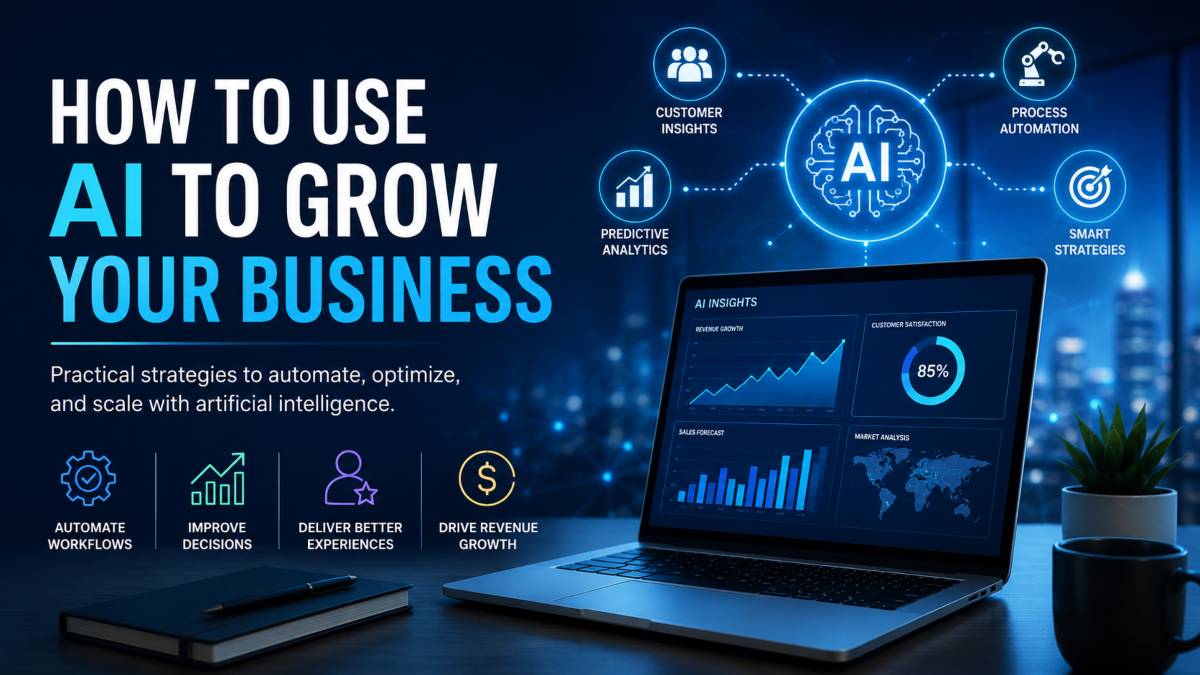
Growing a business often brings a difficult challenge. As demand increases, costs usually rise alongside it. Companies hire more staff, spend more on operations, and invest additional resources just to keep up. Artificial intelligence is changing that equation.
AI helps businesses handle larger workloads without increasing costs at the same pace. From automating routine tasks to improving customer experiences and analyzing large amounts of data, AI allows teams to work smarter and move faster. This creates new opportunities for growth while keeping operations lean and efficient.
The numbers tell a strong story. Businesses using AI report up to 2.5 times higher revenue growth and 2.4 times greater productivity compared to competitors that have not fully adopted AI. Organizations with advanced AI capabilities are also growing 4.7 times faster than their peers.
The appeal of AI goes beyond automation. It helps companies make quicker decisions, identify growth opportunities, improve marketing performance, and deliver better customer experiences at scale.
In this guide, you will learn how businesses use AI to automate operations, increase efficiency, strengthen customer relationships, improve forecasting, and create a foundation for long term growth.
Why AI Is Changing the Way Businesses Scale
Business growth has always required a careful balance between increasing revenue and controlling costs. As companies expand, they often face new challenges that slow progress and reduce efficiency. Artificial intelligence offers a different path by helping businesses grow faster while keeping operations streamlined.
The Shift From Manual Growth to Intelligent Growth
Traditional business growth often depends on hiring more employees, adding new processes, and increasing operational spending. While this approach can produce results, it also creates pressure on budgets and management teams.
Rising labor costs are a major concern for growing businesses. As workloads increase, companies frequently need additional staff to handle customer support, data entry, sales administration, and other routine tasks. Over time, these expenses can reduce profit margins.
Operational bottlenecks create another obstacle. Manual processes slow decision making, increase the risk of errors, and make it harder to handle larger volumes of work. These limitations can restrict growth even when demand remains strong.
What AI Brings to Business Expansion
AI helps businesses move beyond many of these limitations. Automated systems can complete repetitive tasks in seconds, allowing teams to focus on work that requires creativity, strategy, and problem solving.
Faster data processing also helps leaders make better decisions. Instead of relying on guesswork, businesses can use real time information to identify opportunities, predict trends, and respond quickly to changing market conditions.
Perhaps the biggest advantage is scalability. Companies can manage higher workloads and serve more customers without increasing headcount at the same rate as growth.
Key AI Growth Statistics Businesses Should Know
The business case for AI continues to strengthen. Research shows that AI driven companies achieve up to 2.5 times higher revenue growth and 2.4 times greater productivity. Organizations with advanced AI adoption are also growing 4.7 times faster than their competitors.
As more businesses invest in AI tools and automation, the gap between early adopters and slower movers continues to widen.
Automate Repetitive Work to Unlock Growth
One of the biggest barriers to business growth is time. As a company gains more customers, transactions, and daily responsibilities, teams often become overwhelmed by routine work. Tasks that once took a few minutes can quickly consume hours each week. AI automation helps solve this problem by handling repetitive processes with speed and consistency.
Businesses that automate routine operations can serve more customers, process more information, and support growth without constantly adding new staff. This creates a stronger foundation for long term expansion.
Business Processes That Can Be Automated
Many business activities follow the same steps repeatedly. These tasks are ideal candidates for AI automation.
Data Entry
Employees often spend valuable hours transferring information between systems. AI tools can collect, organize, and enter data automatically, reducing manual effort and improving accuracy.
CRM Updates
Customer relationship management systems are essential for sales and marketing teams. AI can update contact records, log interactions, assign leads, and track customer activity without requiring manual input after every conversation.
Invoice Processing
Creating invoices, tracking payments, and managing financial records can become time consuming as a business grows. AI powered workflows can generate invoices, send reminders, and organize payment information automatically.
Employee Onboarding
Hiring new employees involves paperwork, training materials, account setup, and policy distribution. Automated onboarding systems help new team members get started quickly while reducing administrative work for HR teams.
Customer Support
AI chatbots and virtual assistants can answer common questions, guide customers through simple processes, and provide support around the clock. This helps businesses maintain high service levels even as customer demand increases.
How AI Automation Increases Productivity
The main purpose of automation is not to replace people. It is to help teams accomplish more with the resources they already have.
Faster Task Completion
AI systems can process information in seconds. Tasks that previously required hours of manual work can often be completed automatically. This allows businesses to move faster and respond to opportunities more quickly.
Lower Error Rates
Manual work naturally creates mistakes. Incorrect data entries, missed invoices, and incomplete records can lead to operational problems. Automated systems follow predefined rules, which helps reduce errors and improve consistency.
More Time for Strategic Work
When routine tasks are automated, employees can focus on activities that create greater business value. Sales teams can spend more time building relationships. Marketing teams can focus on campaigns and customer engagement. Leadership teams can concentrate on planning and growth initiatives.
The result is a more productive organization where employees spend less time on repetitive work and more time driving results.
Real World Example: JPMorgan and UiPath
Many large organizations have already demonstrated the value of AI automation.
JPMorgan introduced an AI powered system called COiN to review legal contracts and documents. Work that previously required significant manual effort could be completed much faster, allowing employees to focus on higher value responsibilities.
UiPath has become a widely used automation platform across industries. Companies use it to automate back office processes, customer service tasks, finance operations, and administrative workflows. These automated systems help organizations handle growing workloads while maintaining efficiency.
These examples show that automation is no longer limited to large technology companies. Businesses of all sizes can apply similar principles to improve performance and support growth.
Best AI Automation Tools for Growing Businesses
A wide range of tools now make automation accessible to companies at every stage of growth.
Zapier
Zapier connects different applications and automates workflows between them. Businesses can automatically move information between tools, send notifications, update records, and trigger actions without coding knowledge.
UiPath
UiPath focuses on robotic process automation and enterprise workflows. It is commonly used for automating complex business operations, financial processes, customer service activities, and administrative tasks.
Konnectify
Konnectify helps businesses connect systems and automate workflows across departments. It supports data synchronization, process automation, and operational efficiency, helping organizations scale without creating additional manual work.
The key is not to automate everything at once. Start with one repetitive process that consumes significant time. Measure the results, refine the workflow, and then expand automation into other areas of the business. This gradual approach often produces the strongest and most sustainable growth.
Improve Customer Experience With AI Personalization
Customers have more choices than ever before. They can compare products, switch brands, and find alternatives within minutes. Because of this, generic marketing and one size fits all experiences often struggle to capture attention. AI personalization helps businesses create more relevant experiences that match individual customer interests and behaviors.
When customers receive content, recommendations, and support that feel tailored to their needs, they are more likely to engage, make purchases, and remain loyal to a brand.
Why Personalization Drives Revenue Growth
Modern customers expect businesses to understand their preferences. They want relevant product suggestions, useful content, and timely communication instead of broad messages sent to everyone.
When businesses deliver personalized experiences, engagement typically improves. Customers spend more time exploring products, opening emails, and interacting with content that matches their interests.
Personalization also helps increase conversions. A customer who sees products related to previous purchases or browsing behavior is often more likely to complete a transaction. Small improvements across multiple customer touchpoints can lead to meaningful revenue growth over time.
Another advantage is stronger customer loyalty. People are more likely to return to businesses that consistently provide relevant experiences and make interactions simple and convenient.
AI Powered Recommendations and Smart Segmentation
AI allows businesses to personalize experiences on a much larger scale than traditional methods.
Product Recommendations
AI systems can analyze browsing history, purchase behavior, and customer preferences to suggest products that match individual interests. These recommendations can appear on websites, mobile apps, emails, and online stores.
For ecommerce businesses, relevant product suggestions can increase average order value and encourage repeat purchases.
Dynamic Content
Different customers often respond to different messages. AI can automatically adjust website content, email campaigns, and promotional offers based on user behavior.
For example, a first time visitor may see educational content, while a returning customer may receive product recommendations or special offers.
Behavioral Targeting
AI can identify patterns in customer activity and group users based on their actions. This allows businesses to send more relevant messages to different audience segments.
Instead of treating all customers the same, businesses can deliver targeted campaigns that match specific interests, buying habits, and engagement levels.
Using AI Chatbots for Sales and Support
Customer service plays a major role in overall customer experience. AI chatbots help businesses provide quick assistance without requiring large support teams.
Lead Qualification
AI chatbots can ask questions, collect information, and identify potential customers before passing them to sales representatives. This saves time and helps sales teams focus on qualified prospects.
Customer Assistance
Many customer questions are repetitive. Chatbots can answer common inquiries, provide product information, track orders, and guide users through basic processes. Customers receive help immediately instead of waiting for a response.
24/7 Service
Unlike human support teams, AI systems can operate around the clock. Customers can receive assistance at any time, regardless of business hours or location. This improves customer satisfaction and creates a better overall experience.
Real World Example: Netflix Recommendation Engine
Netflix is one of the most recognized examples of AI personalization in action. The platform analyzes viewing habits, watch history, preferences, and engagement patterns to recommend content that matches individual interests.
Rather than showing the same content to every user, Netflix creates a unique experience for each subscriber. This helps viewers discover shows and movies they are more likely to enjoy.
The benefits extend beyond convenience. Personalized recommendations encourage users to spend more time on the platform and reduce the likelihood of canceling subscriptions. Strong engagement and customer retention have become key advantages of Netflix’s growth strategy.
For businesses of any size, the lesson is clear. The more relevant the customer experience becomes, the stronger the opportunities for engagement, conversions, and long term growth.
Make Better Decisions With Predictive Analytics
Growing a business often depends on making the right decisions at the right time. The challenge is that business leaders rarely have perfect visibility into what will happen next. Market conditions change, customer preferences shift, and demand can rise or fall unexpectedly. Predictive analytics helps reduce uncertainty by using data to identify patterns and estimate future outcomes.
Instead of reacting after problems appear, businesses can use predictive analytics to prepare for upcoming opportunities and risks. This allows teams to make smarter decisions based on evidence rather than assumptions.
What Predictive Analytics Means for Business Growth
Predictive analytics uses artificial intelligence, machine learning, and historical data to identify trends and forecast future events. Businesses collect information from sales records, customer interactions, website activity, and operational systems. AI then analyzes this data to uncover patterns that may not be obvious through manual review.
The goal is simple. Use past and current information to make better predictions about what is likely to happen next.
These forecasts can support decisions across many areas of a business, including marketing, sales, inventory management, customer retention, and financial planning. When leaders have a clearer picture of future outcomes, they can allocate resources more efficiently and respond faster to changing conditions.
Predicting Customer Behavior and Market Trends
One of the most valuable applications of predictive analytics is understanding customer behavior before key events occur.
Customer Churn Prediction
Losing customers can slow growth and increase acquisition costs. Predictive models can identify warning signs that suggest a customer may stop using a product or service. Businesses can then take action through targeted offers, improved support, or personalized communication.
Demand Forecasting
Demand forecasting helps companies estimate future product demand based on historical trends, seasonal patterns, and market activity. More accurate forecasts help businesses avoid shortages while reducing excess inventory.
Sales Forecasting
Predictive analytics can estimate future revenue by analyzing past sales performance, customer activity, and buying patterns. This helps organizations set realistic goals, plan budgets, and make informed investment decisions.
These capabilities allow businesses to stay prepared rather than constantly reacting to unexpected changes.
Real World Example: Amazon’s Forecasting Systems
Amazon is widely recognized for its advanced use of predictive analytics. The company processes large amounts of customer and operational data to forecast product demand across its global network.
These forecasting systems help Amazon determine how much inventory should be stored in different locations and when products need to be replenished. By predicting demand more accurately, the company can reduce delays and improve delivery performance.
Predictive analytics also helps balance supply and demand. Products can be positioned closer to customers before orders are placed, creating a faster and more efficient fulfillment process.
This data driven approach allows Amazon to maintain high service levels while managing inventory costs more effectively.
Key Metrics to Track
Predictive analytics delivers the greatest value when businesses monitor the right performance indicators.
Customer Lifetime Value
This metric estimates the total revenue a customer is expected to generate throughout their relationship with a business. Higher lifetime value often signals strong customer retention and engagement.
Churn Rate
Churn rate measures the percentage of customers who stop using a product or service over a specific period. Tracking this metric helps businesses identify retention challenges early.
Forecast Accuracy
Accurate forecasts lead to better planning and resource allocation. Businesses should regularly compare predictions against actual results to improve future performance.
Revenue Growth
Revenue growth remains one of the clearest indicators of business success. Monitoring revenue trends alongside predictive models helps leaders understand which strategies are producing measurable results.
When combined, these metrics provide a clearer view of business performance and support more confident decision making as companies scale.
Use AI to Build a More Efficient Supply Chain
A strong supply chain can support growth, improve customer satisfaction, and protect profit margins. However, as businesses expand, supply chain operations become more complex. Managing inventory, coordinating deliveries, and responding to changes in demand can quickly become difficult when relying on manual processes alone.
Artificial intelligence helps businesses gain greater control over their supply chains by analyzing large amounts of data and identifying patterns that support faster, smarter decisions. From inventory planning to logistics management, AI can improve efficiency across every stage of the supply chain.
Demand Forecasting and Inventory Optimization
One of the most valuable uses of AI in supply chain management is demand forecasting. By analyzing historical sales data, seasonal trends, customer behavior, and market activity, AI can estimate future demand with greater accuracy.
Reducing Stock Shortages
Running out of inventory can lead to lost sales and frustrated customers. AI forecasting systems help businesses predict demand before it occurs, making it easier to maintain adequate stock levels and avoid disruptions.
When companies know which products are likely to sell faster, they can prepare inventory in advance and meet customer expectations more consistently.
Avoiding Excess Inventory
Holding too much inventory creates its own problems. Products take up storage space, tie up capital, and may become outdated before they are sold.
AI helps businesses find a better balance by identifying purchasing patterns and recommending inventory levels that match expected demand. This leads to more efficient use of resources and lower storage costs.
Smarter Logistics and Route Planning
Transportation is often one of the largest expenses within a supply chain. AI helps businesses improve logistics performance by analyzing routes, delivery schedules, traffic conditions, and operational constraints.
Delivery Optimization
AI systems can identify the most efficient delivery routes based on real time and historical data. This helps drivers complete deliveries faster while improving overall service quality.
Better route planning can also support faster order fulfillment, which is becoming increasingly important as customer expectations continue to rise.
Cost Reduction
Efficient logistics reduce fuel consumption, vehicle wear, and unnecessary travel time. Even small improvements across a large delivery network can produce significant savings over time.
For growing businesses, these savings can be reinvested into other areas that support expansion.
Digital Twins and Scenario Planning
AI is also changing how businesses prepare for future challenges through digital twins and scenario planning.
A digital twin is a virtual representation of a supply chain, warehouse, or business process. Companies can use these models to simulate different situations without affecting real operations.
Testing Business Scenarios
Businesses can explore how changes in demand, supplier delays, or market conditions may affect operations. This allows teams to evaluate different strategies before making decisions.
Risk Management
Unexpected events can disrupt supply chains with little warning. AI powered simulations help businesses identify vulnerabilities and prepare response plans before problems occur.
This level of planning improves resilience and supports more stable growth.
Real World Examples: Amazon and Walmart
Amazon has become a leading example of AI driven supply chain management. The company uses machine learning, robotics, and forecasting systems to manage inventory, improve warehouse operations, and speed up order fulfillment.
Automated systems help products move efficiently through distribution centers while reducing delays and operational costs.
Walmart has also invested heavily in AI technology. The company uses advanced forecasting tools, inventory management systems, and data analysis to improve stock availability across stores and fulfillment centers.
Both companies demonstrate how AI can improve warehouse automation, inventory accuracy, and delivery performance at scale.
While not every business operates at the size of Amazon or Walmart, the same principles apply. By using AI to forecast demand, optimize inventory, improve logistics, and prepare for future risks, businesses can build supply chains that support sustainable growth and greater operational efficiency.
Accelerate Marketing With Generative AI
Marketing teams are under constant pressure to create more content, launch more campaigns, and reach larger audiences. As businesses grow, these demands increase even further. Producing high quality marketing materials at scale can quickly become expensive and time consuming.
Generative AI helps solve this challenge by assisting with content creation, campaign development, and performance optimization. Instead of spending days on routine marketing tasks, teams can produce content faster and focus more attention on strategy, creativity, and customer engagement.
Creating Content Faster With AI
Content plays a major role in attracting customers and supporting growth. Generative AI helps marketers create a wide range of materials in less time.
Blog Drafts
Writing blog content often requires research, outlining, drafting, and editing. AI can help create initial drafts, generate topic ideas, suggest headings, and organize information. This allows writers to move from concept to publication more quickly while maintaining quality through human review.
Email Campaigns
Email marketing remains one of the most reliable channels for customer communication. AI can generate subject lines, email copy, follow up sequences, and promotional messages based on campaign goals and audience preferences.
This helps marketing teams create campaigns more efficiently while maintaining consistent communication with customers.
Social Media Content
Keeping social media channels active requires a steady stream of content. AI can generate post ideas, captions, content variations, and publishing suggestions for multiple platforms. This helps businesses maintain visibility without spending excessive time on content production.
Scaling Campaign Production
As businesses expand into new markets and customer segments, marketing campaigns become more complex. Generative AI helps teams manage larger workloads without significantly increasing resources.
Multiple Creative Variations
Different audiences respond to different messages. AI can quickly create multiple versions of headlines, advertisements, emails, and promotional content.
Instead of developing every variation manually, marketers can generate several options and choose the strongest performers. This supports broader audience targeting while reducing production time.
Localization at Scale
Reaching customers across different regions often requires adapting content for local languages, cultures, and preferences.
AI can assist with content adaptation and translation, helping businesses deliver more relevant messaging to diverse audiences. This makes it easier to expand marketing efforts into new markets while maintaining consistency across campaigns.
AI for A/B Testing and Campaign Optimization
Successful marketing depends on continuous improvement. AI helps businesses test ideas faster and identify winning strategies more efficiently.
Faster Experimentation
Traditional testing can take weeks to complete. AI helps generate multiple campaign variations quickly, allowing marketers to test different headlines, calls to action, email formats, and creative concepts in a shorter timeframe.
This increases the speed of learning and helps teams identify what works best for their audience.
Improved Campaign Performance
AI can analyze campaign data and identify patterns that influence results. Marketers can use these findings to refine messaging, improve targeting, and allocate budgets more effectively.
Over time, these improvements can lead to stronger engagement, higher conversion rates, and better returns from marketing investments.
Real World Example: Unilever’s AI Creative Workflow
Unilever has adopted generative AI to support content creation and marketing production across its global operations. By integrating AI into its creative workflow, the company can produce marketing assets more efficiently while maintaining brand standards.
AI assists with generating content variations, adapting materials for different audiences, and supporting creative teams throughout the production process.
One major benefit is faster production cycles. Marketing materials that previously required lengthy development timelines can now be created and refined more quickly.
The company also benefits from lower production costs by reducing repetitive work and improving workflow efficiency. Creative teams can spend more time refining ideas and building stronger campaigns rather than focusing on routine production tasks.
For growing businesses, the lesson is straightforward. Generative AI is not simply a content creation tool. It is a marketing accelerator that helps teams produce more content, launch campaigns faster, test ideas efficiently, and support business growth with greater speed and consistency.
Build the Foundation Needed for AI Growth
Many businesses rush to adopt artificial intelligence because of the promise of faster growth, better efficiency, and stronger decision making. While AI tools can deliver impressive results, success depends on more than simply installing new software. Companies need a solid foundation that supports long term AI adoption and expansion.
Without reliable data, proper governance, and scalable systems, even the most advanced AI solutions can struggle to produce meaningful results. Businesses that invest in the right foundation are better positioned to scale AI across departments and create lasting value.
Why Data Quality Matters
Data is the fuel that powers artificial intelligence. If the data entering an AI system is inaccurate, incomplete, or outdated, the results will be unreliable.
Clean and Organized Data
AI systems learn from the information they receive. Clean and organized data helps models identify patterns more accurately and produce better recommendations, forecasts, and insights.
Businesses often collect information from multiple sources, including customer records, sales systems, marketing platforms, and operational tools. Bringing this data together in a structured format improves consistency and reduces confusion.
Regular data maintenance is equally important. Removing duplicates, correcting errors, and updating records helps maintain data quality over time.
Reliable Reporting
Business leaders rely on reports to guide decisions. Poor data quality can create misleading reports that lead to costly mistakes.
When data is accurate and organized, businesses gain a clearer view of performance, customer behavior, and growth opportunities. Reliable reporting also helps teams measure the impact of AI initiatives and identify areas for improvement.
Understanding MLOps and AI Governance
As AI systems become more widely used, businesses need processes that ensure models remain accurate, secure, and aligned with organizational goals.
Model Monitoring
AI models are not static. Customer behavior, market conditions, and business environments change over time. As these changes occur, model performance can decline.
Monitoring systems help businesses track model accuracy, detect issues early, and update models when necessary. This helps maintain consistent performance and prevents unexpected problems.
Risk Control
AI systems can influence important business decisions. Organizations need safeguards that reduce the risk of inaccurate predictions, biased outcomes, or operational disruptions.
Risk management practices help businesses identify potential issues before they affect customers, employees, or business performance.
Compliance Considerations
Many industries must follow regulations related to privacy, security, and data handling. AI governance frameworks help businesses establish clear rules for data usage, access control, and accountability.
Strong governance practices support responsible AI adoption while helping organizations meet legal and regulatory requirements.
Creating a Scalable AI Infrastructure
A successful AI strategy requires technology that can support growth as business needs evolve.
Cloud Platforms
Cloud based platforms provide the computing power needed for data storage, analysis, and AI model deployment. Businesses can expand resources as demand grows without making large investments in physical infrastructure.
Cloud environments also simplify access to advanced AI tools and services.
Data Pipelines
Data pipelines move information from various systems into a central environment where it can be processed and analyzed. Well designed pipelines ensure that AI models receive timely and accurate information.
Efficient data flow improves reporting, forecasting, and decision making across the organization.
Team Collaboration
AI adoption is rarely limited to one department. Marketing, sales, operations, finance, and customer service teams often rely on the same data and AI systems.
Strong collaboration helps teams share knowledge, align goals, and create consistent processes that support organization wide growth.
Real World Example: Microsoft Copilot Adoption
Microsoft Copilot has become one of the most widely adopted AI productivity platforms in the business world. Many large organizations have integrated Copilot into daily workflows to assist with document creation, communication, data analysis, and administrative tasks.
The success of these deployments is supported by Microsoft’s extensive cloud infrastructure, data management systems, and governance practices. Businesses can implement AI capabilities within familiar workplace applications while maintaining security and operational control.
Organizations using Copilot often report productivity improvements because employees spend less time on routine tasks and more time on high value work. Teams can create documents faster, analyze information more efficiently, and complete everyday responsibilities with greater speed.
The broader lesson is clear. AI growth begins with a strong foundation. Businesses that invest in high quality data, effective governance, scalable infrastructure, and cross functional collaboration are better equipped to unlock the full value of artificial intelligence as they grow.
How to Scale AI Across the Entire Organization
Many businesses successfully launch small AI projects but struggle when trying to expand those successes across the organization. A chatbot may work well for customer support, or an automation tool may improve one department, but company wide adoption requires a structured approach.
Scaling AI is not about deploying as many tools as possible. It is about creating systems that deliver measurable value across multiple teams while supporting long term business goals. Organizations that take a gradual and strategic approach are more likely to achieve sustainable results.
Start With One High Impact Use Case
The most successful AI initiatives often begin with a single business problem that offers clear value.
Pilot Project Selection
Choose a use case where AI can solve a meaningful challenge or improve an important process. Good starting points often include customer support automation, sales forecasting, lead qualification, content creation, or operational reporting.
The goal is to focus on an area where results can be measured and where improvements are likely to produce visible business benefits.
Starting small also reduces risk. Teams can learn how AI works within the organization before expanding into more complex projects.
Measuring Outcomes
Every pilot project should have clear success metrics. Businesses may track time savings, cost reductions, customer satisfaction, revenue growth, or productivity improvements depending on the project.
Measuring results helps leaders determine whether the initiative is delivering value and provides evidence to support future investments.
Successful pilot projects create confidence, encourage adoption, and build momentum for broader AI implementation.
Expand AI Into Core Workflows
Once an initial project demonstrates success, businesses can begin extending AI into essential business functions.
Sales
AI can assist with lead scoring, customer segmentation, sales forecasting, and opportunity tracking. Sales teams can focus their attention on prospects with the highest likelihood of converting.
Marketing
Marketing departments can use AI for content creation, audience targeting, campaign optimization, and customer personalization. These capabilities help teams reach more customers while improving campaign performance.
Operations
Operational teams benefit from workflow automation, inventory management, forecasting, and reporting. AI helps reduce manual effort and improves efficiency across daily processes.
Customer Service
AI powered chatbots, virtual assistants, and support systems help businesses provide faster responses and maintain service quality as customer demand grows.
Integrating AI into multiple departments creates greater organizational impact and allows businesses to capture value across a wider range of activities.
Create Reusable AI Systems
As AI adoption grows, businesses should focus on building systems that can be reused across projects and departments.
Templates
Standardized templates for prompts, reports, workflows, and automation processes help teams work more consistently. Employees can build on proven approaches instead of starting from scratch each time.
Automation Frameworks
Reusable automation frameworks simplify the development of new workflows. Once a successful process is created, similar workflows can often be adapted for other departments with minimal effort.
Shared Workflows
Organizations benefit when teams share successful AI practices and workflows. Knowledge sharing reduces duplication, improves efficiency, and accelerates adoption throughout the business.
Reusable systems allow businesses to scale AI more quickly while maintaining consistency and quality.
Six Step AI Scaling Framework
A structured framework helps organizations move from isolated projects to company wide AI adoption.
1. Define Business Goals
Start by identifying specific business objectives. AI initiatives should support measurable outcomes such as revenue growth, productivity improvements, cost reductions, or customer satisfaction gains.
2. Build a Data Foundation
Reliable data is essential for successful AI implementation. Businesses should focus on improving data quality, accessibility, and organization before expanding AI efforts.
3. Integrate AI Into Workflows
AI should become part of everyday business processes rather than operating as a separate initiative. Integration increases adoption and maximizes value.
4. Establish Governance
Clear governance policies help manage security, compliance, accountability, and responsible AI usage across the organization.
5. Train Teams
Employees need the knowledge and confidence to use AI tools effectively. Training programs help increase adoption and improve outcomes.
6. Expand and Refine
AI scaling is an ongoing process. Businesses should continuously evaluate performance, identify new opportunities, and refine existing systems as needs evolve.
Organizations that follow this structured approach can move beyond isolated experiments and build AI capabilities that support growth across every department. By starting with focused projects, expanding into core workflows, creating reusable systems, and following a clear framework, businesses can turn AI into a long term growth engine rather than a short term technology initiative.
The Three Stages of AI Powered Business Growth
Many businesses begin using AI to solve a specific problem, such as automating tasks or improving customer service. However, the organizations that achieve the strongest results view AI as a long term growth strategy rather than a standalone tool.
As AI capabilities expand, businesses can move through different stages of growth. Each stage builds on the previous one, helping companies improve operations, reach new customers, and create additional sources of revenue.
Stage 1: Strengthen Existing Business Operations
The first stage focuses on improving the performance of current business activities. At this point, AI is used to increase efficiency and create better customer experiences.
Hyper Personalization
AI helps businesses understand customer behavior in greater detail. By analyzing preferences, purchase history, browsing activity, and engagement patterns, companies can deliver more relevant content, recommendations, and offers.
This personalized approach often improves customer satisfaction while increasing conversion rates and repeat purchases.
Efficiency Gains
AI also improves internal operations by automating routine tasks and streamlining workflows. Teams spend less time on repetitive work and more time on activities that contribute directly to growth.
The result is a stronger, more efficient business that can handle increased demand without a matching increase in operational costs.
Stage 2: Expand Into New Markets
Once internal operations become more efficient, businesses can use AI to identify growth opportunities beyond their current customer base.
Market Analysis
AI can process large amounts of market data and identify patterns that may be difficult to detect manually. Businesses can evaluate customer demand, competitor activity, and emerging trends more quickly.
This allows leaders to make informed decisions when exploring new markets or launching new products.
New Customer Opportunities
AI can help uncover customer segments that may have been overlooked previously. Businesses can identify audiences with similar characteristics to existing customers and create targeted campaigns designed to attract them.
This approach increases the likelihood of successful expansion while reducing uncertainty.
Stage 3: Create New Revenue Streams
The most advanced stage focuses on creating entirely new growth opportunities powered by AI.
AI Enabled Products
Some businesses develop products and services that include AI as a core feature. Examples include intelligent software, virtual assistants, recommendation engines, and automated analytics tools.
These offerings can create new value for customers while generating additional revenue.
New Business Models
AI also enables companies to rethink how they deliver products and services. Businesses may introduce subscription based services, personalized offerings, or data driven solutions that were not previously possible.
These new models can open doors to markets and revenue opportunities beyond traditional business approaches.
What High Growth Companies Do Differently
Businesses that achieve exceptional results with AI tend to share several characteristics.
AI Maturity Advantages
High growth organizations move beyond isolated AI projects and integrate AI into multiple areas of the business. They build strong data systems, encourage adoption across teams, and continuously improve their AI capabilities.
This higher level of AI maturity often leads to stronger productivity, better decision making, and faster growth.
Long Term Growth Planning
Successful companies view AI as an ongoing investment rather than a short term initiative. They create clear roadmaps, measure results consistently, and identify new opportunities for expansion over time.
By progressing through these three stages and maintaining a long term perspective, businesses can use AI to strengthen operations, enter new markets, and build new sources of revenue that support sustained growth.
Quick AI Growth Opportunities Businesses Can Implement Today
Many businesses delay AI adoption because they believe it requires large budgets, complex systems, or major organizational changes. In reality, many AI applications can be implemented quickly and begin delivering results within a short period. The key is to start with practical use cases that solve real business problems and improve everyday operations.
12 Practical AI Applications
Personalized Marketing
AI can analyze customer behavior and preferences to deliver more relevant emails, advertisements, and website experiences. Personalized messaging often leads to higher engagement and stronger conversion rates.
Virtual Assistants
AI powered virtual assistants can handle scheduling, answer questions, organize information, and support employees with routine tasks.
Sales Forecasting
Businesses can use AI to predict future sales trends based on historical performance and customer activity. This supports better planning and resource allocation.
Fraud Detection
AI systems can monitor transactions and identify unusual patterns that may indicate fraudulent activity. This helps businesses reduce risk and protect revenue.
Dynamic Pricing
AI can adjust pricing based on demand, customer behavior, market conditions, and competitor activity. This helps businesses remain competitive while improving profitability.
Recruitment Automation
Hiring teams can use AI to screen applications, organize candidate information, and identify qualified applicants more efficiently.
Product Recommendations
AI recommendation systems suggest products based on browsing history, purchase behavior, and customer interests. This can increase sales and improve customer satisfaction.
Operational Automation
Routine tasks such as data entry, reporting, invoice processing, and workflow management can be automated to save time and reduce manual effort.
Supply Chain Management
AI supports inventory planning, demand forecasting, and logistics optimization, helping businesses improve efficiency and reduce costs.
Decision Support
AI can analyze large volumes of data and provide recommendations that help leaders make faster and more informed business decisions.
Customer Service
Chatbots and AI assistants provide instant responses to common customer questions, helping businesses deliver support around the clock.
Campaign Automation
Marketing teams can automate email sequences, audience targeting, content scheduling, and performance tracking to improve efficiency and campaign results.
Businesses do not need to implement all of these applications at once. Starting with one or two high value opportunities allows teams to learn, measure results, and gradually expand AI adoption across the organization.
Common Mistakes That Slow AI Adoption
Artificial intelligence can help businesses improve productivity, increase efficiency, and support growth. However, many organizations struggle to achieve the results they expect. In most cases, the problem is not the technology itself. The challenge comes from how AI is planned, implemented, and managed.
Avoiding a few common mistakes can significantly improve the chances of successful AI adoption.
Starting Without Clear Business Goals
One of the biggest mistakes businesses make is adopting AI simply because it is popular. Without a clear objective, it becomes difficult to measure success or determine whether the investment is producing value.
Before implementing any AI solution, businesses should identify the specific problem they want to solve. This could include reducing operational costs, improving customer service, increasing sales, or saving employee time.
Clear goals help teams stay focused and make better decisions throughout the implementation process.
Poor Data Quality
AI systems rely on data to generate recommendations, forecasts, and automated actions. If the data is incomplete, outdated, or inaccurate, the results will be unreliable.
Many businesses underestimate the importance of data preparation. Cleaning records, organizing information, and maintaining data accuracy are essential steps before expanding AI initiatives.
High quality data creates a stronger foundation for better outcomes.
Ignoring Employee Training
Even the best AI tools can struggle if employees do not understand how to use them.
Team members need training, guidance, and support to feel comfortable working with AI systems. When employees understand the benefits and practical applications of AI, adoption rates typically improve.
Organizations that invest in training often achieve stronger results and experience less resistance to change.
Scaling Too Quickly Without Validation
Some businesses attempt to deploy AI across multiple departments before proving that a solution works.
A better approach is to start with a pilot project, measure results, and refine the process. Once a successful model is established, businesses can expand with greater confidence.
This reduces risk and helps avoid costly mistakes.
Treating AI as a One Time Project
AI is not something businesses implement once and then forget. Customer behavior, market conditions, and business needs continue to change over time.
Successful organizations regularly monitor performance, update systems, and look for new opportunities to improve results. Continuous improvement helps businesses maximize the value of their AI investments and maintain a competitive position.
Companies that avoid these common mistakes are more likely to achieve meaningful results, improve adoption across teams, and build a sustainable foundation for long term AI driven growth.
Final Thoughts
Artificial intelligence is no longer limited to large enterprises with massive budgets. Businesses of all sizes can use AI to improve efficiency, strengthen customer experiences, automate routine work, and make smarter decisions. When used correctly, AI becomes a practical tool that supports growth across every part of an organization.
Throughout this guide, we explored how AI can automate repetitive tasks, personalize customer interactions, improve forecasting, optimize supply chains, accelerate marketing efforts, and support better business planning. We also looked at the importance of building a strong foundation through quality data, governance, and scalable systems. Just as important, we covered common mistakes that can slow progress and prevent businesses from achieving meaningful results.
One of the most important lessons is that successful AI adoption rarely happens overnight. The businesses seeing the strongest results usually start with a single high value use case, measure the outcome, and gradually expand AI into additional workflows and departments. This approach reduces risk while creating a clear path for long term growth.
If you are ready to begin, keep the first step simple. Identify one repetitive task, operational challenge, or customer experience issue that consumes significant time or resources. Explore an AI solution that can help improve that area and track the results.
Small improvements often create momentum. Over time, those improvements can grow into a larger AI strategy that helps your business scale faster, operate more efficiently, and compete more effectively in an increasingly data driven marketplace.
Read More:https://coupasoftware.org/how-businesses-can-automate-recurring-payments-easily/