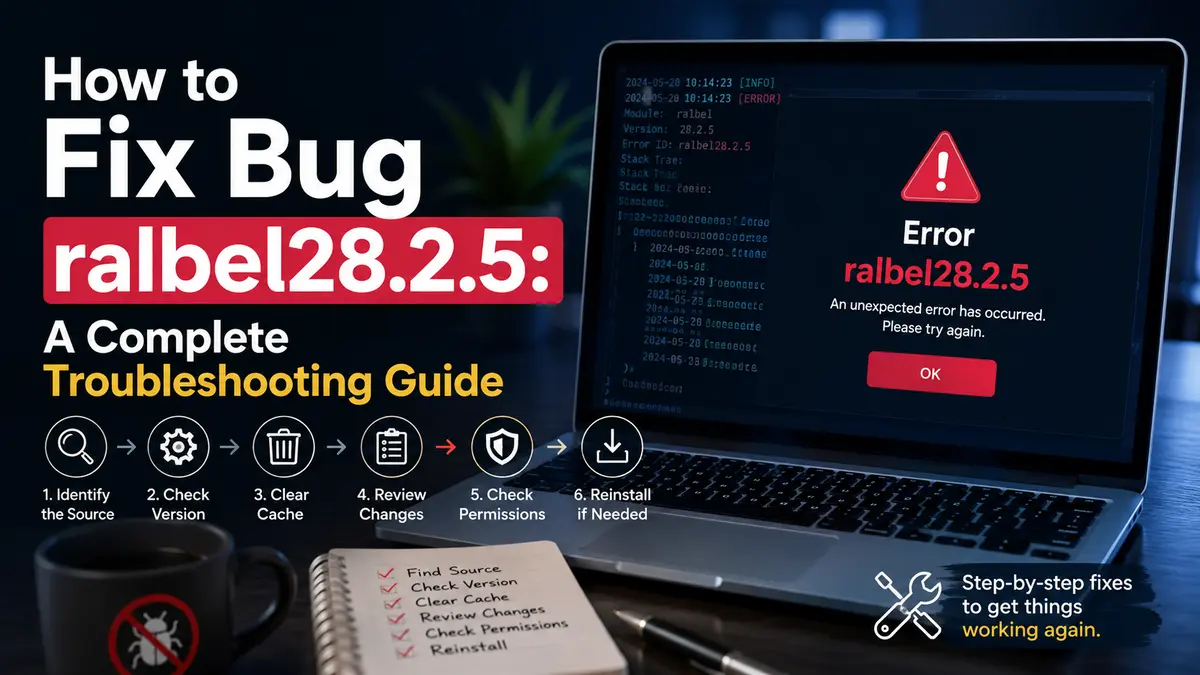
If you’ve landed here, chances are you spotted the string ralbel28.2.5 in a log file, an error popup, a build output, or a support ticket, and you have no idea what it actually means. That’s normal. Codes like this one don’t come with a manual attached. If you’re searching for Fix Bug ralbel28.2.5, you’re likely trying to understand what triggered the issue and what you can do to get things working again.
Here’s the thing: identifiers like ralbel28.2.5 are almost never randomly generated. They usually follow a pattern, with a short prefix that maps to a module, component, or internal build name, followed by a version number, 28.2.5 in this case. When something in that specific version or module breaks, the system spits out the identifier instead of a plain-English explanation, leaving you Googling a string of letters and numbers at 11 p.m.
This guide walks you through how to figure out what’s triggering the issue, how to fix it, and how to stop it from coming back. By the end, you’ll have a clear process for dealing with ralbel28.2.5 and other similarly formatted bug IDs when they show up.
What Does an Error Code Like ralbel28.2.5 Actually Mean?
An error code in this format almost always breaks down into two parts: an identifier and a version marker. Think of “ralbel” as the label for a specific module, plugin, dependency, or internal system, and “28.2.5” as the exact build or release that module was on when things went sideways.
This matters because it tells you where to start looking. You’re not chasing a mystery bug across your entire system. You’re chasing one component, at one version, doing one unexpected thing.
- The prefix (ralbel) usually points to a specific service, library, or feature module
- The version number (28.2.5) tells you exactly which release introduced or is affected by the issue
- The format itself (letters, then a dotted version number) is typical of internal logging systems, plugin managers, and CI/CD pipelines
So before you touch anything, your first move is context-gathering, not code-changing.
Why These Codes Feel So Confusing
Most people’s instinct is to search the exact code and expect a dedicated support article to appear. That works for major, widely-used software with millions of users. It doesn’t work as well for internal tools, niche plugins, or custom builds — which is exactly where identifiers like ralbel28.2.5 tend to show up.
The good news is you don’t need a dedicated article for this exact string to fix it. You need a repeatable troubleshooting process, and that’s what the rest of this guide gives you.
Step 1: Find Where the Error Actually Originates
Before attempting any fix, pin down the exact source. Fixing blind almost always wastes more time than it saves.
Open whatever log or console produced the ralbel28.2.5 reference and look at what surrounds it. Error codes rarely appear alone — they’re usually accompanied by a timestamp, a file path, a stack trace, or a short description.
- Check the full log line, not just the code itself. There’s often a sentence right before or after it that explains what action triggered the failure.
- Look for a file path or module name near the code. This tells you which part of your system to focus on.
- Note the exact time it occurred. Cross-reference that with anything you were doing — installing something, updating, deploying, or opening a specific feature.
Reproduce It on Purpose
Once you have a rough idea of the trigger, try to make the error happen again deliberately. If you can reliably reproduce ralbel28.2.5, you’ve already done half the work. A bug you can trigger on command is a bug you can actually test a fix against.
If it only happens intermittently, note the conditions each time it appears — device, environment, recent changes, specific user actions. Patterns usually emerge after two or three occurrences.
Step 2: Check for Version Mismatches First
Given that 28.2.5 looks like a version number, mismatched versions are the most common root cause of errors formatted this way. This is where you should look before anything else.
Version mismatch bugs happen when one part of a system expects version 28.2.5 of a dependency, but a different version is actually installed, or when two components that are supposed to work together were updated at different times.
- Confirm which version is currently installed versus which version the system expects to see
- Check whether a recent update to any connected tool, plugin, or dependency happened around the time the error started
- Look for a changelog or release notes tied to that version number — even a brief one can tell you what changed and what might have broken
If you find a mismatch, the fix is usually straightforward: align the versions. That might mean rolling back to the last known-good version, or updating the mismatched component so everything is running the same release.
How Version Conflicts Sneak In
Version conflicts rarely happen because someone did something obviously wrong. They creep in through automatic updates, dependency chains that update one library without touching another, or environments where different team members are running slightly different local setups.
This is why “it works on my machine” is such a common phrase in software troubleshooting. The fix isn’t just patching the error — it’s making sure everyone and everything is aligned on the same version going forward.
Step 3: Clear Cached or Corrupted Data
If versions check out and everything looks aligned, the next most likely culprit is cached or corrupted data. A lot of bugs that look like code errors are actually stale data problems in disguise.
Systems cache data to run faster, but if that cached data becomes outdated or corrupted, it can cause exactly the kind of unexpected failure that produces an error code like ralbel28.2.5.
- Clear the relevant cache for the specific module or component, not just your entire browser or system cache
- Restart the affected service or application after clearing, since some caches only fully reset on restart
- Check for partially downloaded or corrupted files if the error relates to an installation or update process
This step alone resolves a surprising number of “unexplainable” bugs. It’s tempting to skip straight to reinstalling everything, but clearing cache first is faster and less disruptive.
Step 4: Review Recent Changes to Your Environment
If the error started recently, something recent probably caused it. This sounds obvious, but it’s the step most people skip because they assume the bug has always been lurking.
Walk back through what changed in the days before ralbel28.2.5 first appeared:
- New software installs or updates
- Configuration or settings changes
- New integrations or plugins added
- System or OS-level updates
- Changes to permissions or access levels
Even a change that seems completely unrelated can be the actual trigger. Software components are often more interconnected than they appear on the surface, and a change in one area can produce a failure in what looks like a totally different module.
Use a Rollback Test
If you have the ability to roll back a recent change, even temporarily, do it. If the error disappears after rolling back, you’ve confirmed the cause. If it doesn’t, you’ve eliminated a suspect and can move on to the next one with confidence instead of guessing.
Step 5: Check Permissions and Access Settings
A smaller but common cause of errors in this format is a permissions issue. If the module or service labeled “ralbel” needs access to a file, folder, network resource, or another service, and that access has been restricted or revoked, it can throw an error instead of failing silently.
- Confirm the affected component has the access it needs to run properly
- Check whether recent security updates or policy changes tightened permissions system-wide
- Test with elevated or admin access temporarily to see if the error disappears — if it does, permissions are your answer
Be careful here. Running something with broader permissions than it needs long-term isn’t a real fix, just a diagnostic step. Once you confirm permissions are the issue, set them at the minimum level that actually resolves the error.
Step 6: Reinstall or Rebuild the Affected Component
If none of the steps above resolve it, a clean reinstall or rebuild of the specific component tied to the error is your next move. This is more disruptive than the earlier steps, which is exactly why it comes later in the process.
- Fully remove the affected module or dependency, not just update it in place
- Reinstall the correct, confirmed-compatible version based on what you learned in Step 2
- Rebuild any configuration files rather than reusing old ones that might carry over the corruption
A full reinstall clears out anything that a simple cache clear or update might have missed, including partially corrupted files or leftover configuration conflicts from a previous version.
What Causes Bugs Like ralbel28.2.5 in the First Place?
The direct answer: these errors almost always come down to one of four things — a version mismatch, corrupted or stale cached data, a recent unaccounted-for change to the environment, or a permissions restriction blocking normal operation.
What makes them tricky isn’t that the causes are exotic. It’s that the error code itself doesn’t tell you which of the four it is. That’s exactly why working through the steps in order, starting with the most common cause and moving to the least common, saves you time compared to guessing randomly.
Most people’s instinct when they see an unfamiliar error code is to assume something is deeply broken. In practice, it’s usually one of these ordinary, fixable issues hiding behind an unfamiliar label.
How Do You Prevent This Error From Coming Back?
The short answer is consistency: keep versions aligned, clear cache regularly, document your environment changes, and review permissions whenever you update software. Prevention here isn’t complicated — it’s just easy to skip when everything seems to be working fine.
- Keep a simple changelog of updates, installs, and configuration changes in your environment. When something breaks later, you’ll have a record to check instead of relying on memory.
- Standardize versions across your setup if you’re working with a team, so no one is accidentally running a mismatched dependency.
- Set a regular cache-clearing habit for systems that are prone to this kind of error, rather than waiting until something breaks.
- Review permissions after major updates, since security patches sometimes tighten access without an obvious notification.
None of this eliminates every possible bug. But it shrinks the pool of likely causes significantly, which means the next time an unfamiliar code shows up, you’ll resolve it in minutes instead of hours.
Conclusion: Final Thoughts
Bug codes like ralbel28.2.5 look intimidating because they’re unfamiliar, not because they’re actually complicated. Once you break the process down, check the source, rule out version mismatches, clear cache, review recent changes, check permissions, and reinstall if needed, you have a repeatable method for Fix Bug ralbel28.2.5 and most other errors formatted the same way.
The real takeaway here isn’t just the specific fix for ralbel28.2.5. It’s the process. Work through possible causes in order of likelihood instead of guessing randomly, and you’ll cut your troubleshooting time down significantly whenever you run into a similar bug.
Start with Step 1 the next time ralbel28.2.5 pops up: find the source before you touch anything. That single habit can save you more time than any individual fix on the list.
Read Also: G15Tools Com Contact: How to Reach G15Tools